There has been a lot of recent attention on attempts to get phones out of schools. The data make clear that phones inhibit students’ learning, cause and exacerbate discipline issues, and harm students’ mental health. Evidence is also clear that phone bans work. Bans improve academic outcomes, especially for the lowest-performing students, and improve the social environment for students.
For all these reasons, schools, school districts, and even entire states are getting rid of phones in the classroom. But what about the other “educational” screens sitting on students’ desks all day?
While phones may be the worst culprits for distraction from learning during the school day, the “educational” screens many children are using in their classrooms, like Chromebooks, tablets, or laptops, are also hurting academic outcomes.
Despite the increasing push over the last decade to get every child a laptop or tablet, the so-called 1:1 laptop policy doesn’t seem to be working out. Instead, student math, reading, and science scores have been on the decline in the United States. The COVID-19 pandemic certainly contributed to recent drops in scores, the largest seen since the 1970s (“virtual learning” on screens at home didn’t help). But the numbers have been on the decline since 2012.
The lowest performers are falling further behind. Screens were supposed to help solve these education inequalities, but that doesn’t seem to be panning out.
A study on the impact of children’s access to computers on educational outcomes in early adulthood found that despite a notable increase in computer access, educational attainment did not increase; the schooling gap between private- and public-school students persisted, despite closing the technology gap.
Other research sheds light on why this is the case. A study out of Norway found that students who read text on computers performed worse on comprehension tests than students who read the same text on paper. Another study using MRI scans of 8-to-12-year-olds showed stronger reading circuits in the brains of those who spent more time reading paper books than those who spent their time on screens. And just this past May, educational neuroscientists at the Teachers College of Columbia University found “evidence that children’s brains process written texts more deeply when they are presented in print rather than on a digital screen.” In short, children derive deeper meaning from printed texts than screens.
The reality is that learning on screens does not yield the same benefits as learning on paper.
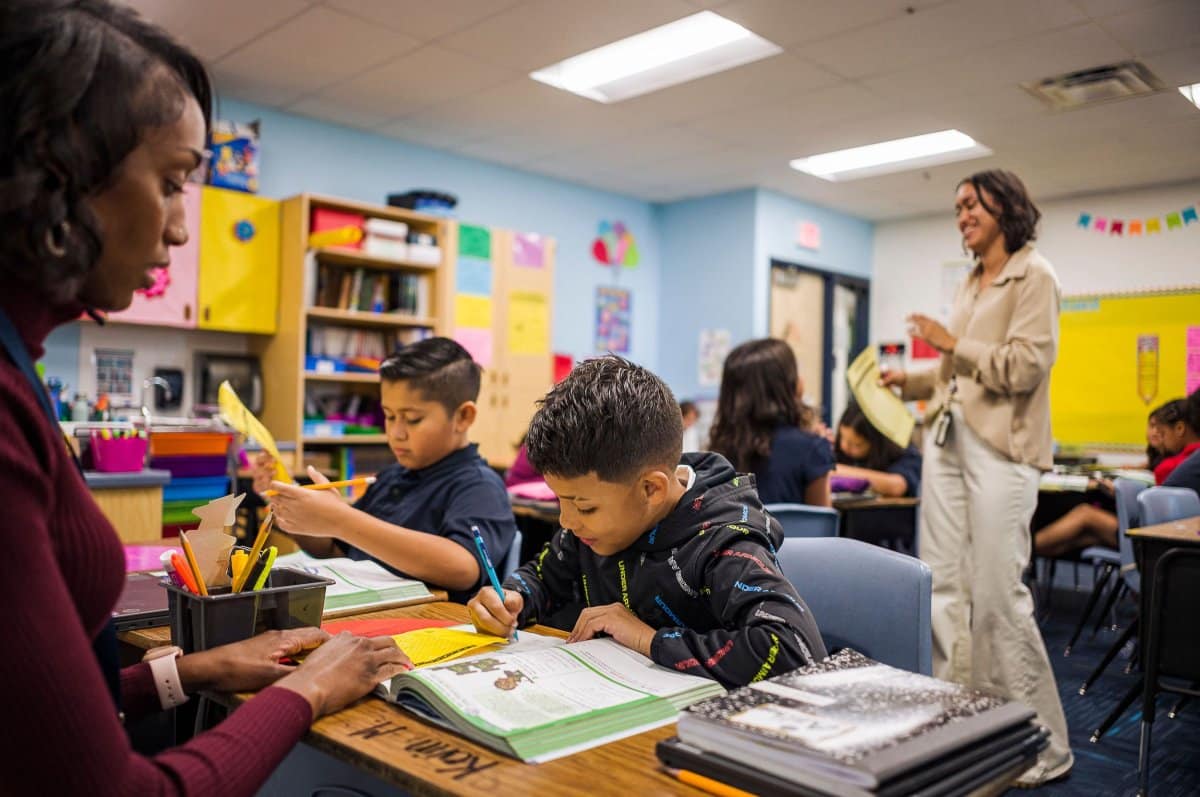
Aisha Thomas (L) learns teaching skills with teacher Alexxa Martinez, in her classroom in Nevitt Elementary School, in Phoenix, Arizona, on October 26, 2022. – Teachers in Arizona are among the United States’ lowest paid, making the cost-of-living crisis even more acute for educators in this key battleground for the upcoming mid-term elections.
Olivier TOURON / AFP/Getty Images
Maryanne Wolf, an education scholar at UCLA, is concerned that the skimming encouraged by screens—rapidly becoming the new norm for reading—is making us lose the deep reading processes that are necessary for literacy and learning. She says, “The digital elephant in every classroom and home is whether our youth will develop full literacy.”
Writing schoolwork out by hand also has cognitive benefits that typing on a screen does not. One study showed that tracing out the ABCs, as opposed to typing them, leads to better and longer-lasting recognition and understanding of letters. Writing by hand also improves memory and recall of words, which lays the foundation for literacy and learning.
Not only does the medium negatively affect educational outcomes—the screens themselves are also distracting from actual learning. One mom who wrote me about her experience of kids using laptops in schools said her daughter was having trouble focusing on the teacher because kids to her left and right were playing video games on their tablets. The mom later found out kids were using the school-provided screens for purposes beyond video games: they were searching anything and everything during school hours. A friend of hers shared how her young son was watching porn in school.
He’s not alone. Common Sense Media found that nearly a third of teens have viewed pornography during the school day. Of these teens, 44 percent had viewed it on a school-issued device.
Are schools trying to prevent this misuse?
One teacher said they can’t stop it, because by the time they get to a student’s desk, the student clicks away from the site. When the mom who wrote me spoke to the principal about her concerns, he told her that no matter how much their IT department tries to block sites, they can’t do it fast enough. They simply can’t stay ahead of it all.
A learning environment for children should not entail the distractions of constantly available video games or pornography or the bombardment of distractions on the screens of their peers. We all know this. But parents feel powerless to change it. Unlike smartphones, which are within a parent’s power to opt out of for their child, school-issued screens are often forced upon parents and families against their will. Some parents are pushing back, however, asking that their kids be screen-free and complete their assignments by pencil and paper instead, with varying rates of success.
But this problem shouldn’t be on parents. It is the job of schools to educate children. Screens are increasingly antithetical to that goal. They aren’t reducing the achievement gap or improving learning outcomes for our kids. Evidence from phone bans shows that removing screens does more to reduce educational inequalities and improve test scores than not. It’s time to get the screens out of schools.
Clare Morell is the Director of the Technology and Human Flourishing Project at the Ethics and Public Policy Center. Her forthcoming book, The Tech Exit: A Manifesto for Freeing Our Kids, will be published by Penguin Random House.
The views expressed in this article are the writer’s own.