Chey Heath, 26, grew up feeling the weight of being the “unfavorite” child in a complex family dynamic.
Raised by maternal grandparents after her mother relinquished custody of her and her younger brother, Heath had always been keenly aware that she wasn’t the favorite. As the eldest of 13 children, her early life in Florida was marked by feelings of abandonment and the constant pressure to live up to difficult standards.
The phenomenon of the “favorite child” is a common feature in discussions about family dynamics. Less heard from though are the unfavorite children— like Heath, who shared with Newsweek how the effects of this hierarchy follow her into adulthood.
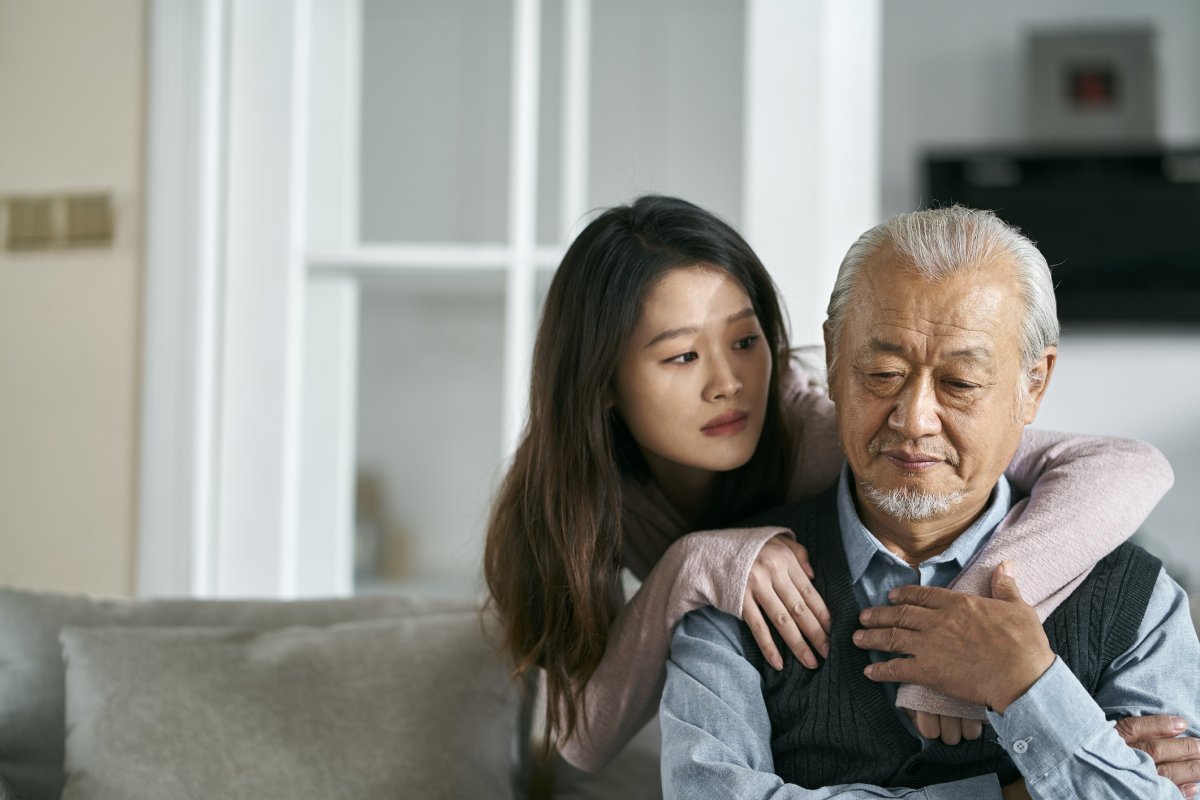
A woman tries to comfort her father. Newsweek spoke to several adult children in their 20s who identify as their parents’ “least favorite.”
imtmphoto/Getty Images
Living as the least favorite
As a youth, Heath said her accomplishments were often met with indifference. Despite being a good student and an obedient child, her achievements were dismissed.
“Every time I achieved anything, it was met with, ‘Here’s how you can be better next time,'” she said. Even more difficult was the role she was forced to take on at a young age. When her younger sister came to live with them, Heath, at just 16, was told she had to raise her.
“I fed her, showered her, got her dressed and did everything to ensure my sister was looked after,” Heath said.
These experiences left Heath feeling inadequate, invisible and emotionally drained. Now, as an adult, Heath said she still feels the lingering effects of being the unfavorite child.
“I have never known the love of a parent who truly loves you with no ‘buts,'” she said. Now diagnosed with autism, ADHD, OCD, and C-PTSD, Heath has spent years working through the trauma of her upbringing, trying to find her place in a world where she never felt fully acknowledged.
Being the “black sheep”
Kim (surname withheld), 28, from Los Angeles, told Newsweek about her experience—similar, but distinct from Heath’s. One of eight siblings, she identified early on as the “black sheep” of the family when she noticed that her interests didn’t align with the rest of her relatives.
“I didn’t quite fit into the family dynamic,” she said. “I probably realized in my teens, because I had vastly different hobbies and interests.”
In her family, she said, favoritism was almost systematically organized. Kim and her siblings would refer to the favored child as “the sun,” a title that shifted depending on which child brought the most “value” to their parents. The shifting hierarchy led to complex emotional dynamics, where siblings were ranked in an unspoken, yet clearly understood system: “We are aware of the ranking system,” she said. “And have a bottom three.”
Kim said her experiences shaped her into adulthood—she constantly battles the internal questions: “Am I enough? Am I too much?”
Now, she believes that parents have a duty to nurture their children as individuals and not show favoritism simply because one child is performing according to their expectations.
“Oftentimes, the black sheep or the least liked sibling is the one who refuses to put up with family dysfunction and is, therefore, the scapegoat,” she said. “No child receives the same two parents, but it is the job of parents to love your kid if they are different.”
The psychological impact of favoritism
Seth Eisenberg, president and CEO of the PAIRS Foundation, works with families dealing with the aftermath of favoritism. He explained that the emotional damage from such dynamics can be long-lasting.
“The ‘unfavorite’ child may feel inadequate, striving for approval that seems always just out of reach,” Eisenberg said. These children often develop patterns of low self-esteem and people-pleasing behavior, which can carry into adulthood.
On the other hand, though, the “favorite” child is often burdened with unrealistic expectations. Eisenberg said that no child should feel like they have to compete for their parents’ love. Instead, families should focus on treating each child as unique and valuable in their own right.
“The challenge is to create a sense of equality—not by treating everyone the same, but by acknowledging each child’s uniqueness,” he said. Open communication, he added, is key to healing these deep emotional wounds. By fostering open, honest conversations about how each child experiences their place in the family, parents can create environments where all children feel valued.
Healing in adulthood, breaking the cycle
For both Heath and Kim, the scars of being the unfavorite or “black sheep” have lingered into adulthood, shaping their relationships and self-perception. Heath, who once strove for her grandparents’ approval, now realizes she was chasing validation that would never come. Kim said she has had to work to identify her own authenticity and its value.
While their scars may run deep, both women are determined to heal and build lives where their worth is not determined by how much they please others. Heath’s decision to cut ties with her birth mother and grandmother is a step in her journey toward self-healing; Kim’s decision to embrace her uniqueness and reject the label of “black sheep” has allowed her to step into her power.
“It’s going to take a long time for me to process and debunk the perfectionism, the invisible feeling, the feeling of never being heard and the reactions I still have to the trauma I was subjected to as a kid,” Heath said. “But I won’t stop trying…I will do whatever I can to make sure that nobody feels the way I felt as a kid. I love with no ‘buts’ afterward.”