Cuban Foreign Minister Bruno Rodríguez Parrilla has told Newsweek that his country’s pursuit of robust relations with China, Russia and other nations has been accelerated by the United States’ policy of severely restricting bilateral cooperation.
In a wide-ranging interview conducted on the sidelines of the United Nations General Assembly, Rodríguez Parrilla decried U.S. President Joe Biden‘s decision to have largely maintained the toughened restrictions against Cuba put in place by former President Donald Trump after a brief period of easing of the six-decade embargo under former President Barack Obama.
But, in addition to the quest to “find a much more efficient economic model and adapt it to our current reality,” Cuba’s top diplomat also stated that “we have many friends all over the world.” In fact, he argued, “we have also developed a broad pattern of international relations based on the lack of relations that we have with the U.S.”
Among the nations he considered to be “important economic partners” was China.
And while Rodríguez Parrilla dismissed U.S. media reports alleging the establishment of a Chinese spy base on the island, and even joked about claims made of Cuba having the capability to take control of F-16s to land them onto alleged Chinese military installations near Havana, he said “it is, indeed, serious that we have a respectful relationship, a mutually beneficial relationship with China and that we are in every right to do so.”
“We would like to have the same kind of relationship with the U.S.,” Rodríguez Parrilla said. “Chinese companies have recently entered Cuba. Whatever prevents American companies from doing the same is the blockade.”
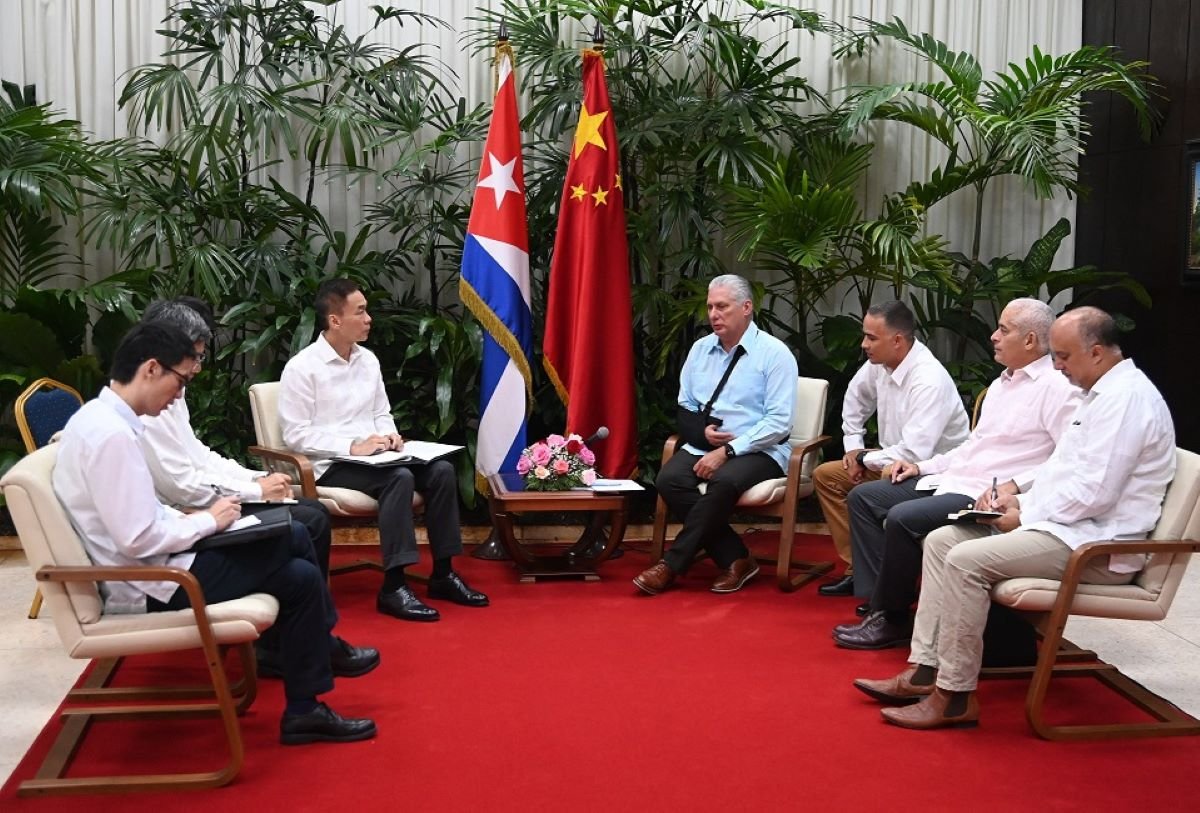
Cuban President Miguel Díaz-Canel meets with Chinese Ambassador to Cuba Hua Xin in Havana on September 20, 2024.
Cuban Ministry of Foreign Affairs.
While much of U.S. foreign policy attention has been drawn as of late toward the ongoing wars in the Gaza Strip and Ukraine, the Biden administration continues to rank the global competition with Beijing as one of its top priorities.
In his final address Tuesday to the U.N. General Assembly after announcing in July that he would not seek reelection, the U.S. leader stated that the nation had “to uphold our principles as we seek to responsibly manage the competition with China, so it does not veer into conflict.”
Biden expressed openness and appreciation for cooperation with China on “urgent issues” such as combating the flow of fentanyl, while at the same time asserted that “the United States is unabashed, pushing back against unfair economic competition and against military coercion of other nations in the South China Sea, in maintaining peace and stability across the Taiwan Straits, in protecting our most advanced technologies so they cannot be used against us or any of our partners.”
But Rodríguez Parrilla questioned the logic behind the U.S. strategy as it appeared to leave Cuba open for Chinese business, including those that relate to cutting edge tech that has emerged at the forefront of the race between Washington and Beijing.
“So, the U.S. government wants to compete with China at the global scale. But they follow a policy leaving Cuba free from this competition on high-tech procedures and technology,” Rodríguez Parrilla said. “Why don’t they compete in Cuba as well?”
He also noted that Cuba does have some important natural resources, including vast amounts of nickel and some of the world’s largest reserves of rare earth cobalt, two crucial elements in manufacturing lithium-ion batteries that power a variety of products such as electric vehicles.
In April, Chinese Embassy to the U.S. spokesperson Liu Pengyu told Newsweek that reports of China developing a spy base in Cuba as “purely slander” and portrayed the broadening of ties between Beijing and Havana as providing value to both sides.
“In recent years, relations between China and Latin American and Caribbean countries have continued to deepen,” Liu said at the time. “The essence of China-Latin America cooperation is mutual benefit, win-win results, and common development. We will continue to respect Latin American countries’ independent choice of development paths that suit their own national conditions.”
He argued that “China will continue to firmly support the Cuban people’s efforts to oppose external interference and blockade and defend sovereignty and national dignity.” This extended to backing at the U.N. General Assembly, which for three decades, has produced a near-unanimous vote calling for the lifting of sanctions against Cuba.
“This shows that the vast majority of countries in the world are gravely concerned about and firmly opposed to the U.S.’ arbitrary unilateral sanctions on Cuba that seriously threaten the basic human rights of the Cuban people,” Liu said, “and that they support Cuba’s just fight for its sovereignty and against the blockade.”
“This should prompt the U.S. to listen and respond to the international community’s call for justice and put an immediate end to the economic, commercial and trade restrictions and embargo on Cuba,” he added.
Now, Rodríguez Parrilla argued that if the U.S. was “so concerned about the geographical proximity, so is the case for our relations with Russia or other countries, well, unbelievably, the U.S. keeps a military base in Guantánamo.”
“We do not quite well know what this base is good for, but this is an obstacle in our bilateral relations,” the Cuban foreign minister said. “Sometimes, they engage in a sort of show of force. But we have followed a very prudent policy.”
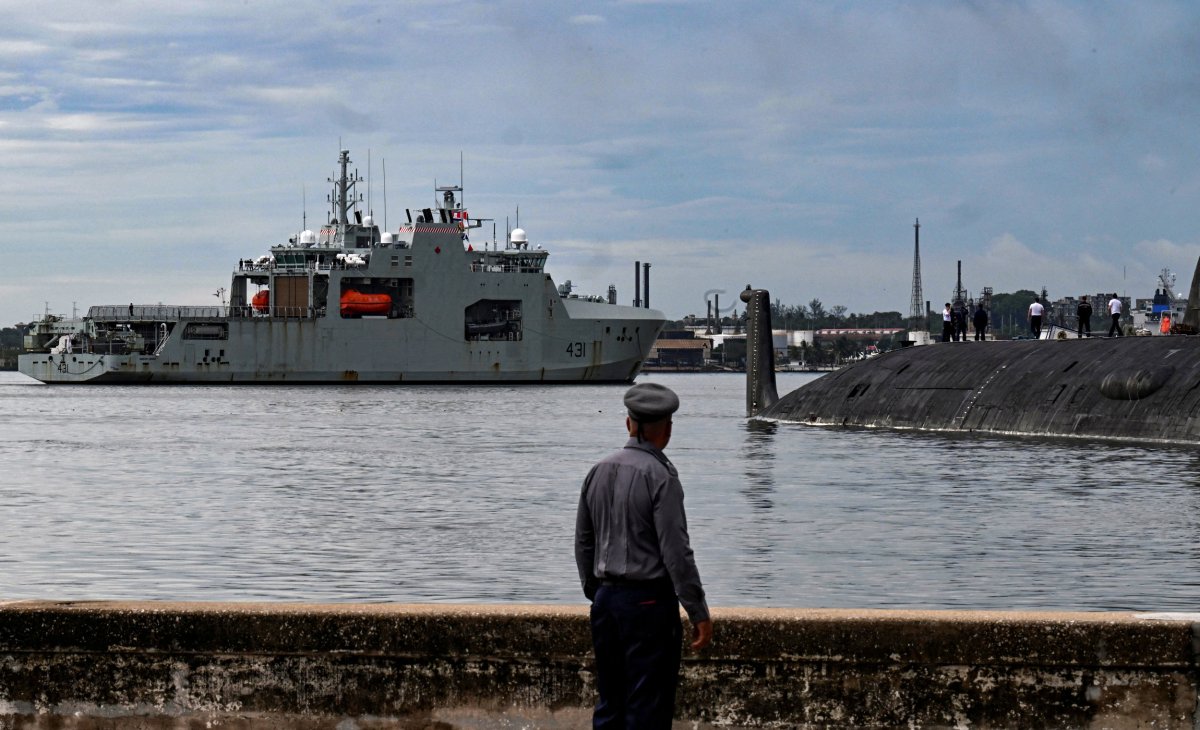
Russian Marines standing atop the nuclear-powered submarine Kazan watch Canada’s HMCS Margaret Brooke offshore patrol vessel upon arrival in Havana Harbor on June 14, 2024.
YAMIL LAGE/AFP/Getty Images
U.S. Naval Station Guantánamo Bay was first established more than 120 years ago as part of a 1903 indefinite leasing agreement that has been rejected by the Communist Party of Cuba since coming to power in a 1959 revolution. The base became the source of considerable international controversy after 9/11 for hosting uncharged detainees of the U.S.-led “war on terror.”
But Cuba has also welcomed the arrival of foreign military vessels in line with mutual upon agreements. This summer, a contingent of Russian warships visited Havana harbor as part of what Rodríguez Parrilla referred to as a routine “exchange.”
In the face of criticism by U.S. officials and lawmakers, Rodríguez Parrilla argued that “the U.S. government should take these actions in a very natural manner based on its own behavior.”
“It has more than 800 military bases all over the planet,” he said. “They have warships and bombers present in the oceans of all latitudes, including Guantánamo Bay. Its military doctrine has been increasingly aggressive. So, I don’t see why this should be a sign of alarm.”
Rodríguez Parrilla also stated that the majority of international military ships visiting Cuba have been from NATO member states, including Canada, which had a vessel present in Havana harbor at the same time as the Russian visit. He emphasized that Cuba had no intention of posing any threat to the U.S. and called for Washington to commit to a similar position.
“We will exercise our sovereign rights, and we will do nothing, nor will we allow others to do anything on Cuban territory, that could be felt by Americans as a threat,” Rodríguez Parrilla said. “We would like to see some reciprocity.”
“We would like to see the ceasing of the groups based in Florida receiving financing from the federal government or from entities very close to the government of the U.S. in order to prop up groups perpetrating terrorist actions in Cuba, or which pay persons in Cuba to create acts of violence,” he added.
Newsweek has reached out to the Chinese Embassy to the United States, the Russian Embassy to the United States and the U.S. State Department for comment.
Cuba-Russia relations also made the news earlier this year when Latvia-based Russian-language news outlet The Insider published claims that the Russian Armed Forces General Staff Main Directorate (GRU) was behind a series of apparent energy attacks that caused health issues among staff at the U.S. Embassy in Havana.
The incidents, widely referred to after they came to light in 2017 as “Havana Syndrome,” sparked outrage under the Trump administration and led to a tightening of sanctions against Cuba. Uncertainties arose as similar cases were reported at U.S. official sites worldwide, even at the White House itself, yet the issue was used as one of the pretexts for the Trump administration returning Cuba to the list of state sponsors of terrorism just nine days before Biden’s inauguration.
Shortly after Biden took office in 2021, the administration began to refer to “unexplained health incidents” without attributing any blame.
Then, late last month, the National Institutes of Health announced that it would be ending its investigation into the mysterious phenomena, citing concerns over indications that some patients had been coerced into being part of the research by the CIA. Newsweek has reached out to the CIA for comment.
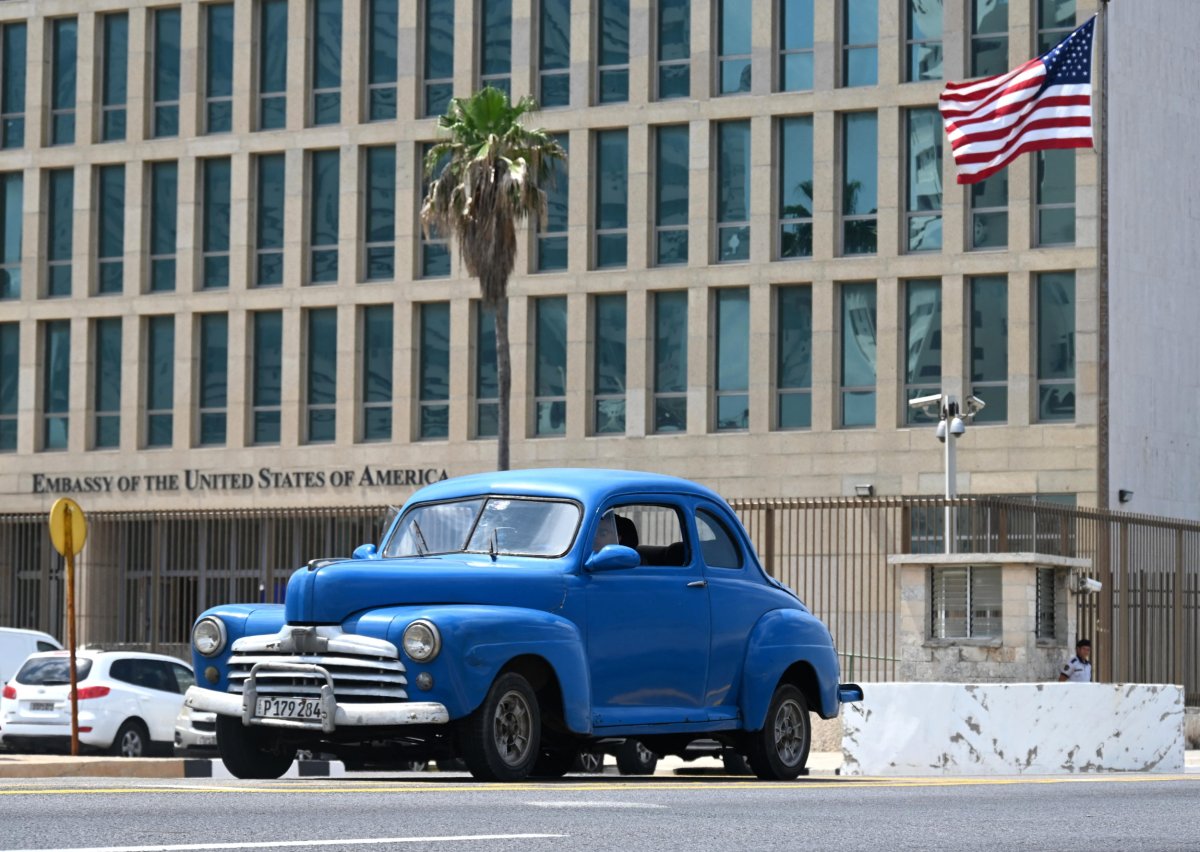
An American classic car drives past the U.S. Embassy in Havana. Its chargé d’affaires was summoned to the Cuban Foreign Ministry over accusations of “interfering conduct.” Washington denied involvement in protests against blackouts and food shortages in Santiago de Cuba, on March 18, 2024.
Yamil Lage/AFP/Getty Images
Reacting to the news, Russian Foreign Ministry spokesperson Maria Zakharova pointed out how Cuba remains designated a state sponsor of terrorism despite the connections to the incidents proving “ungrounded” during a press conference on Wednesday.
“They have been trying to find scientific and medical proof of the ‘sonic attacks’ for eight years, but to no avail,” Zakharova said. “Moreover, the Americans who worked in Havana publicly mentioned coercion by U.S. security services, direct and veiled threats if they refused to ‘cooperate,’ and ‘stretch’ their testimony to suit their goals.”
“In short,” she added, “the plan to blame Cuba, as well as Russia, of inhumane influence on the health of American foreign policy staff has turned out to be impossible to implement.”
Rodríguez Parrilla also ridiculed such “futuristic sagas” but warned that the accompanying “slanders generate undesirable consequences later on.”
“The pretext was demolished by science, with the participation of Cuban scientists, American scientists, Canadian and also European scientists,” Rodríguez Parrilla said. “But this was the pretext used to apply more than 200 measures deliberately designed to bring about humanitarian damage.”
“So, the pretext exists no more, but the sanctions exist,” he added, “as well as the humanitarian damages.”