Politics is dividing America in the polls, but it also has implications for our dating lives.
According to a new 5,000-person survey from Oddspedia, one in six Americans has ended or considered ending a relationship because of political differences.
Meanwhile, over half outright refused to date someone with opposing political views.
Despite the fact that politics can play such a major role in building or ending a relationship, three-fourths of Americans said discussing politics should be entirely avoided on a first date.
How Americans view politics in dating also differs by gender as well.
The report found men were more likely to view politically informed dates negatively, while women saw this as a pro. Men associated politically informed partners as more cynical and elitist, while women saw it as sexier and more compassionate and tolerant.
Still, a third of those surveyed said it was a dealbreaker if their partner was apolitical and had no opinions on major issues.
Robert Shapiro, a political science professor at Columbia University, said this trend has long been occurring, and it can extend into family conflict as well.
“Partisan conflict, manifested in ‘affective partisanship’ has grown to such a high and emotional level that dislike for the opposing party has extended to its supporters and affected interpersonal relationships as the survey once more confirms,” Shapiro told Newsweek.
“It has affected relationships in families where family members include adherents to opposing candidates and parties. It has made family gatherings more difficult and the need for agreement not to discuss politics.”
A previous survey shared with Newsweek revealed topics like fake news and abortion were significant reasons why Americans did not want to enter a relationship with someone of differing political views.
Political polarization is especially strong in the United States compared to other countries.
Research from the Carnegie Endowment for International Peace found America to have “chronically pernicious levels of polarization,” since 2015 and noted the U.S. was “quite alone” for having this level of polarization as a wealthy country with a long history of democracy.
Another 2022 study found 62 percent of Republicans had a very unfavorable view of Democrats. That was a substantial increase from 21 percent in 1994. Meanwhile, 54 percent of Democrats had an unfavorable view of Republicans, up from 17 percent in 1994.
For some, choosing whether to date someone with different political beliefs might not necessarily be tied to their party identification but instead, whether they voted for a certain candidate.
More than 70 percent of single Democrats said they wouldn’t date someone who voted for Trump, according to a 2020 Pew Research Center poll.
The dislike can go even beyond just not wanting to date across the political aisle. Another CBS poll found a plurality of Democrats and Republicans saw each other as “enemies”.
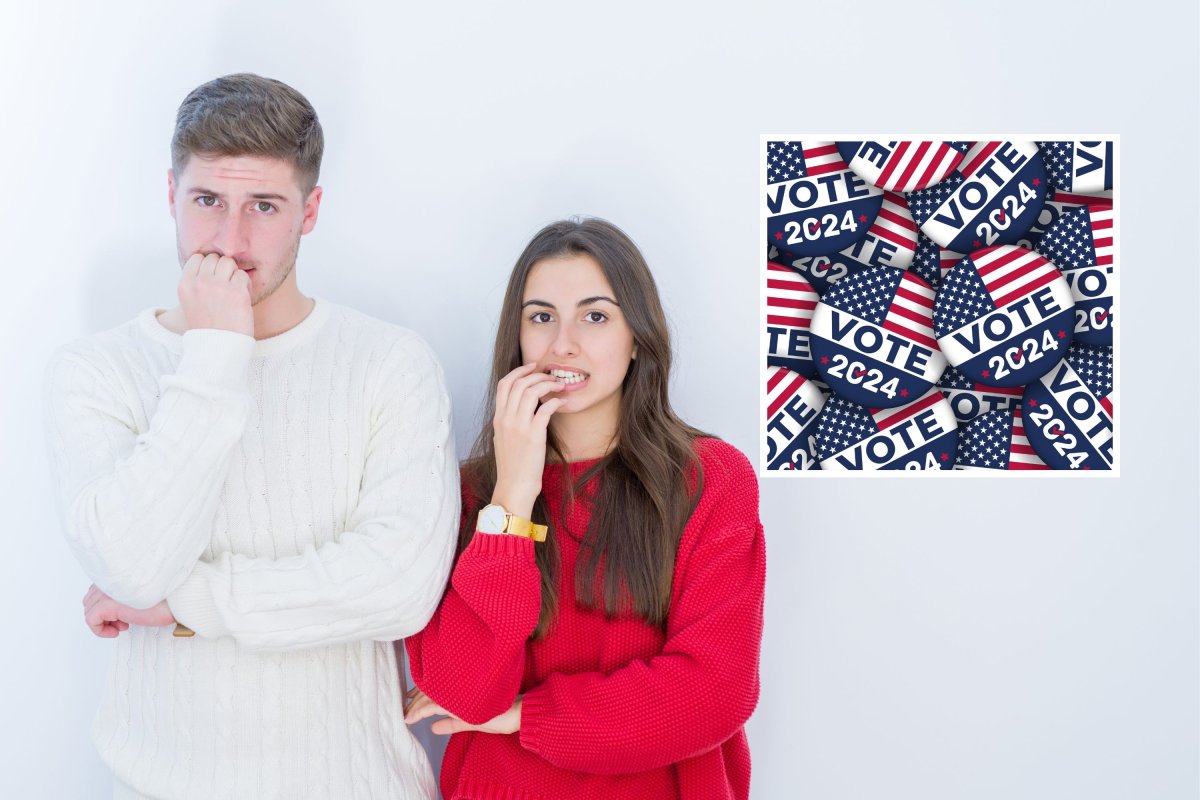
Stock image of a couple looking nervous with inset Vote 2024 badges. American are breaking up over politics, a new study shows.
AaronAmat/Elena Sunagatova/Getty Images