On paper, the two brands could not be more different. Bugatti is a century old, having cut its teeth on racing circuits across Europe in the earliest parts of the 1900s and worked its way into modern buyers’ hearts thanks in no small part to its uber-powerful 16-cylinder engine.
Rimac is a relatively new brand, started in 2009 as a company converting old BMWs to electric power, and only debuted its first true production series car, Nevera, an all-electric model, in 2018.
Now under the Bugatti Rimac company umbrella, it’s important to continue their stories while infusing modern design and powertrain elements into the vehicles coming down the line. It’s also vital to keep the identities of each brand intact despite the new parent company structure.
“In design, we live in the future,” Frank Heyl, director of design at Bugatti Rimac told Newsweek during an interview at The Quail, A Motorsports Gathering. “One thing that we must not do is to run after current trust.”
“These things are made for decades, if not centuries,” he said, speaking of the cars he designs. “Trends of today are irrelevant tomorrow. This is the aspect of timelessness that is so key. So how do you make a car timeless? For it to be timeless, it needs to be authentic. It needs to tell its own story.”
Keeping Bugatti, Bugatti
Bugatti sells some of the most expensive new cars in the world. At that cost level, automakers like Rolls-Royce and and Bugatti work to balance a super luxury ownership experience with aesthetics of a vehicle and performance. Each company has their own recipe.
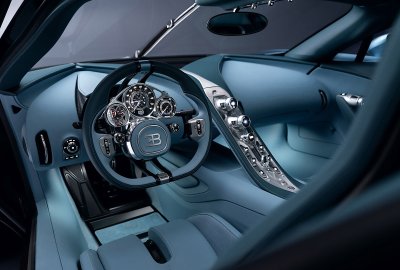
“We believe that driving a Bugatti must be an incomparable experience, and so it is very much about how you feel when you sit in the driver’s seat,” Heyl said.
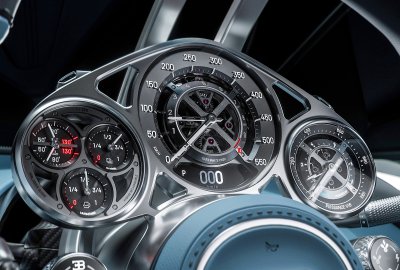
This is typified by the company’s new Tourbillon hypercar, which pushes past traditional engineering and style typically found in a Bugatti, debuting new techniques, equipment, engineering and comfort.

Bugatti

Bugatti
“We can speak about the numbers, zero to 60 [miles per hour], for sure, these numbers will be amazing. However, what we see … it’s kind of shifting more towards how how you feel [for the Bugatti brand]. It’s things that you cannot put into ones and zeros. It’s the emotional, the human aspect of it. How do you feel when you sit in the driver’s seat? The smell of the leather, the haptics of the aluminum switch gear, how weighted are the buttons,” Heyl said.
Part of that feeling comes from the Bugatti engine. “The noise of the engine, the sound, that’s why we also went with a naturally-aspirated V16,” he said. That 16-cylinder engine is new, and electrified. Tourbillon is the first car on the company’s new platform and marks its powertrain’s first production outing.
“Our shapes have a performance to give. That’s why we like to say it’s form follows performance. And, that performance has an aerodynamic factor to it,” Heyl said. If it’s top speed the brand is after, there needs to be a concentration on downforce or a long tail to avoid drag.
Bugatti
Bugatti
“There is always a story to tell,” he said, “And if the car tells a story, it becomes authentic through its story, because all its shapes are tailor-made to this purpose.”
Tourbillon is about more than just a great powertrain and inspired aesthetics. The car retails for $4.6 million USD and customers will spend “a considerable amount of money” to customize their purchase to their personal specification, Heyl said.
“We need to create shapes and forms that make your heart tell your mind that it’s worth spending millions on this car,” he said, detailing what he calls the “car couture approach” to Bugatti design.
Making Rimac Stand Out
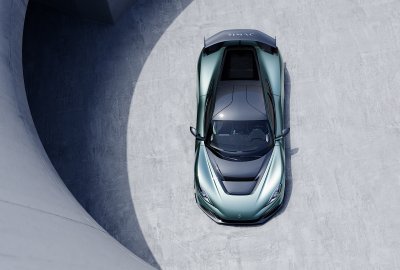
Rimac is crafting vehicles that have the added complexity of electric powertrains. Often, electric vehicle designers and engineers are tasked with transforming a skateboard-like platform with a battery and electric vehicle wiring attached into a sellable model. Achieving targets for range and performance must happen through engineering rather than design in this scenario. The undercarriage dictates the appearance.
“What we do in the Design Center I like to regard as not styling,” Heyl said, likening styling to putting a candy wrapper around something that’s nearly already ready to go.

Rimac
Rimac
“Design means you go and you understand all of its technologies, working together with all of its stylistic aspects, all of its proportional aspects, all of its aesthetic aspects, and you make that look like it came out of one hand. Yes, obviously there’s teams of hundreds of people involved in it, and they all have their specialties, but what I love about our approach on the design team is to really still understand all of its technologies,” he said.
Aerodynamics achievements are what bind Bugatti and Rimac engineer and design together. Heyl fancies himself an engineer despite not having a formal degree. “I am a gearhead and so I have spent the last 16 years of my life sitting, [taking] in all this engineering, becoming an engineer myself without having an engineering degree.”
That has allowed him to better understand vehicle dynamics, suspension geometry, crash protection, manufacturability, and production and tooling vectors, he said. Having an all-electric car has added a variable to the mix.
But, even there Heyl has a leg up. He was an electronics major in college before he became a designer. “I love this kind of stuff. I totally immerse myself. I want to understand, and that’s where also, then inspiration comes from.”

Rimac
Rimac
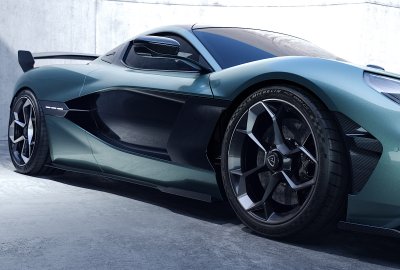
Pointing to the Nevera R in front of him during the interview, Heyl said that its “huge battery pack” has three orange cables that come out of it because it has a three-phase motor. That number three plays out in various places on the new Nevera R – three-spoke wheels, three pillars on the rear wing.
Because of the demands of the engineering, Heyl started in on Nevera R’s design differently, seeing it as “a game of proportion”, first getting the stance of the 2,107-horsepower car just right.
When it comes to aerodynamics, Heyl notes that thermodynamics play a vital role in the car’s performance and design. “Thermodynamics are very interesting, and they have a big influence of what I do. Because, if the thermodynamics aren’t right, somebody will come and say, ‘I need to cut more holes into your design.’
“It’s about streaming through the car. It’s about fragmentation. It’s about not having a solid object that is streamed around. But, we are streaming through the car. That means air goes in and must come out, so there is a pressure drop. It’s like a chimney on the fireplace. If it’s not good design, then you get smoke. It’s the same thing here.”
.videoc {position: relative;padding-bottom: 56.25%} .player> iframe {position: absolute;top: 0;left: 0;width: 100%;height: 100%;overflow:hidden;}
Those precise swoops, vents and cuts tell a story. “It tells the story of, yes, we have a big radiator in the front, and we need to get those batteries cooled, and we need to stream air through the radiator, and there needs to be a pressure drop,” he said.
Heyl’s team works at the intersection of this engineering and traditional beauty-centric design, on a car suited for a futuristic drive experience.
They also work in the future. By the time a car debuts today, Heyl’s team is already well onto the next thing and a few things after that.