Among the thousands of U.S. students starting college this year, there’s Barron Trump, the former president’s youngest son, who had his first day attending New York University this week.
But as the child of such a prominent and divisive figure in American politics, Barron’s time in college is unlikely to be anything like that of his fellow freshmen.
Until now, the teenager has lived a relatively private life, mostly kept away from the public eye by his family during Donald Trump‘s presidency and his 2024 campaign. That is likely to change in college, where other students can easily take photos and videos of him and share them on social media—similar to what happened to Malia Obama, Barack Obama‘s oldest daughter, when she arrived on campus as a Harvard freshman in 2017.
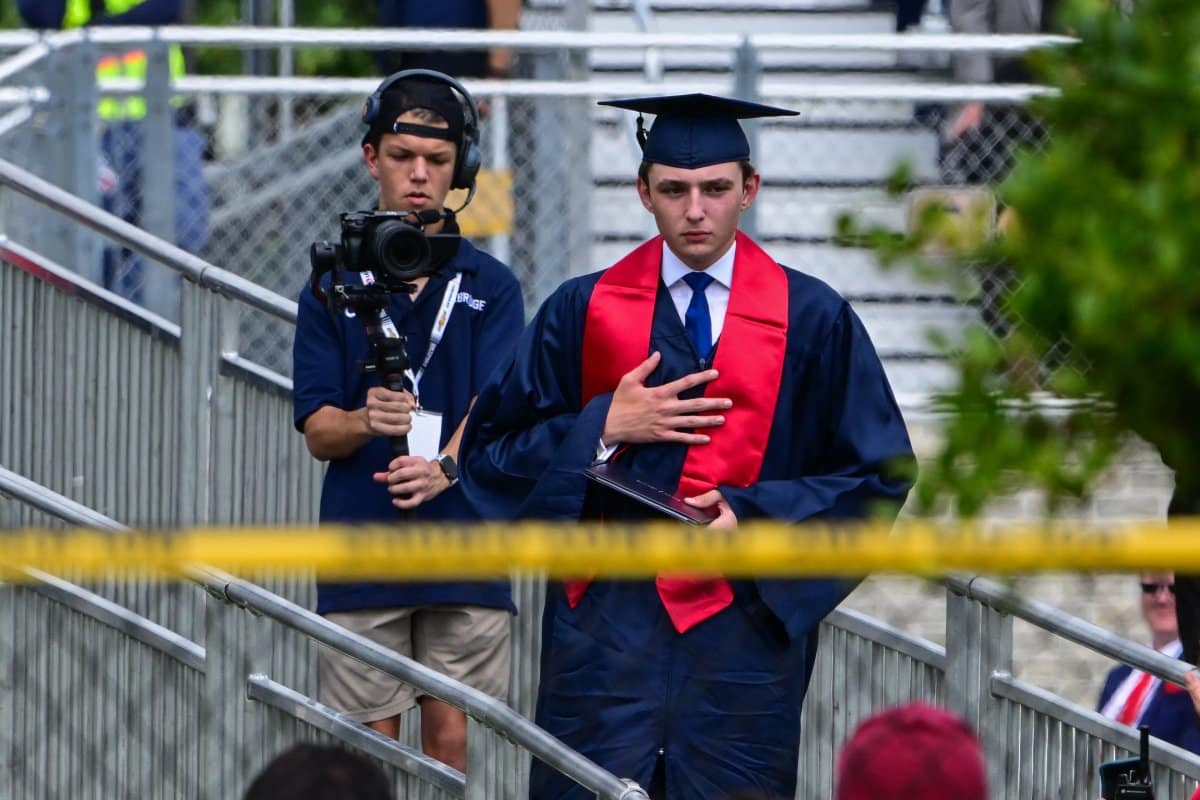
Barron Trump, son of Donald and Melania Trump, graduates from Oxbridge Academy in Palm Beach, Florida, on May 17. The Secret Service will discreetly follow him during his time in college, making sure that the former president’s son is safe.
GIORGIO VIERA/AFP via Getty Images
“His social media presence is certainly being managed, but how do you manage everyone else’s? When he goes to college and he’s exposed to different people, his social media exposure will increase significantly,” Philip Grindell, CEO and founder of Defuse, a security firm in the U.K., told Newsweek.
In 2016, a video clip of Malia Obama smoking at Chicago’s Lollapalooza festival was widely shared in tabloids and the news media as the teenager found herself the target of a massive amount of scrutiny, sparking calls from supporters to “let her live.” As he goes through college, Barron is likely to face the same scrutiny—and engage in similar teenage activities.
“He’s 18 and he’s going to college. There are all kinds of more social issues that he’s going to be dealing with,” Grindell said. “More social events, girlfriends and other things like that. I’m sure there are college students that will have parties and drink before they’re 21.”
He continued: “But how would that look if Trump is the president, for example, and his son is breaking the law by consuming alcohol under the age of 21? So that may be something that his security team has to manage, as well as his personal safety.”
Barron’s potentially bigger exposure on social media could be a threat to his personal safety as much as his privacy.
“If you want to attack Donald Trump by attacking his son, then what you need to do is know where he is. If other students are going to be posting about him consistently, then a pattern of life can be created,” Grindell said.
“That predictability is a gift to a potential attacker. If a student posts a picture of Barron Trump saying, for example, that he’s in the library…that is a challenge for his security team,” he said.
In terms of security, Grindell expects that the security around Barron will increase now that he’s started college.
“Trump has actually mentioned his son more recently, and that is going to bring attention to him,” Grindell said. “I think that’s going to increase the security on him, but I would imagine that whatever security he’s already had at school will just continue.”
Security around the former president’s son “will probably be fairly low-key,” and it will have to be negotiated with the university, he said.
Newsweek contacted the Office of Donald J. and Melania Trump, New York University and the Secret Service for comment by email on Thursday morning.
Paul Eckloff, a former Secret Service agent who worked to protect George W. Bush, Barack Obama and Donald Trump, as well as their families, told The Independent that every child and grandchild of a current president receives protection by the Secret Service. While children of a former president are guaranteed protection only until they turn 16, the Secret Service confirmed to the U.K. online newspaper that Barron is under protection by the agency.
The goal of Secret Service agents watching over kids in college, Eckloff said, is “to impair the college experience as little as possible while providing the strongest security environment that you can.”
Newsweek contacted Eckloff for further comment by email on Thursday morning.