China has condemned what it describes as U.S. attempts to maintain global influence following the Netherlands’ move to update its export licensing requirements for certain lithography machines, further restricting China’s access to older chipmaking processes.
Dutch company ASML Holding NV, a leader in lithography technology, must now apply for export licenses from the Dutch government for deep ultraviolet immersion lithography systems. Such tools are vital for producing less advanced semiconductors than those made with extreme ultraviolet (EUV) lithography, which is used for more cutting-edge processes and which China also cannot effectively import.
“The Dutch side has further expanded the scope of control on lithography machines, which China is not satisfied with,” a spokesperson for China’s Commerce Ministry said on Sunday.
Newsweek has contacted the State Department as well as the Dutch and Chinese foreign ministries for comment.
The new regulation, effective September 7, applies to immersion deep ultraviolet (DUV) semiconductor machinery, essential for producing smaller, more powerful semiconductor circuits. It specifically concerns ASML’s TWINSCAN NXT:1980i and NXT:1970i systems.
ASML is at the center of the U.S.-China tech rivalry as the only firm currently capable of manufacturing the extreme ultraviolet (EUV) lithography machines that produce advanced microchips essential for a wide range of technologies, from electric cars to guided missiles.
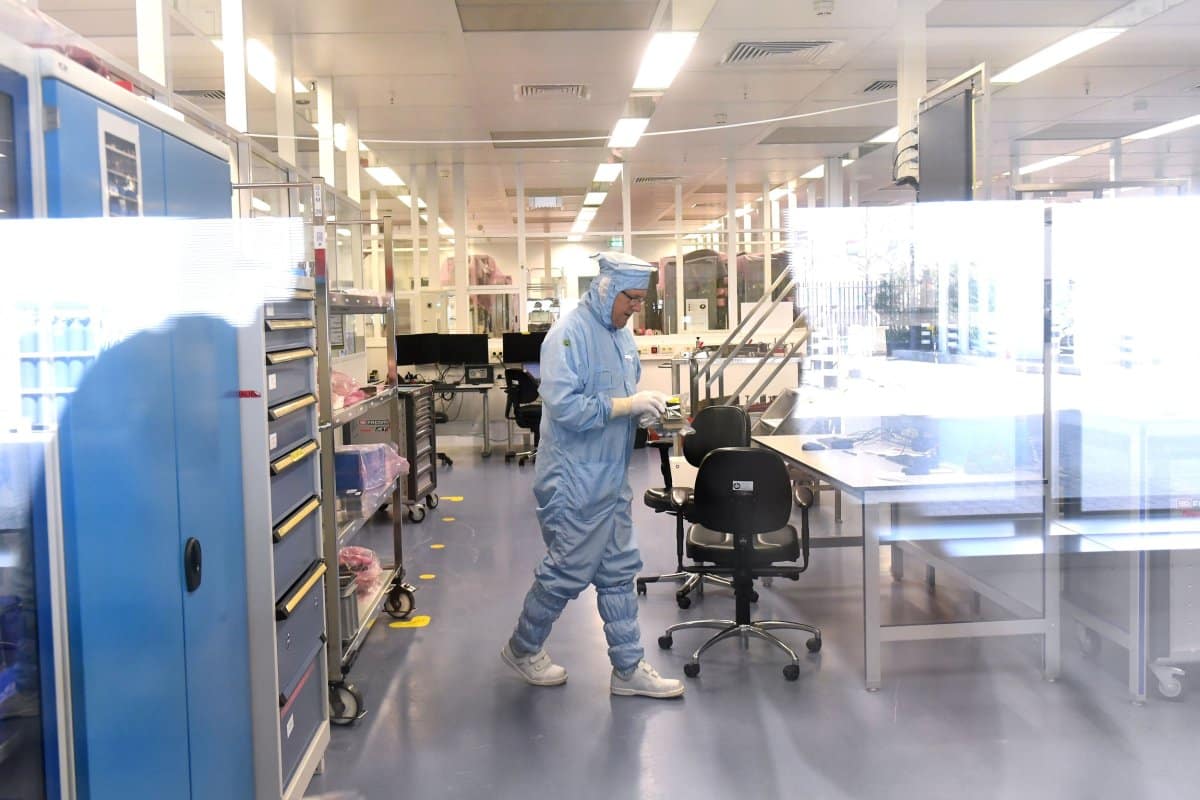
An employee makes his way in a laboratory at ASML, a Dutch company that is currently the largest supplier in the world of semiconductor manufacturing machines via photolithography systems, in Veldhoven on April 17. ASML is at the center of the U.S.-China tech rivalry.
Emmanuel Dunand/AFP via Getty Images
The Chinese Commerce Ministry criticized Washington for “coercing” allied nations like the Netherlands into tightening export controls, framing it as a U.S. strategy “to maintain its global hegemony.” The spokesperson added that these measures pose a serious threat to the stability of global semiconductor supply chains and harm businesses’ “legitimate rights and interests.”
ASML downplayed the regulatory impact, calling it a “technical change” in a statement on Thursday. “This announcement is not expected to have any impact on our financial outlook for 2024,” the company added.
The U.S. has increasingly been focused on curbing China’s rapid advances in strategic technologies like supercomputing and artificial intelligence, which pose national security concerns. Washington has pressured key partners in the semiconductor supply chain, including the Netherlands and Taiwan, to limit China’s access to advanced chipmaking equipment.
Many of the components in ASML’s lithography systems rely on U.S. technology, requiring companies like ASML to seek U.S. export licenses for products that include significant American content. Under U.S. regulations, even foreign companies using U.S. technology in their equipment must comply with export control requirements when dealing with restricted nations.
With the Netherlands assuming responsibility for its own controls, ASML must apply directly to its home government for permission to ship DUV machines to China.
Earlier this year, ASML canceled shipments of certain proprietary machines to China in alignment with U.S. export controls. in January, then Dutch Trade Minister Geoffrey van Leeuwen cited national security concerns regarding the sale of advanced lithography machines to China, noting the technology could be used to “promote self-sufficiency in its military-technical development” and power “high-value weapons systems.”
China accounted for 29 percent of ASML’s total revenue in 2023, up from 14 percent in 2022, according to company reports.
China has accused the U.S. of a technological blockade and threatened to restrict American access to rare earth elements and other critical minerals needed for emerging technologies.