Fresh research has revealed that marine animals are facing an unprecedented risk of extinction because of climate change and other human impacts, even in seemingly pristine coastal regions.
The research, published in the journal PLOS ONE, provides a comprehensive analysis of threats to marine biodiversity on a global scale, painting a grim picture for our planet’s sea life.
“We found that climate stressors are dominant in many parts of the world, even far from direct human interactions with the ocean—especially sea surface temperature increases, marine heat waves and ocean acidification,” the study’s lead author, Casey O’Hara, told Newsweek.
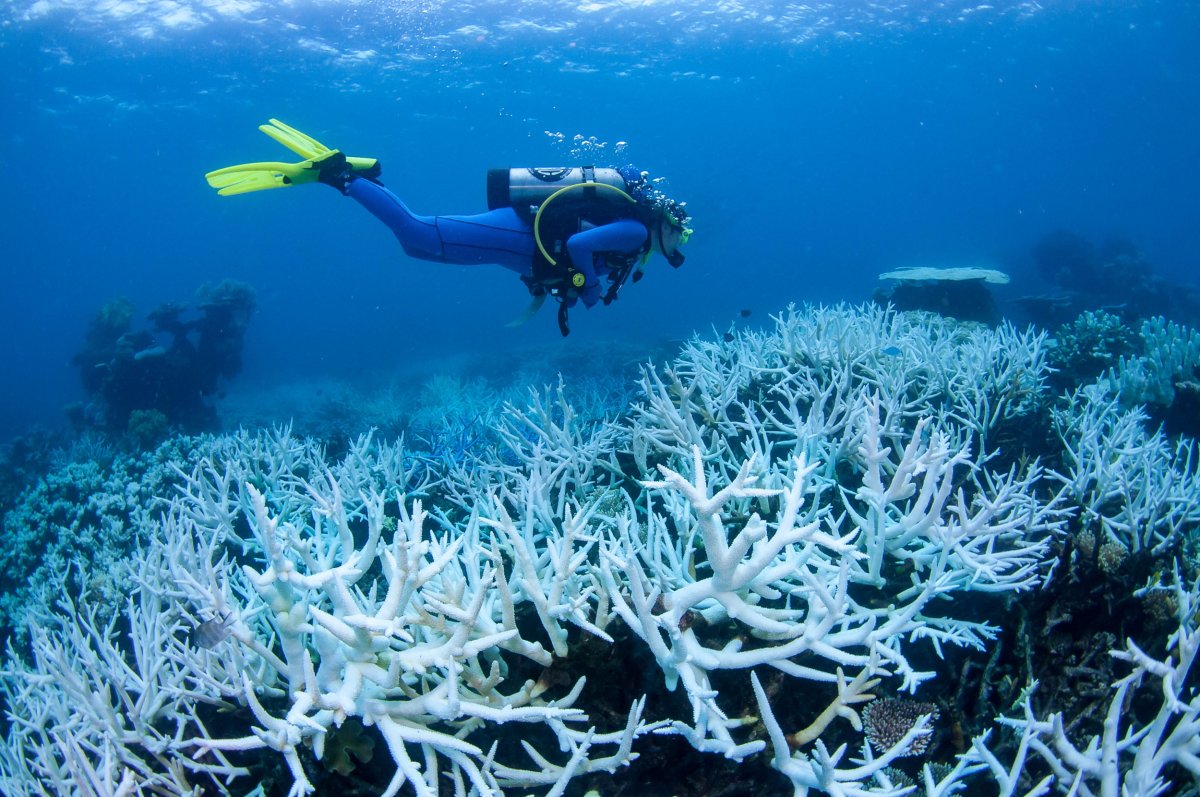
A diver swims over bleached staghorn coral during the 2017 coral bleaching event on the Great Barrier Reef, Australia. Corals are the marine group most at risk overall, according to a new analysis.
Brett Monroe Garner
The study evaluated more than 21,000 marine animal species for their vulnerability to various human-caused stressors, including fishing, shipping and land-based threats. Researchers then mapped these impacts across the global ocean, identifying locations where climate-driven impacts overlap with other human-caused stressors.
“Each species differs in terms of which stressors are most potentially harmful, so my colleagues and I developed a framework that uses the physical traits of each species to estimate how vulnerable the species is to each of a broad range of stressors,” O’Hara said.
These traits include body size, breathing mechanisms, and whether the species relies on calcium to build shells.
O’Hara elaborated: “So, a large air-breathing species such as a whale is more vulnerable to ship strikes, while a small shell-building species like a mollusk or coral is more likely to be harmed by ocean acidification.”
With these vulnerabilities in hand, the team then compared where the 21,000 species lived to mapped distributions of 11 human-driven stressors. Unsurprisingly, the regions where many species overlap with high intensities of stressors to which they were vulnerable were found to be of most concern.
What was more surprising, however, is where such high-risk regions lay. The effects of climate change as a dominant force on marine species’ lives meant that even relatively untouched habitats may harbor species at risk of extinction.
Additionally, many coastal areas with high biodiversity face greater threats than previously thought, based on earlier studies that focused on habitats rather than individual species, the authors said.
Among the marine animals studied, corals were found to be at the highest overall risk. Other highly vulnerable groups include mollusks such as squid and octopuses, echinoderms like sea stars and sea urchins, and crustaceans including shrimp, crabs and lobsters.
O’Hara emphasized the importance of their species-focused approach in identifying specific practices and activities that most affect at-risk marine species.
“While blanket protections such as exclusive marine reserves are effective at conserving marine biodiversity, they also can impose economic hardship on locals and provoke political opposition,” he said in a statement.
That’s not to say marine protected areas (MPAs) don’t help, though.
“In fact, MPAs are an important and effective tool for protecting and preserving marine ecosystems for their own sake as well as for the benefits those ecosystems provide to us, such as nutrition, jobs and economic livelihoods, recreation, coastal protection, and cultural or spiritual value,” O’Hara said.
“The better we understand how species and ecosystems are impacted by human activities and climate change, the more opportunities we hope to create for targeted conservation management that is ecologically effective while remaining politically and economically feasible.”
Do you have a tip on a science story that Newsweek should be covering? Do you have a question about marine ecosystems? Let us know via science@newsweek.com.
References
O’Hara, C. C., Frazier, M., Valle, M., Butt, N., Kaschner, K., Klein, C., & Halpern, B. S. (2024). Cumulative human impacts on global marine fauna highlight risk to biological and functional diversity. PLOS ONE. https://doi.org/10.1371/journal.pone.0309788