Israeli intelligence agency Mossad is believed to be responsible for using hundreds of pagers owned and operated by members of the political party and militant group Hezbollah to kill at least nine people and injure thousands in Lebanon and Syria on September 16.
The Lebanese government, as well as Hezbollah, have claimed that Israel conducted this as a remote attack by placing hidden explosives in the pagers, which Hezbollah fighters started using after their leader warned them not to use cellphones to prevent tracking by Israel. The Israeli military has declined to comment on the pager attack.
Mossad, the national intelligence agency of Israel whose director answers only to the prime minister, Benjamin Netanyahu, has launched at least 12 operations and conducted at least 25 assassinations since the 1950s that are publicly known. The agency’s ability to conduct complex operations on foreign soil has made it one of the most feared and respected intelligence organizations in the world since its founding in 1949.
Here is a list compiled by Newsweek of some of Mossad’s most audacious attacks.
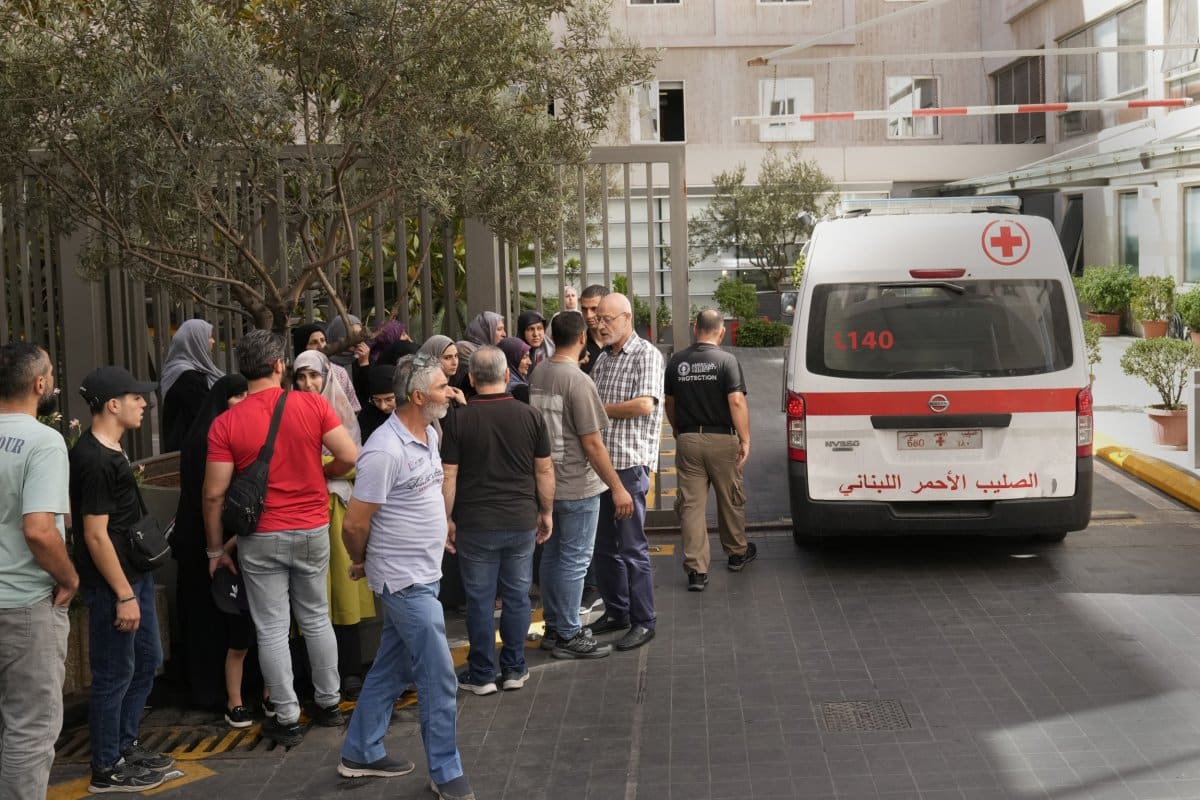
A Red Cross ambulance passes families of victims after the pager attacks, photo taken in Beirut, Lebanon on September 18. The pager attacks are just one of many of Mossad’s fatal operations and assassinations conducted since the 1950s.
Hussein Malla/Associated Press
The Israeli Ministry of Defense declined to comment when contacted by Newsweek.
Assassinations After the Munich Massacre
Following the Munich massacre during the 1972 Summer Olympics in which the Palestinian militant organization Black September took hostage and killed several members of the Israeli Olympic team, Mossad commenced Operation Bayonet. This operation to assassinate individuals the intelligence agency believed were involved in the terrorist attack in 1972 is believed to have taken place over 20 years, and targeted individuals in countries throughout Europe and the Middle East.
Hindawi Affair
Mossad allegedly stopped an attempt to bomb an El Al flight from London to Tel Aviv in April 1986. The bomb was allegedly planted by Nezar Nawwaf al-Mansur al-Hindawi, a Jordanian citizen engaged to Irish citizen Anne-Marie Murphy, who was five months pregnant at the time. Murphy claimed she was unaware that Hindawi had planted a Semtex explosive in her suitcase, and she was flying to Tel Aviv to meet his parents. Israeli security guards discovered the bomb in Murphy’s suitcase before the flight took off, thought to be following a Mossad intervention.
The Assassination of Gerald Bull
Gerald Bull, a Canadian engineer who designed a “supergun” for Saddam Hussein’s government in Iraq as part of Project Babylon, was assassinated outside of his home in Brussels in 1990. He was reportedly shot five times in the back of the head at point-blank range, allegedly by three Mossad agents, while approaching his doorstep. While never officially confirmed, the killing is widely believed to have been carried out by Mossad, but no one has ever been charged with his murder.
Operation Orchard
Also known as Operation Outside the Box, in 2007 Israel conducted an airstrike on a suspected Syrian nuclear facility. Mossad began gathering intelligence for the attack in 2001, profiling Syrian President Bashar al-Assad and profiling a top Syrian official in London. The intelligence agency also infiltrated the suspected nuclear site and raided materials to be brought back to Israel in August of 2007. The operation in 2007 involved cyber warfare techniques to disable Syrian air defenses and provide them with a false-sky picture, allowing Israeli jets to enter Syrian airspace to bomb their target.
The Assassination of Mahmoud Al-Mabhouh
In 2010, Mossad agents allegedly assassinated co-founder of the military wing of Hamas, commander Mahmoud Al-ouh, in Dubai in his hotel room. The operation involved a team of at least 26 operatives using forged European passports and wearing various disguises, including wigs, clothing changes, and glasses. While the exact method of assassination remains disputed, it is believed that Al-Mabhouh was killed using a combination of a muscle relaxant and suffocation.
The Stuxnet Worm
Stuxnet, a malicious computer worm, was first discovered in 2010 but is believed to have been in development since 2005. The computer malware is believed to have been jointly created by the United States and Israel as a part of the rumored Operation Olympic Games, in order to target supervisory control and data acquisition systems, although neither country has claimed responsibility. This highly sophisticated malware targeted Iranian nuclear facilities, causing significant damage after it was loaded into centrifuges, one of which was used for uranium enrichment.
The Motorcycle Assassinations
Between 2010 and 2012, Mossad attempted to assassinate five Iranian nuclear scientists in Tehran, with one target surviving the attack. Following the attacks in a 24-month span, Iran blamed both the U.S. and Israel and specifically noted Mossad’s responsibility for the attack in January 2012. In most cases, the attacks involved motorcyclists attaching magnetic bombs to the victims’ cars.
The Assassination of Ismail Haniyeh
It is widely believed that Mossad agents assassinated Ismail Haniyeh, the chairman of the Hamas Political Bureau from 2017 onward, on July 31, 2024, in Tehran. It is believed that Mossad agents either planted a bomb or coordinated an airstrike at his house. This assassination followed Israel’s vow to kill all Hamas leaders after the October 7 attacks. The assassination of Haniyeh came one day after Israel claimed responsibility for the killing of a senior Hezbollah commander in Beirut.
The Exploding Pager Attack
The attack in Lebanon on Tuesday involving the simultaneous detonation of pagers used by Hezbollah members is believed to be the result of a supply-chain hack, allowing Mossad operatives to plant explosives into the devices in a long-planned operation, according to experts. According to Lebanon’s health minister, the attack killed at least nine people, including an eight-year-old girl, and injured approximately 2,750 people. A Hezbollah official said that the pagers contained lithium batteries that exploded.
Do you have a story we should be covering? Do you have any questions about this article? Contact LiveNews@newsweek.com.