Vice President Kamala Harris sat down with the National Association of Black Journalists (NABJ) on Tuesday for one of the longest interviews of her campaign so far, and touched on several major policy areas.
The NABJ’s last interview with former President Donald Trump proved to be one of the most significant moments of the campaign, with his comments on Harris’ racial identity being brought up consistently since then.
Harris’ interview was more focused on policy, as hosts Gerren Keith Gaynor, Eugene Daniels, and Tonya Mosley attempted to flesh out her positions on key issues. Here are the five of the biggest takeaways from the interview.
1. Gaza Remains a Tough Issue for Harris
The conflict in Gaza has been a tricky issue for Harris to navigate since she became the Democratic candidate. With subsections of her party supporting different sides in Israel’s war in the Palestinian territory, Harris’ rhetoric when asked about her approach to the situation remained moderate.
Harris said: “Right now, the thing we need to get done is this hostage deal and this ceasefire deal. We need a ceasefire. We need a hostage deal.”
She stressed that she supported President Joe Biden‘s decision to pause the shipment of 2,000-pound bombs to Israel in May, and that “Palestinians deserve dignity and a right to self-determination.”
However, she balanced those comments with a recommitment to Israel’s right to defend itself.
There was also a tense exchange when Harris had to talk over the panel when an interviewer asked her what the difference was between aggression and defense.
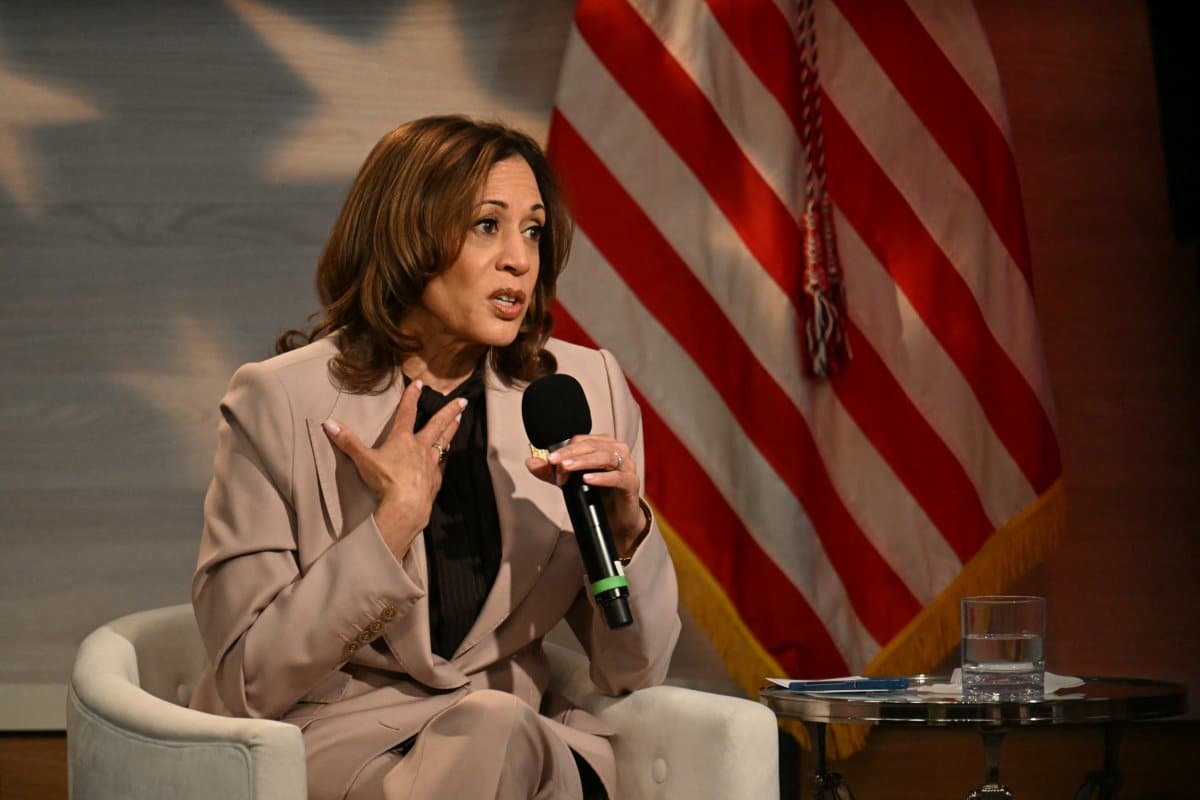
Vice President Kamala Harris in Philadelphia on September 17, 2024. The Democrat has taken part in a discussion hosted by the National Association of Black Journalists.
Getty Images
2. Trump’s Springfield Comments Aren’t Going Away
The defining moment of the ABC presidential debate on September 10 came when Donald Trump claimed that immigrants were eating dogs in Springfield, Ohio, and the comments resurfaced again during Harris’ interview.
Trump’s claim has provided Harris with the opportunity to counter “hateful rhetoric,” which she demonstrated at the NABJ, saying: “It’s a crying shame, what’s happening to those families, those children in that community.
“I know that people are deeply troubled by what is happening to that community in Springfield, Ohio, and it’s got to stop. And we’ve got to say that you cannot be entrusted with standing behind the seal of the president of the United States of America, engaging in that hateful rhetoric that, as usual, is designed to divide us as a country.”
3. Abortion is Still Harris’ Strongest Issue
Abortion has been the Democrats‘ strongest motivator for their core vote since the abolition of Roe vs. Wade, and it has been central to the Harris campaign’s political ads this cycle.
At the NABJ talk, Harris tripled down on her commitment to restoring the protections of Roe vs. Wade, drawing yet another line between her and the Trump-JD Vance ticket.
When asked about what her administration would do to restore abortion rights across the U.S., Harris said: “We need to put back in place the protections of Roe vs. Wade and let an individual in consultation with her doctor make the decision based on what she can determine, ’cause she’s smart enough to know what’s in her best interest, instead of having her government tell her what to do.”
4. Harris Isn’t Taking the Black Vote for Granted
A curveball question came when Politico White House correspondent Daniels asked Harris what her message was for Black voters thinking of voting for Trump.
Rather than immediately jump into an appeal, Harris first stressed that she wasn’t making any assumptions about how different demographic groups might vote for her.
Harris said: “I think it’s very important to not operate from the assumption that Black men are in anybody’s pocket.
“Black men are like any other voting group. You gotta earn their vote. So I’m working to earn the vote, not assuming I’m going to have it because I am Black.”
5. Harris Isn’t Comfortable Talking About Reparations
Harris noticeably dodged a question about whether or not she would use an executive order to create a commission to study the possibility of reparations for slavery.
Harris said: “We just need to speak the truth about history. In spite of the fact that some people are trying to erase history and try and teach our children otherwise, we need to speak truth about the generational impact of our history, in terms of the generational impact of slavery, the generational impact of redlining, of Jim Crow law, I could go on and on.”
Redlining is a discriminatory practice in which financial services are withheld from neighborhoods that have significant numbers of racial and ethnic minorities.
Jim Crow laws were a series of state and local laws in the United States that enforced racial segregation and discrimination against Black Americans from the late 19th century until 1965.
Harris concluded by implying the legislature would be able to do something about the issue, stopping short of saying she would take action on it: “I think Congress ultimately will have the ability to do this work.”
Newsweek has contacted the Harris campaign for comment on her interview.
Do you have a story we should be covering? Do you have any questions about Harris and the 2024 election? Contact LiveNews@newsweek.com.