The United Nations chief Secretary-General stressed the urgency for a ceasefire in the Israel-Gaza War on Monday, saying the conflict had reached an “unprecedented” level of suffering that is beyond anything he has seen during his years in office.
On Oct. 7, Hamas led the deadliest Palestinian attack on Israel in history. Israel responded by launching a sustained assault on Gaza.
The ongoing war has left 90 percent of Gaza’s population of 2.3 million displaced, with many forced to flee their homes multiple times, leading to calls for a ceasefire.
In an interview with The Associated Press on Monday, António Guterres said: “The level of suffering we are witnessing in Gaza is unprecedented in my mandate as secretary-general of the United Nations. I’ve never seen such a level of death and destruction as we are seeing in Gaza in the last few months.”
At least 1,200 people were killed in the Hamas attack on Israel and approximately 250 hostages were taken. Around 120 remain held, about a third of them are believed to be dead. More than 40,900 Palestinians have been killed in Gaza, per the Gaza Health Ministry.
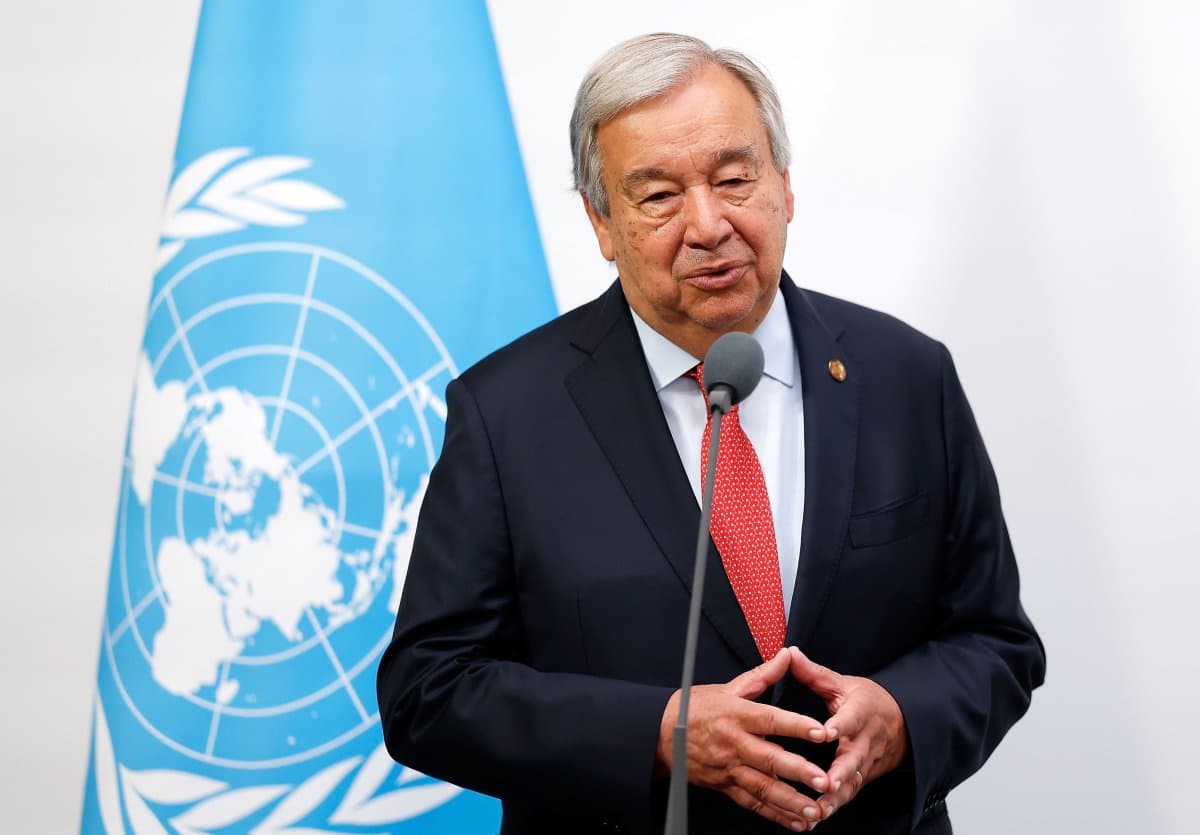
UN Secretary-General Antonio Guterres meets with International Olympic Committee (IOC) President Thomas Bach (unseen) prior to the Opening Ceremony of the Olympic Games Paris 2024 on July 26, 2024 in Paris, France. Amid the Israel-Hamas war, Guterres stressed the urgency for a ceasefire on Monday as he said the conflict has reached an” unprecedented” level of suffering he has seen during his years in office.
Wang Lili – Pool/Getty Images
Negotiations for a ceasefire and hostage release continue, with the United States urging Israeli Prime Minister Benjamin Netanyahu to continue talks.
Beyond a ceasefire, Guterres pointed towards a two-state solution to the decades-old Israeli-Palestinian conflict as not only viable, but “it’s the only solution.”
“I do not think you can have two peoples living together if they are not in a basis of equality, and if they are not in a basis of respect—mutual respect of their rights,” Guterres said. “So the two-state solution is, in my opinion, a must if we want to have peace in the Middle East.”
Guterres also emphasized the U.N.’s readiness to monitor any potential ceasefire. However, he acknowledged the challenges of securing Israeli approval for any significant U.N. role in Gaza,
“The U.N. will be available to support any ceasefire,” Guterres stated, referencing the U.N.’s long-standing military monitoring mission, UNTSO, in the region since 1948. “Of course, we’ll be ready to do whatever the international community asked for us. The question is whether the parties would accept it, and in particular whether Israel would accept it.”
Netanyahu, who has previously vowed to dismantle Hamas’ military and governance structures and secure the return of the remaining hostages, has pushed back on a ceasefire deal and recently opposed calls for a two-state solution.
This comes after Netanyahu’s government has been openly critical of the U.N.’s humanitarian efforts in Gaza, accusing the international body of harboring an anti-Israel bias.
The United Nations‘ top court previously declared Israel’s continued presence in the Palestinian territories “illegal” and urged the country to immediately cease all new settlements, evacuate settlers, and issue reparations, in an advisory opinion released in July.
In the decision, the International Court of Justice (ICJ) determined that Israel is obliged to end its presence as “rapidly as possible.”
The ICJ’s opinion, delivered by a panel of 15 judges from around the world, including one from the United States, lacks enforcement measures but is likely to impact international politics, especially with increased scrutiny on Israel’s Prime Minister.
However, Netanyahu responded in a statement on social media rejecting the court’s findings.
“The Jewish people are not occupiers in their own land, including in our eternal capital Jerusalem nor in Judea and Samaria, our historical homeland. No absurd opinion in the Hague can deny this historical truth or the legal right of Israelis to live in their own communities in our ancestral home,” he wrote on X, formerly Twitter.
This article includes reporting from The Associated Press