Political rhetoric has been under the microscope in this year’s presidential election following an assassination attempt and another suspected attempt, arrests over violent threats leveled against both major candidates and additional perils linked to culture war talking points.
Former President Donald Trump, his running mate JD Vance and some other Republicans have blamed President Joe Biden and Vice President Kamala Harris, the Democratic nominee, for an attempt on Trump’s life during a Pennsylvania rally in July and another suspected assassination attempt in Florida on Sunday.
But Trump and his allies have long been accused of stoking violence and threats through rhetoric that includes repeatedly voicing false claims about the 2020 election being “stolen” and disparaging remarks about immigrants, LGBTQ+ people and anyone perceived to be a political enemy of the ex-president.
Most recently, the former president has been criticized for promoting evidence-free claims of Haitian immigrants abducting and eating pet cats and dogs in Springfield, Ohio. The Haitian community and multiple schools in the small Midwestern city in the state represented by Vance in the U.S. Senate have since been subjected to bomb threats and intimidation attempts.
Newsweek asked political analysts whether they thought rhetoric from either candidate has played a significant role in the recent rise in political violence and threats.
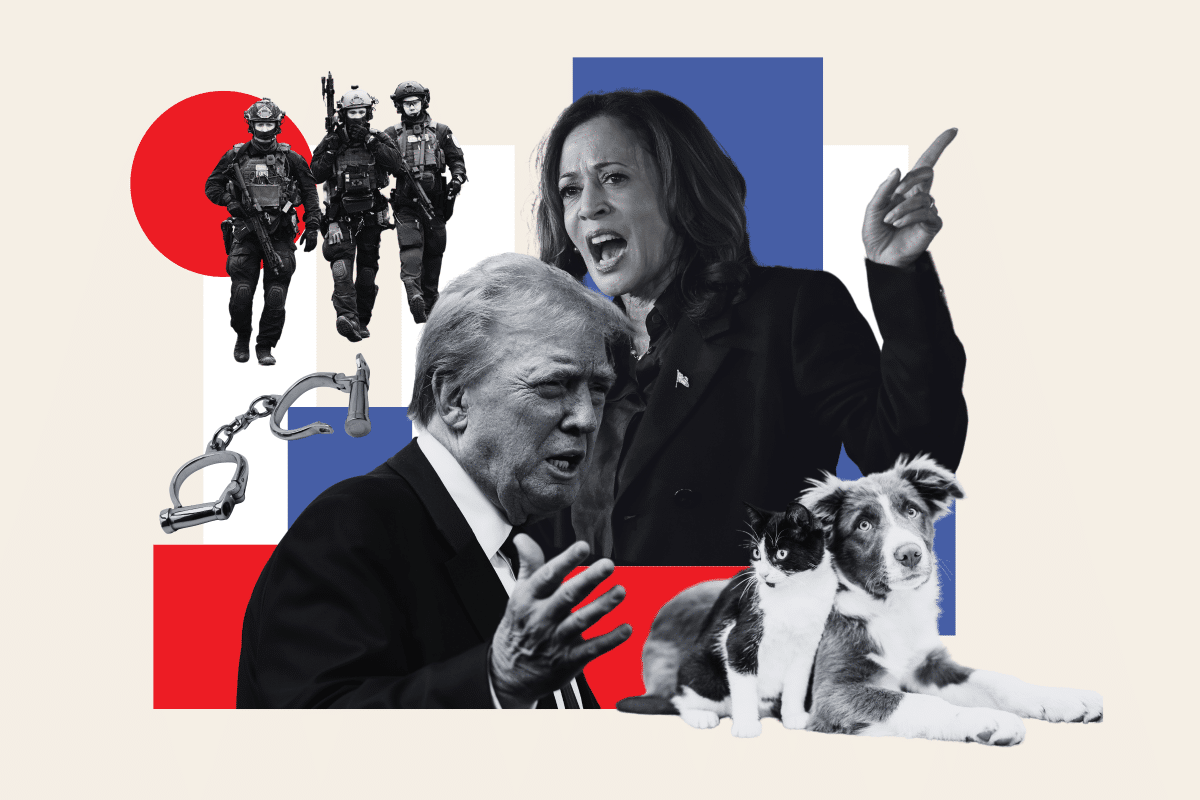
Newsweek asked political analysts to delve into the heightened political rhetoric in America as the 2024 presidential election approaches.
Photo-illustration by Newsweek/Getty
The Blame Game
While political scientists largely agree that the U.S. has been grappling with an era of elevated and divisive rhetoric, most have refrained from blaming the phenomena entirely on a single candidate, political party or issue.
U.S. political violence is also nothing new, despite a recent increase. In the 1960s, the country suffered multiple high-profile political assassinations, politically motivated domestic terror attacks and other acts of violence.
Grant Davis Reheer, professor of political science at Syracuse University, told Newsweek that he would “hesitate to blame certain comments from either candidate, campaign, or its supporters for specific acts,” while adding that “there are way too many variables and a very complicated and cluttered political environment.”
Trump told Fox News Digital on Monday, one day after the weekend’s suspected assassination attempt, that Biden and Harris were responsible for the incident through “a combination of rhetoric and lawsuits they wrap me up in.”
Similar accusations were made following the July 13 assassination attempt, which resulted in the death of one Trump rallygoer, serious injuries to two others and a minor injury to Trump’s ear.
In particular, Republicans have suggested that accusing Trump of being a threat to democracy—in part due to his actions surrounding efforts to overturn Biden’s 2020 election win and the January 6 U.S. Capitol attack that followed—is the root cause of violence targeting the former president.
“Democrats arguably have more bad behavior to point to as evidence for their claims, but they nonetheless have characterized the election as one determining whether democracy itself will survive,” Reheer said. “If someone took that to heart, it’s not hard to see how violence could result.”
Harris and Biden, however, have repeatedly condemned political violence and never publicly suggested that their supporters physically harm political opponents in any way. Some Democrats have lashed out at Trump and Vance for attempting to blame the Democratic ticket.
“There is nothing causal about what we have seen in terms of someone trying to harm Trump and anything that the Democrats have said and done,” Democratic strategist Aisha Mills said during an interview with CNN‘s Erin Burnett on Monday night.
“The fact that Donald Trump and JD Vance want to create a looky-loo and somehow make this the Democrats’ fault is absolutely ridiculous,” she added.
Ashley Moraguez, co-chair and associate professor of political science at the University of North Carolina Asheville, said that there was no evidence to support the notion of Harris being responsible for the assassination attempt and suspected attempt.
“I do not believe that Harris’ rhetoric can be seen as the proximate or even the indirect cause for the assassination attempts on Trump, especially given the information and evidence we have at present,” Moraguez told Newsweek. “Harris has been consistent in forcefully condemning political violence as a result of the attempts on Trump’s life.”
“While she is critical of Trump on the campaign trail, I cannot think of any of her rhetoric that can be deemed as aimed at inflaming or inciting violence among her supporters,” she added. “It is irresponsible and potentially dangerous for Trump or anyone else to lay blame at Harris’ feet or to speculate that anything she has said has contributed to these occurrences.”
Dan Lamb, senior lecturer at Brooks School of Public Policy at Cornell University, pointed out that Trump suggested in 2016 that “Second Amendment people” could act against former Secretary of State Hillary Clinton, a comment interpreted by many as a threat of gun violence against his Democratic opponent.
“Trump is seeking political gain from the assassination attempt by baselessly blaming his opponents’ rhetoric for the incident,” Lamb told Newsweek. “From someone who once suggested that ‘2nd Amendment People’ should stop his opponent, this is not only ironic and dangerous, but a missed opportunity.”
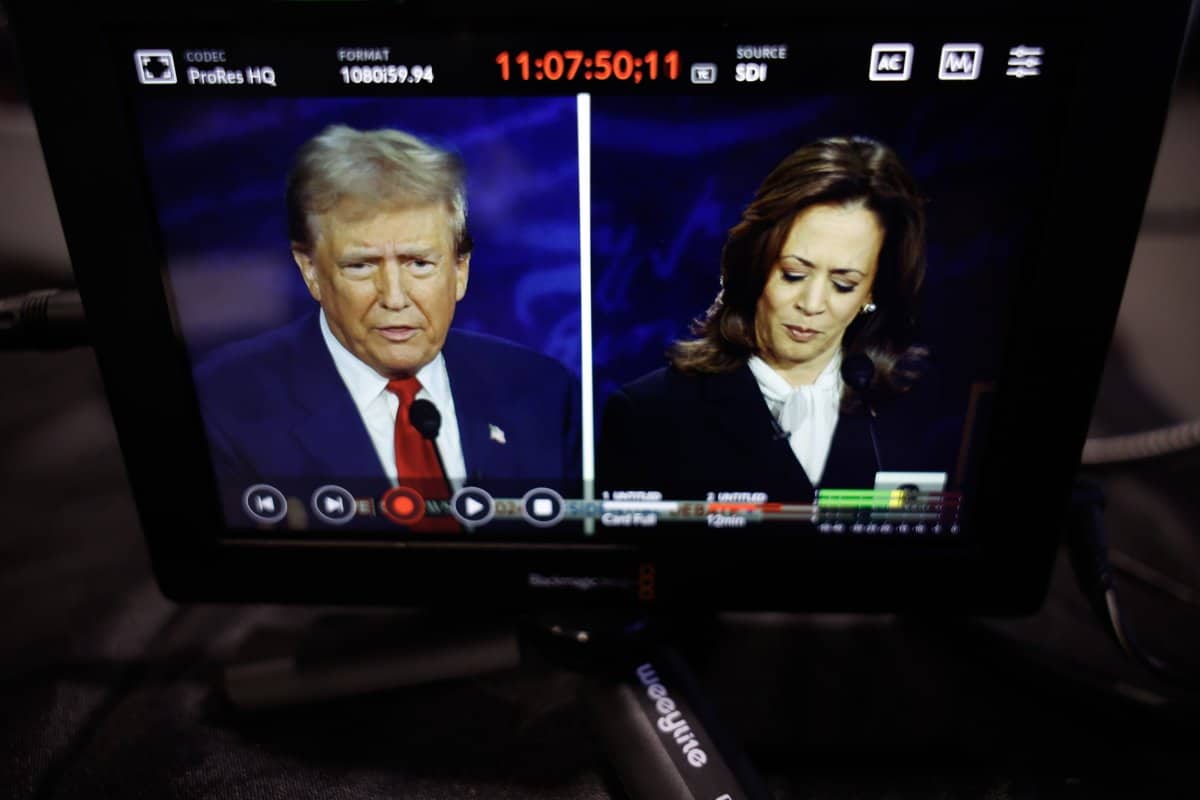
Former President Donald Trump and Vice President Kamala Harris are pictured on a monitor during their presidential debate in Philadelphia on September 10.
Kevin Dietsch
Trump Rhetoric vs. Harris Rhetoric
While both candidates have faced fierce criticism during this year’s election cycle, several of the experts that Newsweek spoke with agreed that rhetoric used by Harris and Biden pales in comparison to Trump’s history of incendiary rhetoric.
William Reno, professor and chair of the political science department at Northwestern University, said that Harris and her running mate Tim Walz “don’t even register in terms of inflammatory rhetoric” based on his “research in political violence over the past 30 years.”
“Trump’s rhetoric is a different matter,” Reno said. “He points to ‘out groups’ to create a narrative of threat. He presents himself as the defender against such threats.”
“If one takes a survey of violent political acts over the past eight years (i.e., Charlottesville, January Sixth) Trump has made statements suggesting that people who carried out those acts were justified in their behavior,” he added. “One doesn’t see such rhetoric among other politicians at that level.”
Reheer said that “the demonizing rhetoric that the former president engages in speaks for itself,” adding that “one might have thought that the first assassination attempt would have toned down the rhetoric, but that lasted for a matter of hours.”
Moraguez suggested that Trump and Vance “do bear some culpability for the increases in tension and fear” in Springfield following the recent false claims concerning Haitian migrants eating pets.
“Since the presidential debate during which Trump mentioned the false claims, over 30 bomb threats have been made in the city,” Moraguez said. “It seems likely that this type of rhetoric is fueling those threats and that changes in it, especially by Trump and Vance, could help ease the increased tensions. To my knowledge, however, that rhetorical shift has not yet occurred.”
Lamb argued that Trump’s decision to seemingly double down on divisive rhetoric concerning Springfield was increasing the risk of future political violence.
“Since the incident on Sunday, Trump has promised mass deportations of protected Haitian migrants in Springfield, Ohio, where schools face dozens of bomb threats due to a campaign of disinformation about household pets being eaten,” Lamb said.
“Trump also found time on Sunday to declare his hatred of Taylor Swift. At a time when he could capitalize on a call for unity to reduce risks of political violence, Trump defies norms and explanation,” he continued.
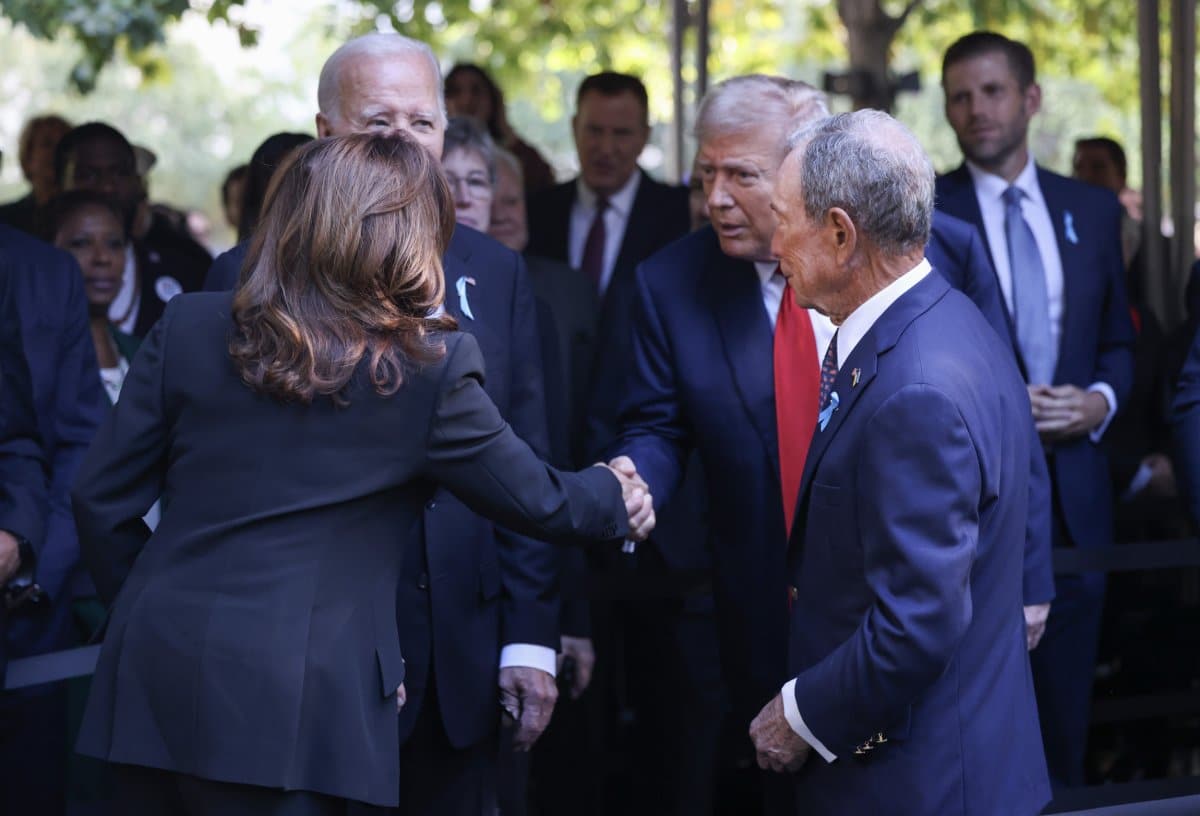
Vice President Kamala Harris and former President Donald Trump are pictured shaking hands while President Joe Biden and former New York City Mayor Michael Bloomberg look on during a ceremony honoring the victims of the 9/11 terrorist attacks in New York City on September 11.
Michael M. Santiago
A ‘Poisonous Environment’
“Blaming politicians for the poisonous environment is too easy,” said D. Stephen Voss, political science professor at the University of Kentucky. “American politics has changed in fundamental ways since the 90’s, when the clash between President Bill Clinton and Speaker of the House Newt Gingrich first moved Sixties-era cultural conflicts to center stage.”
“The policy preferences and ideological stances of voters are more polarized than they used to be, in ways that touch directly on daily life,” he added. “American identity is tied up with politics to an extent that would have been unthinkable in the 20th Century, as people express partisan hostilities today that are as severe as racial divisions used to be.”
Voss said that politicians are now forced to choose between trying “to benefit from the divisions pulling the country apart” or assuming “that they’ll fade in significance” and potentially risking their careers as a result. He noted that politicians who “have tried to take the high road” are largely no longer in power.
Polling suggests that most Americans agree that the country is too divided by politics. An Ipsos survey released this year found that 81 percent of respondents agreed that the U.S. was “more divided than united,” with 78 percent saying that the country was “less united than ten years ago.”
Despite the divide, a 69 percent majority agreed “that most Americans want the same things out of life,” according to the poll.
Reheer argued that “the nasty and demonizing rhetoric has gone way too far” and asserted that it was not an “accident that both candidates have received threats, and in one case, actual attempts” when “each side is evil incarnate, according to the other.”
Reheer went on to say that what may seem to be a recent “trend” of heightened rhetoric “has been around for a long time” and predates “the Trump era,” despite turning “worse since then.”
“The rhetoric has become a game of political chicken in which everyone always goes ahead and crashes the car,” Reheer said. “Citizens look at the damage, and are then disgusted. It’s hard to blame them.”