Researchers have announced the discovery of one of the “last” Neanderthals—and its remains cast new light on the history of these archaic humans.
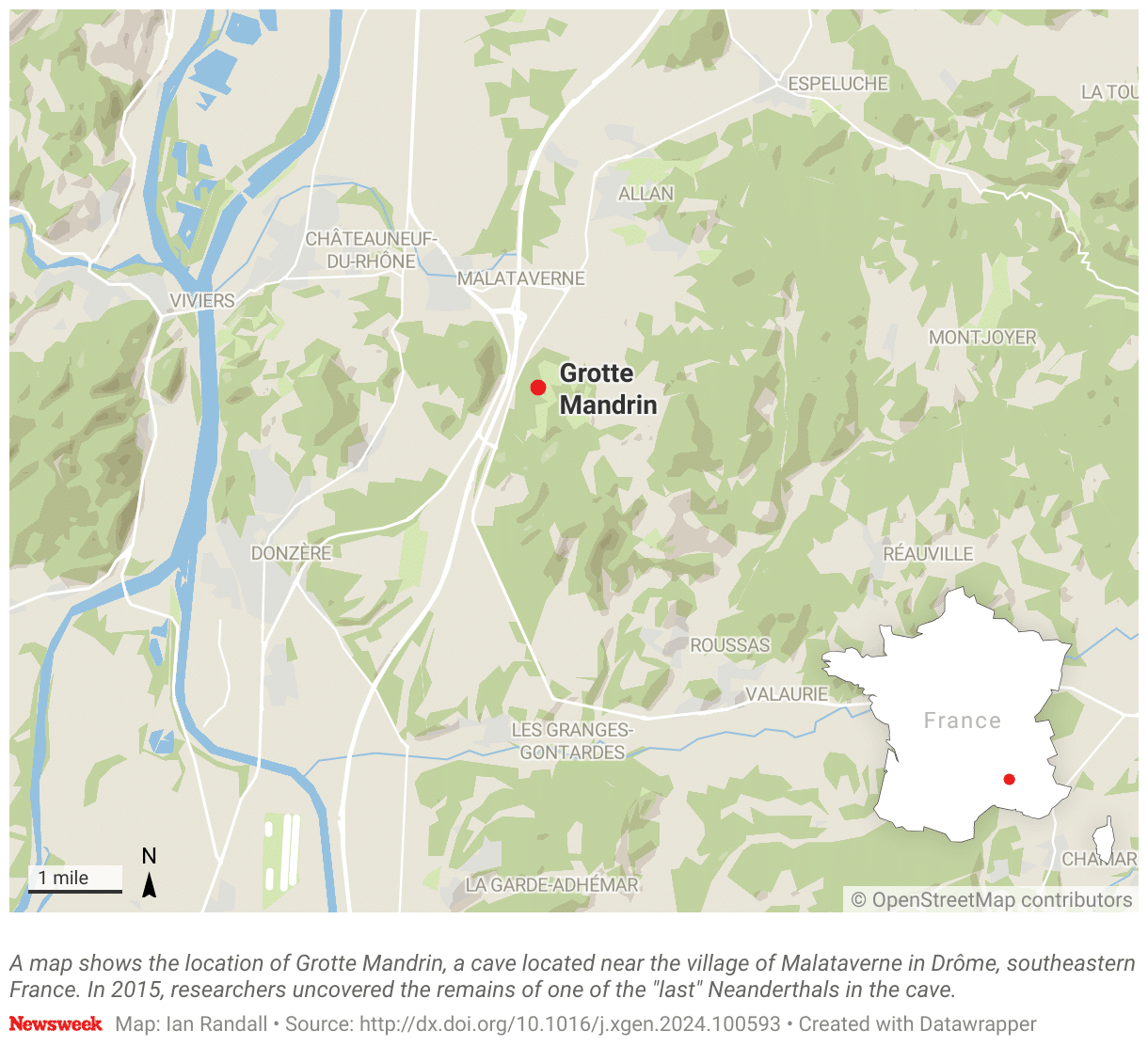
The Neanderthal was found in 2015 at a cave known as “Grotte Mandrin” in southern France’s Rhône Valley. The find is now being reported in the scientific literature for the first time in a study published in the journal Cell Genomics.
The authors—led by Ludovic Slimak, a researcher with Paul Sabatier University in Toulouse, France—nicknamed the individual “Thorin” in homage to a character in J.R.R. Tolkien’s 1937 novel The Hobbit, a dwarf king and the last of his line.
“The Thorin of Mandrin is, in turn, one of the last Neanderthals,” Slimak wrote in a piece for The Conversation.
After discovering Thorin, the research team analyzed his genome, which revealed surprising insights.
According to the paper, Thorin lived in a small, isolated community between 42,000 and 50,000 years ago, one that represents a previously undescribed and particularly ancient Neanderthal lineage.
This population seemingly diverged from other currently known “late Neanderthals” around 100,000 years ago and remained genetically isolated for more than 50,000 years, the authors say.
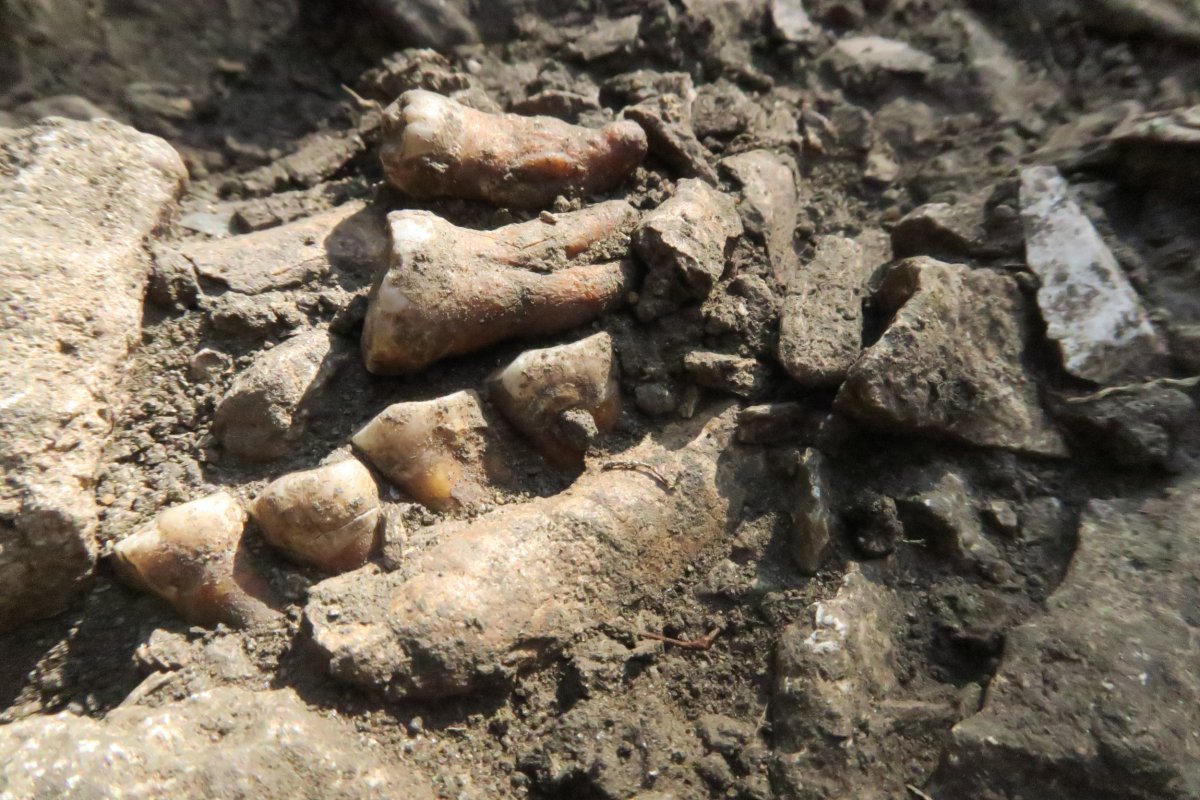
The remains of the Neanderthal known as Thorin in Grotte Mandrin, France. Analysis of the remains is revealing new insights into the history of these ancient humans.
Ludovik Slimak/Cell Press
Slimak told Newsweek that the latest results challenge what was previously known about the nature of the last Neanderthal populations. The findings could help researchers understand the mysterious disappearance of the Neanderthals, the causes of which are subject to significant debate.
“Now, everything must be rewritten about the greatest extinction of humanity,” Slimak said.
Neanderthals (Homo neanderthalensis) are one of our closest extinct relatives. This species lived in Eurasia until their disappearance about 40,000 years ago. In certain regions and periods, they coexisted with anatomically modern humans and even interbred with us.
“Until now, the story has been that at the time of the extinction there was just one Neanderthal population that was genetically homogeneous. But now we know that there were at least two populations present at that time,” study first author and population geneticist Tharsika Vimala with the University of Copenhagen, Denmark, said in a press release.
The population that Thorin belonged to seemingly spent around 50,000 years without exchanging genes with other Neanderthal populations.
“We thus have 50 millennia during which two Neanderthal populations, living about ten days’ walk from each other, coexisted while completely ignoring each other. This would be unimaginable for [Homo sapiens] and reveals that Neanderthals must have biologically conceived our world very differently from us,” Slimak said in the release.
Thorin’s remains, found lying at the entrance of Grotte Mandrin, are still being slowly excavated. So far, researchers have identified a number of teeth, the jawbone, fragments of the skull and a variety of other remains. According to the authors, he is the most complete Neanderthal individual found in France since 1979.
Thorin’s location within the sediments of the cave initially led the team to suspect that he lived around 40-45,000 years ago, making him a “late Neanderthal”—one of the last representatives of the species in the final millennia of its existence.
The team subsequently extracted DNA from his teeth and jaw and compared his full genome sequence to previously sequenced Neanderthal genomes.
This work raised an issue. The initial genomic analysis suggested that Thorin lived much earlier than the estimate indicated by the archaeological data. Namely, his genome differed significantly from other late Neanderthals, much more closely resembling those of Neanderthal populations who lived more than 100,000 years ago.
The team spent years trying to unravel this contradiction, analyzing isotopes—atoms of the same element that have the same number of protons but a different number of neutrons—from Thorin’s bones and teeth in an attempt to understand what type of climate he lived in. Late Neanderthals lived during the last ice age, while early members of the species experienced a significantly warmer climate.
The isotopic analysis revealed that Thorin lived in a very cold climate, indicating that he was indeed a late Neanderthal, a result that corresponded with the genomic data.
“This genome is a remnant of some of the earliest Neanderthal populations in Europe,” study senior author and population geneticist Martin Sikora of the University of Copenhagen said in the release.
The comparison with known Neanderthal genome sequences revealed that Thorin’s most closely resembled an individual excavated in Gibraltar, a British Overseas Territory located at the southern tip of the Iberian Peninsula. According to Slimak, this suggests that Thorin’s population may have migrated to France from Gibraltar.
“This means there was an unknown Mediterranean population of Neanderthals whose population spanned from the most western tip of Europe all the way to the Rhône Valley in France,” he said in the release.
The study’s results suggest the presence of multiple isolated late Neanderthal communities in Europe close to their time of extinction. They also cast light on Neanderthal social organization, indicating that there was limited, if any, interaction between different Neanderthal populations in their last millennia, even though these populations were geographically very close to each other.
Living in small and insular communities is generally considered a disadvantage for population survival.
“It’s always a good thing for a population to be in contact with other populations,” Vimala said. “When you are isolated for a long time, you limit the genetic variation that you have, which means you have less ability to adapt to changing climates and pathogens, and it also limits you socially because you’re not sharing knowledge or evolving as a population.”
As a result, this factor may have played an important role in the extinction of the species.
“For me, the main implication is that our study provides more evidence that genetic isolation and small population sizes might have been a general characteristic of Neanderthal populations,” Sikora told Newsweek. “This is quite different to what we know about early modern human populations, which likely were much more connected.”
“To what extent such differences in social organization played a key role in their decline will be one of the fascinating questions to ask when yet more genomic data of Neanderthals becomes available.”
Do you have a tip on a science story that Newsweek should be covering? Do you have a question about archaeology? Let us know via science@newsweek.com.
References
Slimak, L., Vimala, T., Seguin-Orlando, A., Metz, L., Zanolli, C., Joannes-Boyau, R., Frouin, M., Arnold, L. J., Demuro, M., Devièse, T., Comeskey, D., Buckley, M., Camus, H., Muth, X., Lewis, J. E., Bocherens, H., Yvorra, P., Tenailleau, C. (2024). Long genetic and social isolation in Neanderthals before their extinction. Cell Genomics. https://doi.org/10.1016/j.xgen.2024.100593