Over half of foreign-made parts in Russian weapons found in Ukraine come from and via China, President Volodymyr Zelensky’s adviser has said.
Despite strong trade ties between Russia and China, Beijing has repeatedly denied supplying weaponry to any party and has said that it was not involved in the Ukraine conflict.
“If you take all the usual types of weapons and count the foreign-made components, about 60 percent would be coming from China. We have had lengthy discussions with some manufacturers about this. The PRC (China) is the biggest problem, I would say,” presidential adviser Vladyslav Vlasiuk told reporters in Brussels on Tuesday, Reuters reported.
Newsweek has reached out to the Chinese Embassy in Washington, D.C, for comment.
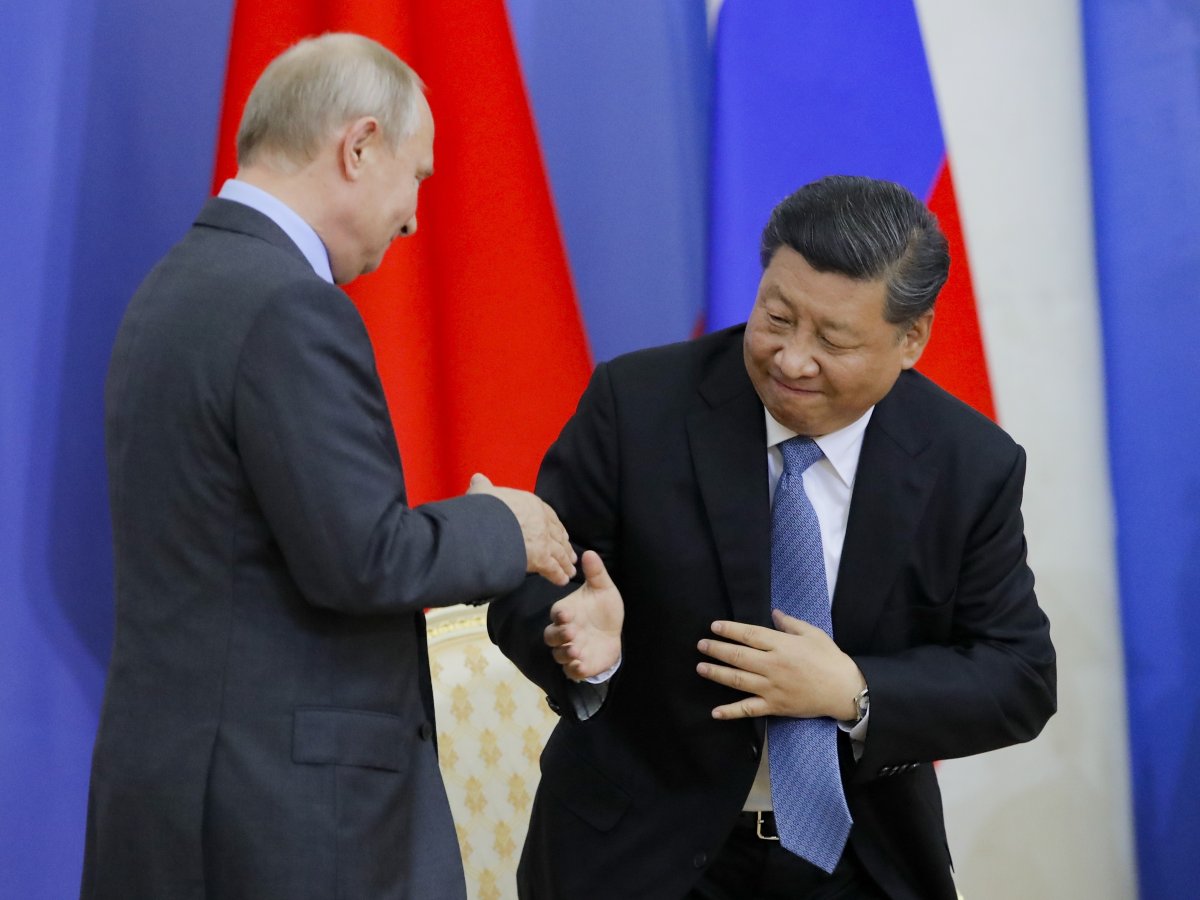
Chinese President Xi Jinping, right, and Russian President Vladimir Putin shake hands in St. Petersburg, Russia, Thursday, June 6, 2019. Ukrainian Presidential adviser Vladyslav Vlasiuk said roughly 60 percent of the foreign parts found in Russian weapons in Ukraine come from and via China.
Dmitri Lovetsky/AP
Vlasiuk, who was in the Belgian capital to meet with European Union and G7 members to discuss sanctions against Russia, said that key components used in surveillance systems, drones, and missiles have also come from the United States, the Netherlands, Japan, Switzerland and other Western nations.
He added, showing documents to reporters, that some products were manufactured over a decade ago, while others were made as recently as last year, still according to Reuters.
Since Russia launched its full-scale invasion of Ukraine in 2022, Moscow has managed to sustain its military operations by acquiring Western microchips and semiconductors, despite facing a mountain of extensive sanctions.
Vlasiuk suggested that the European Union could take stronger action to curb the flow of Western products, including imposing measures against Russia’s state nuclear company, Rosatom.
“We believe Russia has been using Rosatom’s networks to supply its military,” he said. European capitals have been hesitant to act due to Russia’s dominance in nuclear plant supplies, said Reuters.
The EU bloc could also target Russia’s logistics, such as airports and seaports, and financial institutions that facilitate the sales, he said.
According to Reuters, Vlasiuk praised a U.S. package of sanctions on IT, which he said has been very effective after coming into force earlier this month.
President Volodymyr Zelensky is currently in the U.S. and he aims to present President Joe Biden with a “victory” plan this week. He is to also give a speech at the United Nations General Assembly in New York on Wednesday .
In June, Zelensky said Chinese President Xi Jinping had vowed not to provide Russia with weapons in the ongoing Russia-Ukraine war.
“I had a phone conversation with the leader of China by phone. He said that he will not sell any weapons to Russia. We will see,” Zelensky said during a press conference with President Joe Biden at the Group of Seven summit in Italy. “He gave me his word.”
China’s foreign minister said in February that Beijing doesn’t sell lethal weapons in the Russia-Ukraine war.
“China’s principled position on the Ukrainian issue, emphasizing that China adheres to the political solution of hot-spot issues, insists on promoting peace and promoting talks, does not add fuel to the fire, does not take advantage of opportunities, and does not sell lethal weapons to conflict areas or conflict parties,” Wang Yi, foreign minister and director of the Chinese Communist Party’s foreign affairs commission, told his then Ukrainian counterpart Dmytro Kuleba.
Do you have a story we should be covering? Do you have any questions about this article? Contact LiveNews@newsweek.com