Russia has installed Starlink terminals in its Iranian-designed Shahed drones, according to a Ukrainian media report, which would mark the latest upgrade to the destructive kamikaze drones long used against Ukrainian cities if confirmed.
Ukrainian air defenses shot down a Shahed-136 attack drone that was fitted with Starlink during aerial attacks overnight between Tuesday and Wednesday, Ukrainian outlet Defense Express reported. Early on Wednesday, Ukraine’s air force said it had intercepted 28 out of 32 Shahed drones launched from Russia’s Kursk and Krasnodar regions.
Ukraine’s air force declined to directly address the reported discovery of Starlink within a Shahed drone when approached by Newsweek, but said Ukrainian experts were studying targets shot down by air defenses. Ukrainian teams investigating the changes to Russian drone designs have not yet received the wreckage of the downed drone, Newsweek understands.
Defense Express shared images purporting to show the drone fitted with Starlink. Newsweek could not independently verify these images, and has reached out to Starlink and the Russian Defense Ministry for comment via email.
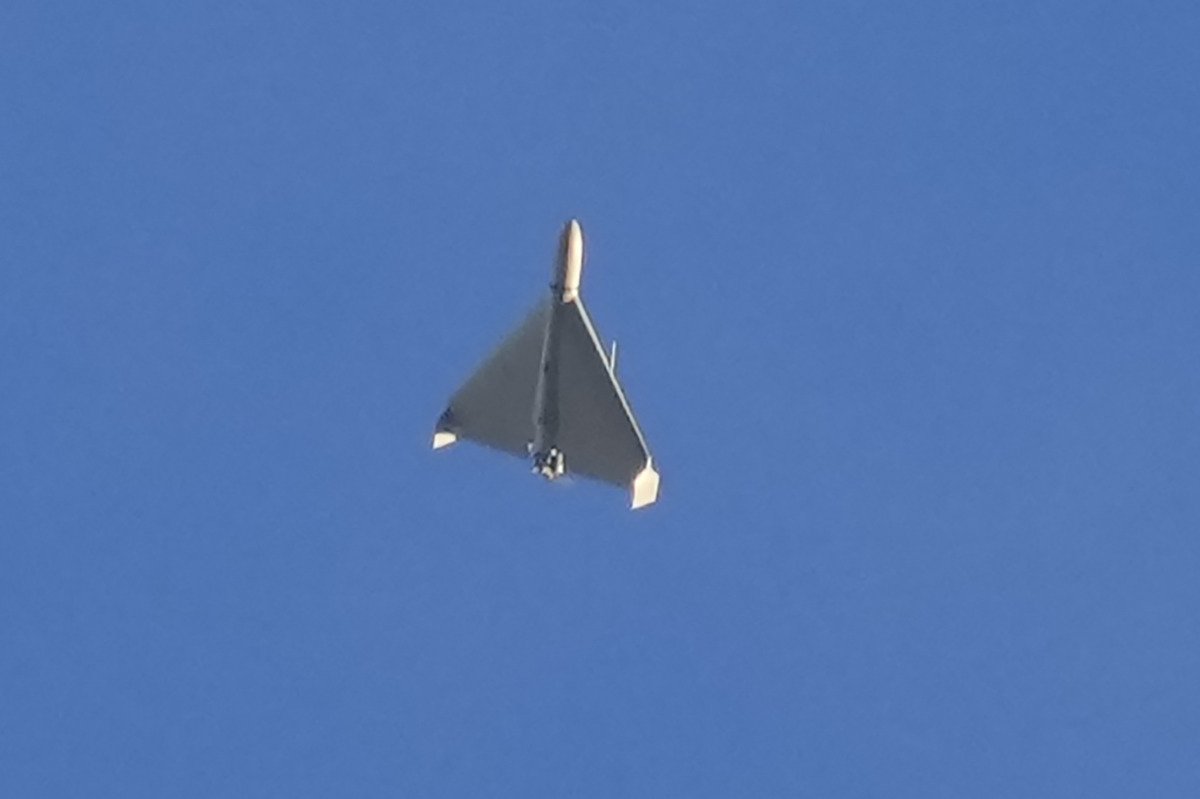
A drone is seen in the sky seconds before it attacked buildings in Kyiv, Ukraine, on Oct. 17, 2022. Russia has installed Starlink terminals in its Iranian-designed Shahed drones, according to a Ukrainian media report.
AP Photo/Efrem Lukatsky, File
Kyiv has leaned heavily on Starlink’s internet access for battlefield communications and for controlling Ukraine’s vast drone fleets.
Ukraine’s military intelligence agency said in February that Russian forces were using Starlink terminals along the front lines, pointing specifically to Russia’s 83rd Separate Air Assault Brigade that it said was operating in the eastern Ukrainian Donetsk region at the time.
Andriy Yusov, a spokesperson for the Ukrainian GUR military intelligence agency, told Ukrainian media at the time that Russian use of Starlink was becoming “systemic.”
Starlink is owned and operated by entrepreneur Elon Musk‘s aerospace firm, SpaceX, and accounts for a huge percentage of active satellites. Musk has vehemently denied that Starlink is being sold to Russia.
SpaceX said earlier this year that it does not “do business of any kind with the Russian government or its military.”
“Starlink is not active in Russia, meaning service will not work in that country,” the company said in a statement. “SpaceX has never sold or marketed Starlink in Russia, nor has it shipped equipment to locations in Russia. If Russian stores are claiming to sell Starlink for service in that country, they are scamming their customers.”
“If SpaceX obtains knowledge that a Starlink terminal is being used by a sanctioned or unauthorized party, we investigate the claim and take actions to deactivate the terminal if confirmed,” the company added.
A Kremlin spokesperson said in February that Starlink is “not a certified system with us” and therefore “cannot be used officially in any way.”
But back in May, the then-assistant secretary of defense for space policy in the Pentagon, John Plumb, told Bloomberg that the U.S. was “heavily involved in working with the government of Ukraine and SpaceX to counter Russian illicit use of Starlink terminals.”
“At this time we have successfully countered Russian use,” Plumb added at the time. “But I am certain Russia will continue to try and find ways to exploit Starlink and other commercial communications systems.”
Russia’s use of Starlink will continue to be a problem, he said.
Moscow has made extensive use of Iranian-designed Shahed drones and the Russian-made versions, referred to as Geran uncrewed aerial vehicles (UAVs), to strike Ukraine throughout more than two-and-a-half years of full-scale war.
Shaheds are known for their distinctive, low buzzing sound. They are capable of carrying a warhead that shatters or explodes when it reaches the intended target. Once spotted, they can be relatively easy for Ukraine to shoot down—often with large-caliber machine guns or self-propelled anti-aircraft guns—but detecting them is often the biggest challenge.
Russia has previously upgraded the Shahed drones, including using radar-absorbent material and black paint to make the attack UAVs more difficult for Ukrainian forces to spot.