A U.S. military drone’s ability to fly deep into the strategic and contested Arctic region has been successfully demonstrated, the Northrop Grumman Corporation announced Thursday.
The MQ-4C Triton is an unmanned aircraft capable of providing real-time intelligence, surveillance, reconnaissance, and targeting over vast ocean and coastal regions, the company said. It can fly above 50,000 feet and has a flight endurance of over 24 hours.
The test came as General James Hecker, commander of the U.S. Air Forces in Europe and NATO Allied Air Command, revealed on Tuesday that his command was experimenting with drones to conduct surveillance “farther north in the Arctic Circle” to monitor Russia.
The U.S. Air Force already operates the MQ-9 Reaper and the RQ-4 Global Hawk in Europe. The MQ-9 collects intelligence and conducts strikes using bombs and missiles. The RQ-4 is an unarmed spy drone similar to the Triton and can stay in the air for more than 34 hours.
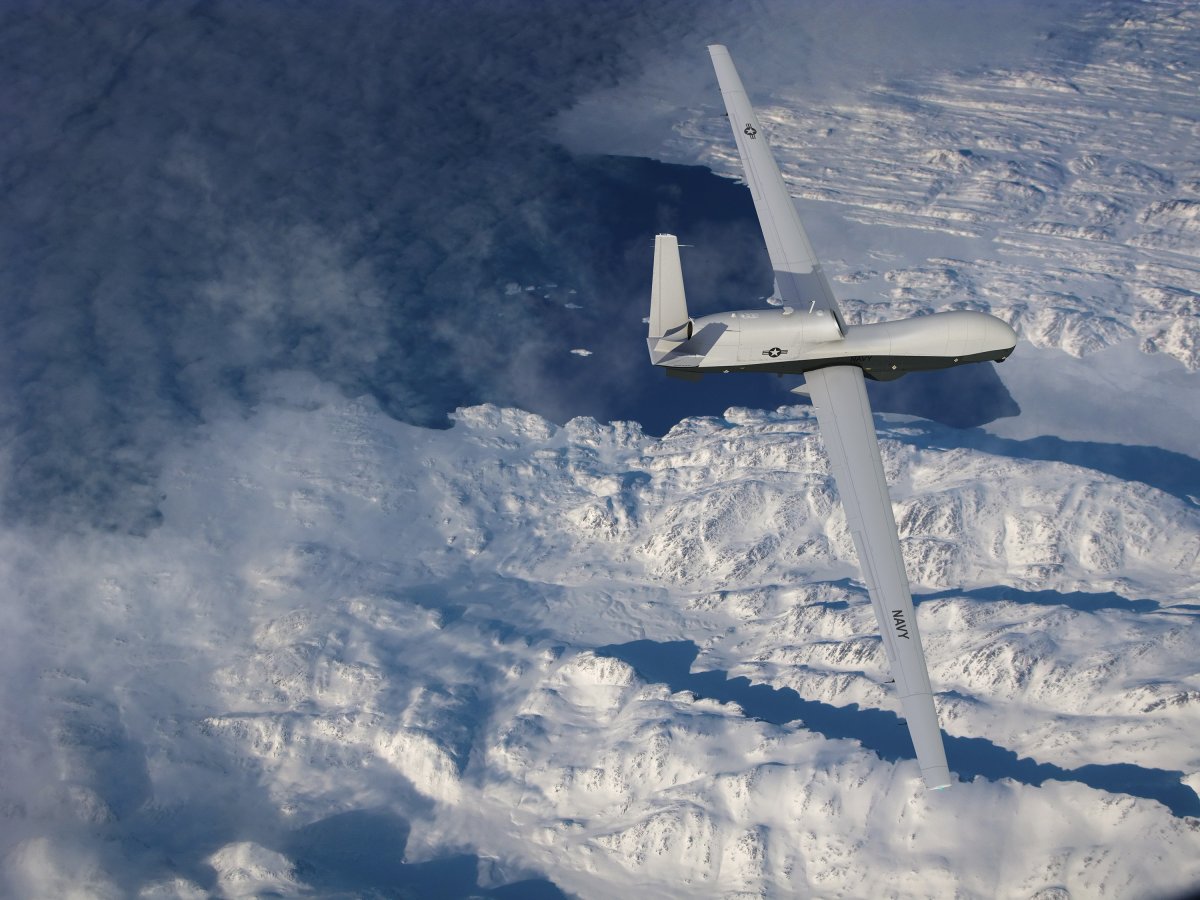
The MQ-4C Triton. It is capable of operating at an altitude of over 50,000 feet, enabling it to fly above harsh weather conditions.
Northrop Grumman
The Kremlin views the resource-rich Arctic region as its backyard, where Russia has been consolidating its military presence. The U.S., Canada, Denmark’s Greenland, Norway, Sweden, and Finland all have territory within the Arctic Circle, and they are all members of NATO.
The U.S.-Russia rivalry in the freezing Arctic region heated up recently. Russian military aircraft, including nuclear-capable bombers, flew over the Arctic seas and approached the coast of Alaska while submarines sailed to the Far East region under the ice of the Arctic.
The U.S. Air Force also sent strategic bombers and reconnaissance aircraft to Alaska as a response. An updated strategy released this summer has urged the U.S. to strengthen its Arctic technological capabilities and build “readiness for operations” at high latitudes.
The Triton proved its ability to operate in the harsh, austere environment over the Arctic Ocean during the test flight, said Northrop Grumman, the drone’s manufacturer, in a news release. It flew over the Arctic Ocean with upgraded operational flight programs.
The test flight began in Deadhorse, a remote community situated on Alaska’s Arctic coast. The Triton flew within 100 miles of the North Pole and collected navigation data during the five-hour flight. It remained within U.S. and Canadian airspace for the duration.
The de-icing and anti-icing capabilities ensured this “multi-intelligence” drone, which is in service with the U.S. Navy and the Royal Australian Air Force, was ready for missions and capable of navigating in extreme Arctic conditions, according to Northrop Grumman.
“Arctic regions are an increasingly important theater of operations with unique threats and environments. We are ready to support those mission sets for domestic and international customers,” said U.S. Navy Captain Josh Guerre, the Triton program manager.