Having been through something similar, former professional tennis player James Blake says “it’s sad, but not surprising” to see Miami Dolphins wide receiver Tyreek Hill being detained and forced to the ground by police.
Hill, 30, was handcuffed and pushed onto the pavement Sunday in Miami near Hard Rock Stadium after he was allegedly “uncooperative” while stopped for speeding, according to a Florida police union. Fan-captured video of the incident has gone viral, showing the wide receiver on the highway surrounded by several officers. He claims he was respectful and compliant with officers.
In 2015, Blake, now 44, was standing outside of a New York hotel minding his own business when NYPD Officer James Frascatore, who did not identify himself as a policeman, tackled him to the ground, mistaking him as a suspect in a credit card fraud scheme. The NYPD took away five vacation days from Frascatore as punishment, even though he was accused of using excessive force four times before the incident with Blake.
Blake’s incident happened nearly a decade ago, but he tells Newsweek that he still thinks about it “way too often,” especially when he sees someone in the news in a similar predicament.
“But there are other times where I’m just playing with my kids, and I think ‘this is one of the most wonderful moments of my life,’ and I think how lucky I am that I wasn’t seriously injured,” Blake said Monday.
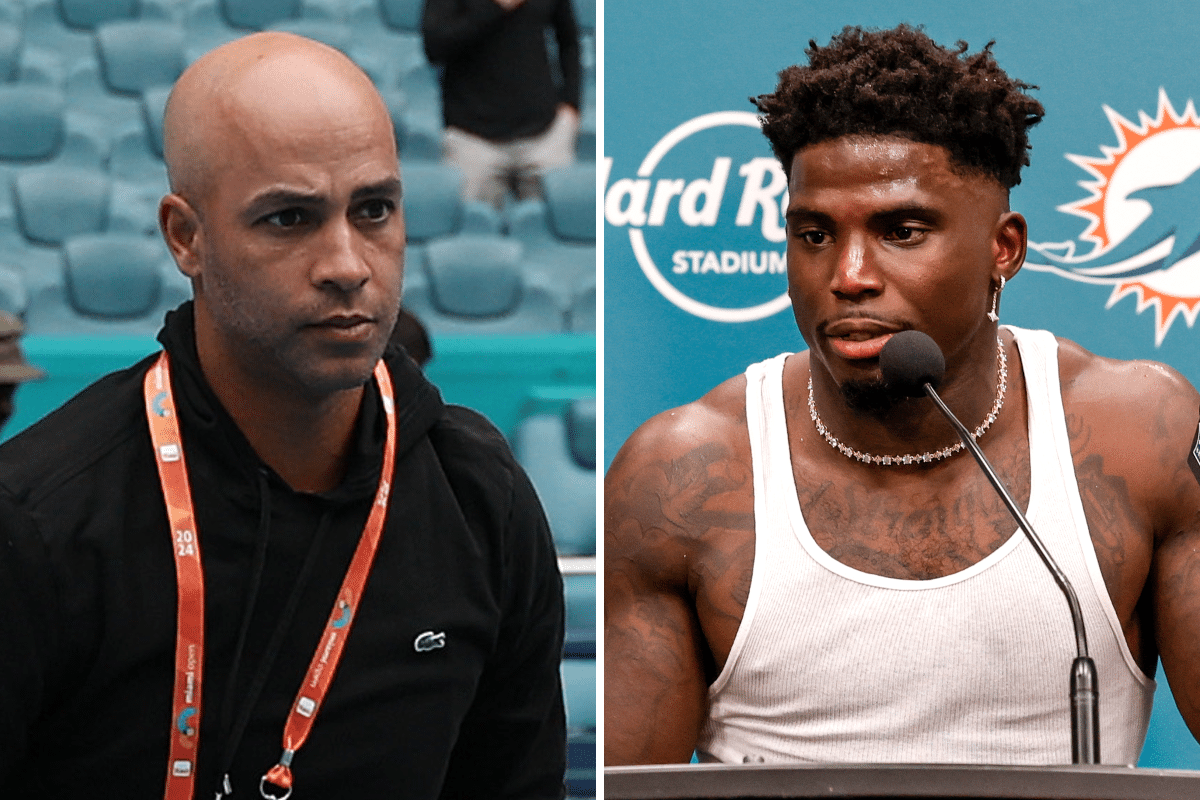
James Blake (left) and Tyreek Hill (right)
Getty Images
Watching the aftermath of Hill’s incident, Blake said, “It makes you wonder what would happen if it wasn’t Tyreek Hill and it was just anyone else. Tyreek Hill the plumber, Tyreek Hill the accountant, not Tyreek Hill the celebrity football player, so that’s what’s the most scary to me.”
“That’s why I needed to speak out when it happened to me because I thought about what would have happened if I didn’t have the video and the ability to hire lawyers, the ability to make use of my time and my platform,” he added.
To this day, Blake does not know why Frascatore didn’t just calmly approach him and ask to see his ID.
“Five minutes before the incident, a reporter recognized me and walked up and basically did an impromptu five-minute interview with me. It’s not like walking up and talking to someone is going to cause problems because I was obviously standing there,” Blake recalled. “I was I was not causing harm to anyone else. I couldn’t have possibly been causing harm to anyone else.”
Blake acknowledged that police officers “do have very difficult jobs” but some could use a refresher course on de-escalation.
“The person that’s being arrested is sometimes being put under the microscope of they should have been more calm,” he explained. ” But speaking from experience, I’m going to be less calm the next time I have an encounter with a police officer because of what happened to me, whereas they’re the ones who are supposed to be trained to be calmer in those situations.”
Blake passionately continued, “You need to have a way of either retraining or just getting into a different profession because you don’t belong in that profession. If that’s your first reaction, and if your motivation is just to kind of wreak havoc and impose your physical authority over someone that’s not the job for you, then that’s not someone I feel comfortable allowing to have lethal force at their disposal.”
Wrapping up his interview with Newsweek, Blake urged the importance of possibly “revisiting” Colin Kaepernick’s NFL career-paralyzing kneeling during the national anthem in protest of police brutality and racial inequality in America.
“I feel like a lot of people took the opinion of, “Well, he’s already so privileged. He’s making millions of dollars, how can he be complaining?” he said of the highly-criticized quarterback.
“And I get that, but I also feel like he’s trying to help the other people, the Colin Kaepernicks that aren’t millionaires, the Tyreek Hills that aren’t millionaires, the ones that this is happening to far too often.”
“Speaking out about something basically costing him his career is something that maybe needs to be revisited when you see something like this happening to Tyreek Hill. Maybe you understand and realize that it’s a real danger. It’s something that people think about every single day,” Blake said.
Use-of-Force Expert Weighs In
Former Boca Raton Police Chief Andrew J. Scott has a doctorate in criminal justice. He has been in law enforcement for over 30 years in South Florida and testifies across the country on police practices and procedures, including the use of force.
Scott spoke with Newsweek on Monday about Hill being detained over the weekend.
“If this was a normal traffic stop and you or me got stopped for reckless driving, I would imagine that I would be asked to get out of the car, put my hands behind my back if I was going to get arrested, and I’d be patted down. I’d be in handcuffs,” Scott said.
“For me, to get from the driver’s seat, onto the ground, I don’t understand how that happens unless the officers felt that they were there was going to be some type of anticipated or potential violence.”
According to ESPN’s Jeff Darlington, Hill got into a verbal altercation with police during the stop. In response, police told him to exit his car and had him lay on the street to handcuff him.
However, Hill claims he “wasn’t disrespectful because my mom didn’t raise me that way,” Hill said. “I didn’t cuss. Didn’t do none of that.”
Scott added, “Let me make it clear here that if Mr. Hill is mouthing off, so to speak, that’s not a crime. It may be impolite but it’s not a crime.”
“I’ll give you an example,” Scott continued. “If Mr. Hill rolls down the window and says, you know, what the hell you stopping me for?’ That’s not a crime. If Mr. Hill rolls down the window and says, ‘What the hell are you stopping me for? I’ll kick your ass,’ that’s a different story.
“Keep in mind, in Florida, reckless driving is an arrestable offense, so, I don’t know if the officers wanted to arrest him immediately for that reckless driving charge,” Scott said. “Or, if they articulate that they were fearful that the individual they stopped was potentially violent, they could contain them with handcuffs.”
Do you have a story Newsweek should be covering? Do you have any questions about this story? Contact LiveNews@newsweek.com