NASA on Monday gave the green light for a mission to Jupiter to study the moon Europa’s underground ocean.
The Europa Clipper mission will launch next month following a critical review of the spacecraft’s ability to handle the intense radiation there.
The spacecraft is designed to investigate whether the ocean believed to exist beneath Europa’s icy surface could support life.
Concerns emerged earlier this year about the reliability of the Europa Clipper’s transistors after similar issues appeared in other spacecraft.
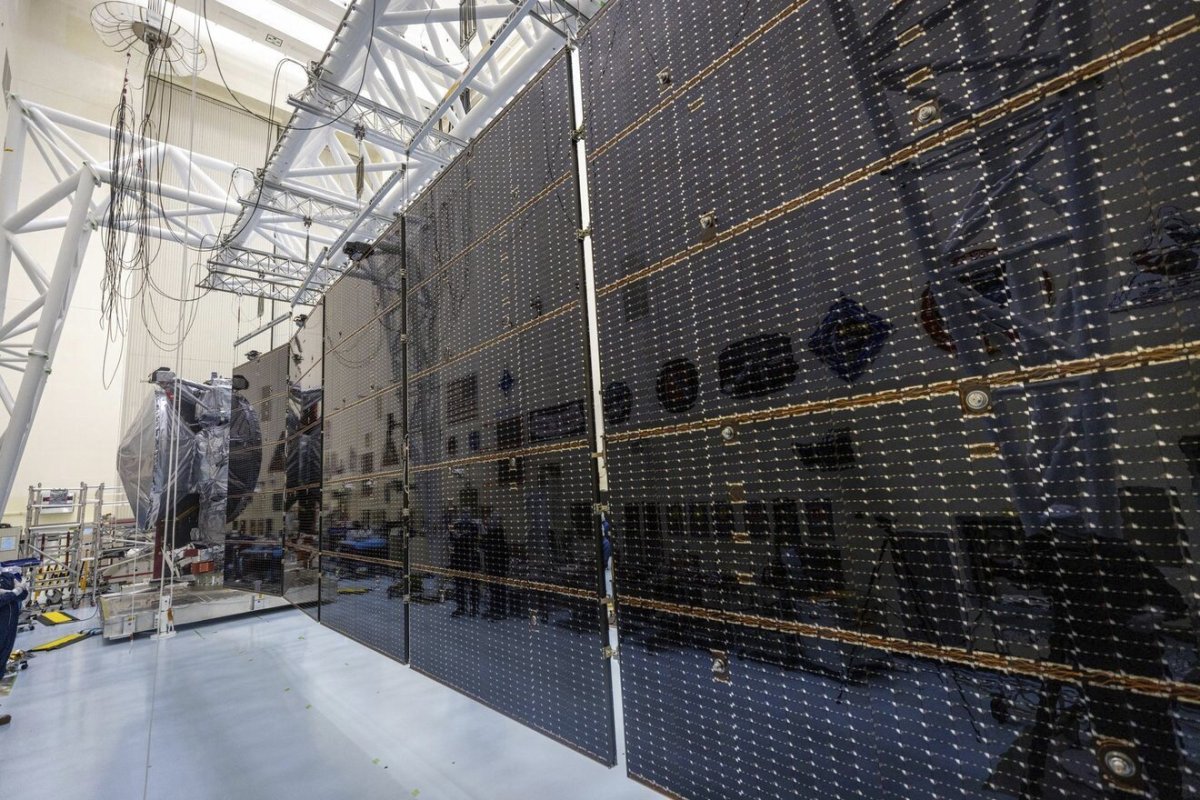
In this image released by NASA, NASA’s Europa Clipper is seen here on Aug. 21, 2024, at the agency’s Kennedy Space Center in Florida. Engineers and technicians deployed and tested the giant solar arrays to be sure they will operate in flight.
Frank Michaux/NASA/AP
NASA scrambled to ensure the $5 billion mission could proceed in time for the launch.
Jordan Evans, project manager at NASA‘s Jet Propulsion Laboratory, explained that the spacecraft’s transistors, located throughout the system, are expected to degrade when exposed to Europa’s radiation during its 49 flybys.
However, Evans said the parts should recover between each encounter, spaced three weeks apart.
After four months of intense testing by teams from labs across the U.S., Evans expressed confidence in the mission. “We are ready for Jupiter,” he said.
Liftoff is set for Oct. 10 aboard a SpaceX Falcon Heavy rocket.
NASA has a three-week window to launch before the alignment required for the spacecraft’s journey is lost for over a year.
The spacecraft will need gravity assists from Mars and Earth on its six-year trek to Jupiter.
Once it reaches Jupiter, Europa Clipper will orbit the gas giant every three weeks, conducting flybys as close as 16 miles from Europa’s surface.
Its instruments, including ice-penetrating radar, will map nearly the entire moon.
Europa Clipper is the largest spacecraft NASA has ever built to explore another planet, and spans over 100 feet with its solar panels extended.
Europa is the sixth-largest moon in the solar system, and is one of the most-promising locations in the search for life outside our planet.
Evidence suggests that a salty ocean of liquid water with a rocky seafloor lies hidden below the moon’s thin water-ice crust.
Last year, data collected by NASA’s James Webb Space Telescope (JWST) revealed that Europa may contain carbon, a key ingredient for life,
The Europa Clipper is one of several key launches this year, which include Viper, a mission to search for water on Earth’s moon.
NASA is also continuing its Artemis program, which aims to return humans to the moon by 2026.
In February, China announced it wanted to rival NASA with 100 space launches in a year.
China’s space program has made considerable strides, including sending probes to distant planets and extending the duration of crewed missions.
These efforts are part of a broader strategy to establish a permanent presence in orbit and, eventually, on the moon.
This article includes reporting from The Associated Press