Parents are being charged transaction fees when paying for their children’s lunch fees, a new report has revealed.
As more schools turn to cashless payment systems, more districts have contracted with processing companies that charge as much as $3.25 or 4% to 5% per transaction, according to a new report from the Consumer Financial Protection Bureau.
Schools must legally offer a fee-free option to pay by cash or check, but the report found there’s rarely transparency around it.
In its review of the 300 largest public school districts in the U.S., the CFPB found that 87% of sampled districts used payment processors, and the average company charged an average of $2.37 or 4.4% of the total transaction.
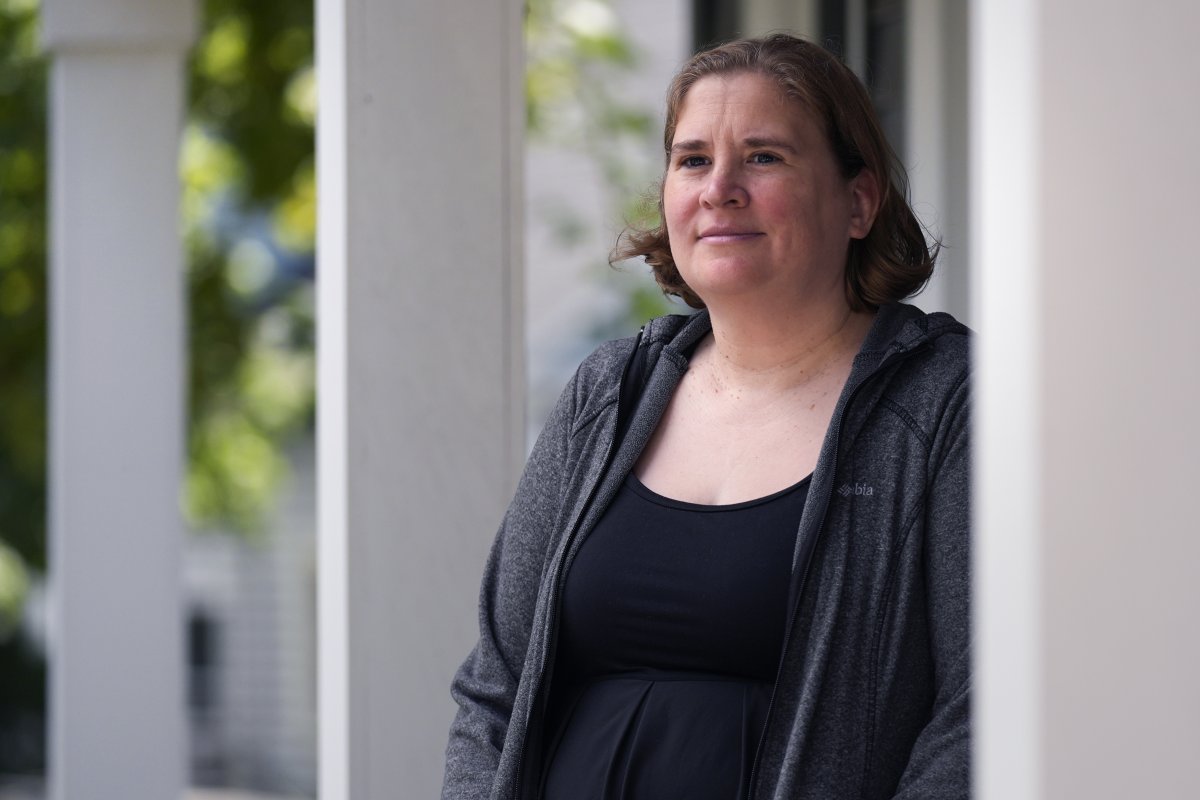
Rebecca Wood stands for a portrait outside her home, Friday, Aug. 30, 2024, in Maynard, Mass. Wood noticed a “program fee” required each time she loaded money onto her daughter’s school lunch account.
Charles Krupa/AP
The fees disproportionately affect families with lower incomes who can’t afford to load large sums in one go, and these may hit weekly or even more frequently.
This means that families that qualify for free or reduced lunch pay end up paying as much as 60 cents per dollar in fees when paying for school lunches electronically, according to the report.
Rebecca Wood, 45, noticed she was being charged a $2.49 “program fee” each time she loaded money onto her daughter’s school lunch account in 2020.
The single mother was already dealing with high medical bills.
“It wouldn’t have been a big deal if I had hundreds of dollars to dump into her account at the beginning of the year,” Wood said.
“I didn’t. I was paying as I went, which meant I was paying a fee every time. The $2.50 transaction fee was the price of a lunch. So I’d pay for six lunches, but only get five.”
“They take money from people who need it the most,” said Wood.
The U.S. Department of Agriculture has mandated that districts inform families of their options since 2017.
But even when parents are aware, having to pay by cash or check to avoid fees can be extra work.
“It’s just massively inconvenient,” said Joanna Roa, 43, who works at Clemson University in South Carolina as a library specialist and has two school-aged children.
Roa said that she switched her son to pack lunches when she saw the $3.25-per-transaction fee for lunch account transactions.
“A dollar here and there, I expected,” she said. “But $3.25 per transaction, especially here in rural South Carolina where the cost of living is a lot lower—as are the salaries—is a lot.”
Roa said packing lunch for two kids every day was an increased burden of time and effort.
Payment companies maintain that school districts have the chance to negotiate fees and rates when they form their contracts.
However the CFPB found that complex company structures “may insulate companies from competition and make school districts less likely to negotiate.”
Just three companies—MySchoolBucks, SchoolCafe, and LINQ Connect—dominate the market, according to the report.
Without the ability to choose which company to work with, “families have fewer ways to avoid harmful practices,” the agency said, “including those that may violate federal consumer protection law.”
Newsweek emailed the companies named in the report for comment on Wednesday.
This article includes reporting from The Associated Press