The U.S. and Russia engaged in a show of force in Northern Europe and Northeastern Asia from Tuesday to Thursday, sending their nuclear-capable bombers to these two regions.
The deployment of American and Russian bombers, which are the air component of their countries’ nuclear triad, came as the Russian military’s strategic exercise Ocean-2024 was underway across the country’s waters and in the Mediterranean Sea, while Russia also joined China in an exercise held in the Far East.
The White House has said there was no reason to change military posture or deterrent posture in response to the Russian and Chinese exercises. Beijing claimed the joint drills are aimed to deepen strategic coordination between the two militaries and enhance their abilities to respond to threats.
Meanwhile, Russian President Vladimir Putin accused the U.S. and its allies of using what he called the Russian threat and the China containment policy as a pretext for building up military presence along Russia’s western borders, as well as in the Arctic and the Asia-Pacific.
This show of force began with an exercise involving stealth combat aircraft from the U.S. Air Force and the Japan Air Self-Defense Force over the Pacific Ocean. An American B-2 “Spirit” bomber and four Japanese F-35A “Lightning II” fighter jets trained over Japan’s east coast on Tuesday.
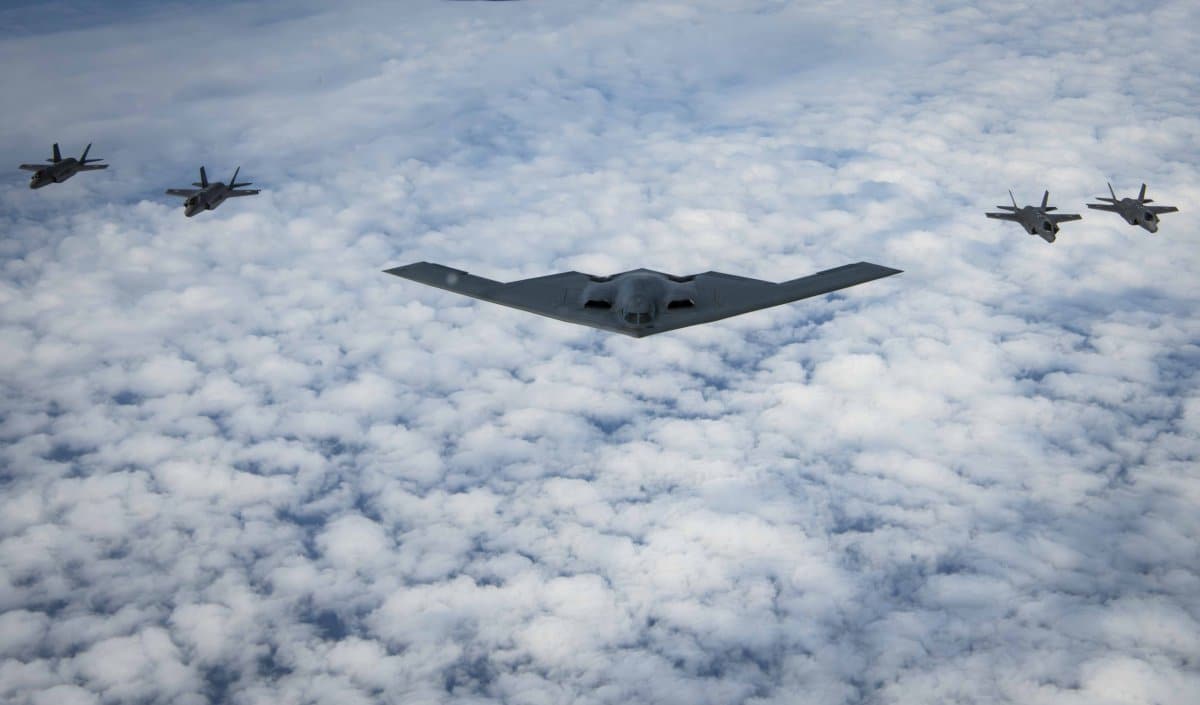
A U.S. Air Force B-2 “Spirit” stealth bomber, middle, and four Japan Air Self-Defense Force F-35A “Lightning II” fighter jets, fly in formation over the Pacific Ocean on September 10.
U.S. Air Force/Senior Airman Samantha White
According to the Bulletin of the Atomic Scientists, there are 20 stealth bombers in service with the U.S. Air Force, but one of them will be retired following a crash in December 2022. The “Spirit” is the Air Force’s only bomber capable of penetrating an adversary’s air defense to deliver its payload.
The dual-capable “Spirit” has a payload of 40,000 pounds for dropping conventional and nuclear munitions. In a nuclear configuration, each aircraft can carry 16 nuclear gravity bombs at maximum.
The bomber, deployed in Australia as part of a task force since August 16, conducted integration and aerial refueling operations with the Japanese fighter jets. The U.S. Air Force said this was the first time a “Spirit” launched from Australia and rendezvoused with Japan’s “Lightning II.”
“This collaboration not only strengthens our defense posture but also underscores our commitment to maintaining peace and stability in the region,” the U.S. Air Force added. The Japanese Air Force said this training aimed to enhance the U.S.-Japan alliance’s deterrence and response capabilities.
Meanwhile, photos published by the U.S. Air Force showed a “Spirit” conducted hot pit refueling at Andersen Air Force Base in Guam, the American military hub in the Western Pacific Ocean, on Tuesday. It was not immediately clear whether this was the same bomber that trained over Japan.
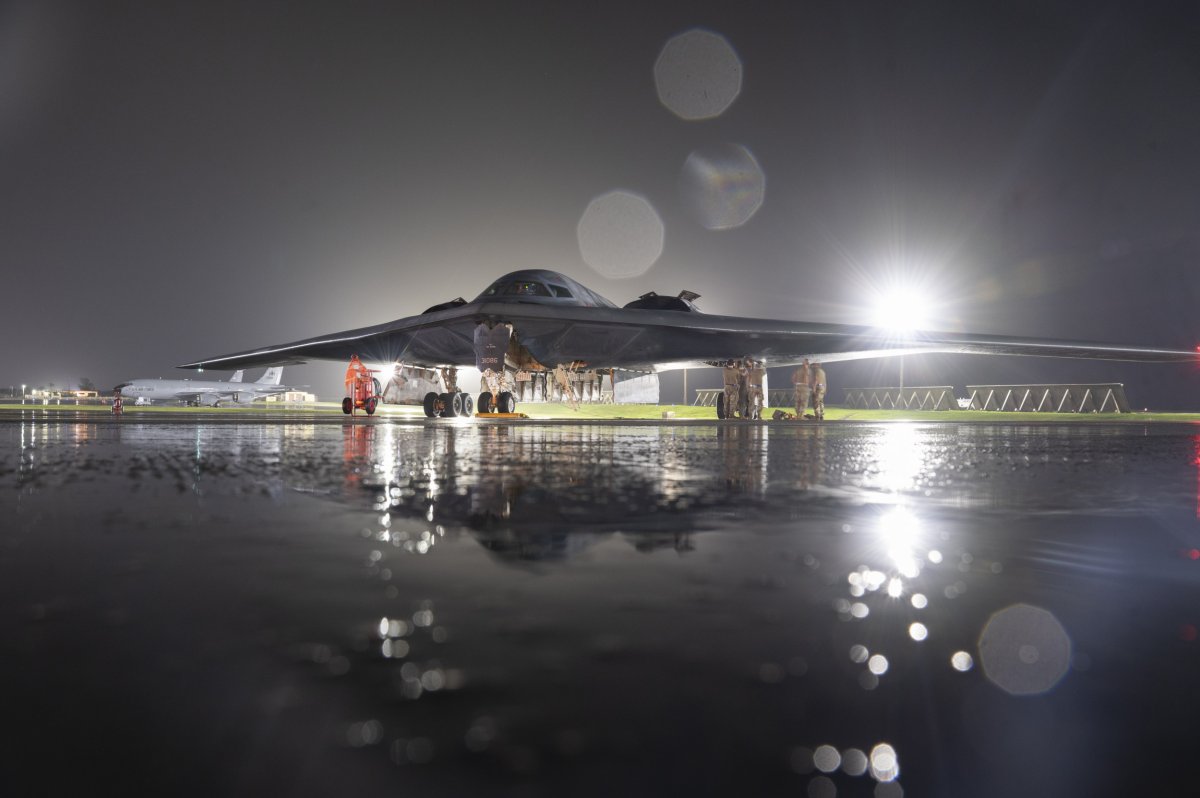
A U.S. Air Force B-2 “Spirit” stealth bomber begins preparations for a hot pit refuel at Andersen Air Force Base in Guam on September 10.
Tech. Sgt. Eric Summers Jr./U.S. Air Force
The refueling involved providing fuel to the bomber after it landed and while its engines were running to minimize time spent on the ground and extend power projection capabilities. The U.S. Air Force claimed that bomber missions deterred aggression by demonstrating the ability to operate globally.
Over the European continent, at least three groups of American and Russian bombers conducted flight operations on Wednesday, according to military disclosures and open-source tracking data.
One of the groups comprised two U.S. Air Force B-52H “Stratofortress” bombers. They transited the Atlantic Ocean and flew over NATO member states Sweden and Poland, before returning to home station at Minot Air Force Base in North Dakota, aircraft tracking service Flightradar24 showed.
B-52 bombers are back over Europe. After arriving over southern Sweden – a new favorite operating area for B-52s – planes went south for operations over central Poland. Now heading back out over Baltic.
Both (60-0044 and 60-0055) are nuclear-capable (but not carrying nukes now). pic.twitter.com/dGfY8IxLtO— Hans Kristensen (@nukestrat) September 11, 2024
These American bombers were nuclear-capable but not carrying nukes during this flight, said Hans Kristensen, director of the Nuclear Information Project at the Federation of American Scientists.
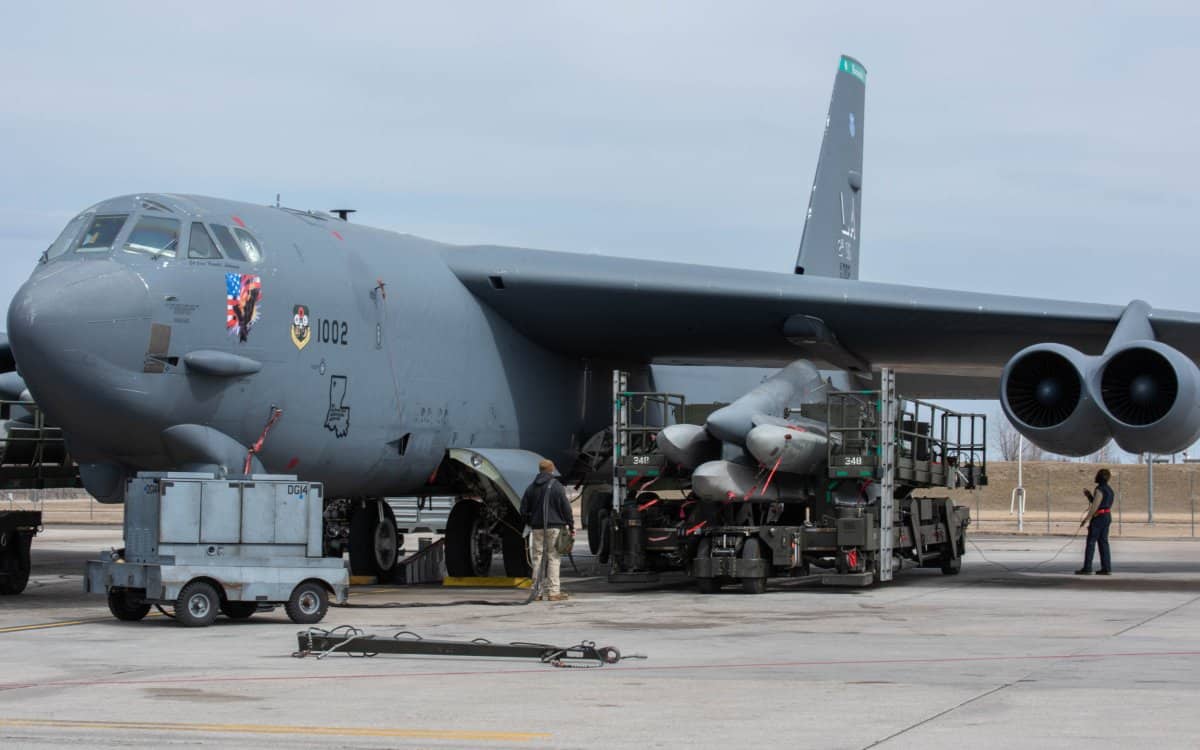
A U.S. Air Force B-52H “Stratofortress” bomber loads with air-launched cruise missiles at Minot Air Force Base in North Dakota on April 7.
Airman 1st Class Kyle Wilson/U.S. Air Force
According to the Pentagon, the Air Force has 60 bombers capable of delivering nuclear weapons. The Bulletin of the Atomic Scientists estimated that 42 of them are the “Stratofortress,” while the rest are the “Spirit.” There are 76 B-52H bombers in total for conventional and nuclear strike missions.
The “Stratofortress” has a payload of 70,000 pounds, and it can carry up to 20 nuclear-tipped air-launched cruise missiles, as well as mixed conventional ordnance of bombs, mines, and missiles.
The Russian military announced that two Tu-160 bombers, also known as “Blackjack” in NATO reporting name, flew over the Barents Sea and the Norwegian Sea during the Ocean-2024. This type of aircraft can carry up to 12 nuclear cruise missiles as well as conventional weapons.
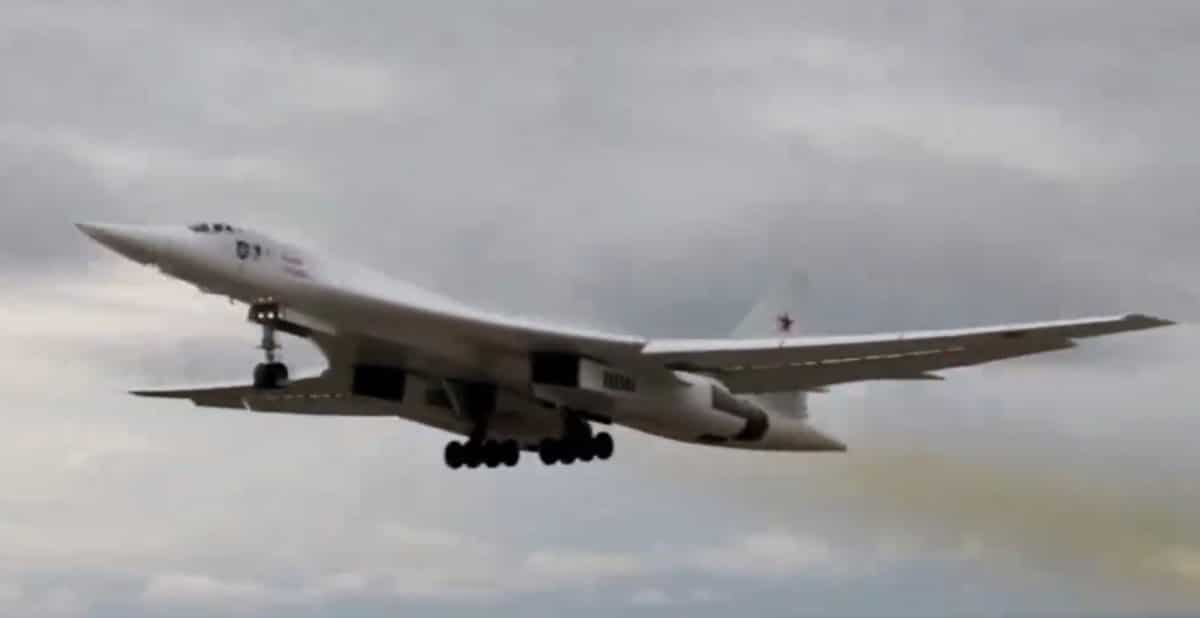
In this screen grab taken from a video released by the Russian Defense Ministry on September 11, a Russian Tu-160 “Blackjack” bomber takes off for flight operations over the Barents Sea and the Norwegian Sea.
Russian Defense Ministry
The bombers trained on firing cruise missiles on “critical objects” of a simulated enemy. The nine-hour flight, escorted by Su-35S and Su-30SM fighter jets, was carried out in strict accordance with international rules on the use of airspace, the Russian Defense Ministry said on Wednesday.
The German Air Force also announced on the same day that a group of Russian military aircraft, including two Tu-22M3 “Backfire” bombers, were spotted flying over the Baltic Sea without a flight plan and active transponders for identification. They were intercepted by Germany’s fighter jets.
The “Backfire” is part of the Russian nonstrategic nuclear forces, capable of firing nuclear cruise missiles. It has also seen extensive use in conventional strikes against Ukraine’s critical infrastructure.
On Thursday, the Russian Defense Ministry revealed that another pair of “Backfire” flew over the Sea of Okhotsk and the Pacific Ocean during the Ocean-2024. They trained on defeating a group of a simulated enemy’s ships, and at least one of the bombers carried a missile under its wing.
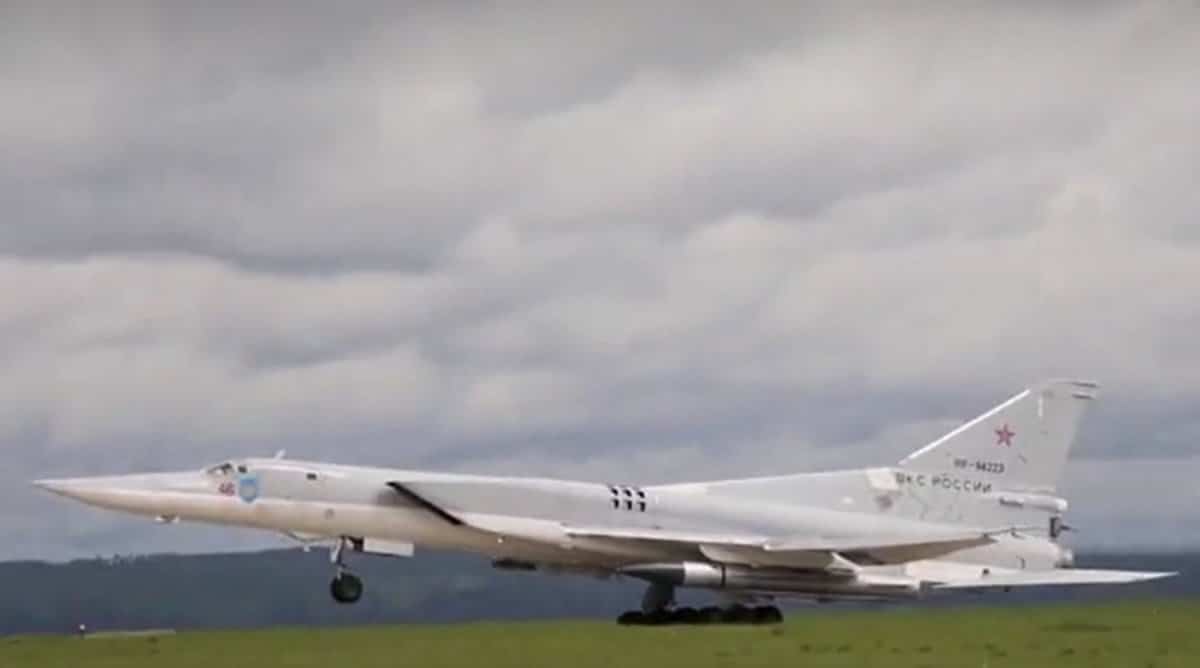
In this screen grab taken from a video released by the Russian Defense Ministry on September 12, a Russian Tu-22M3 “Backfire” bomber takes off for flight operations over the Sea of Okhotsk and the Pacific Ocean.
Russian Defense Ministry