United Launch Alliance fired off a next-generation Vulcan rocket Friday in the second of two “certification” test flights needed before the new launcher can be used to carry high-priority national security payloads for the U.S. Space Force and the National Reconnaissance Office.
ULA
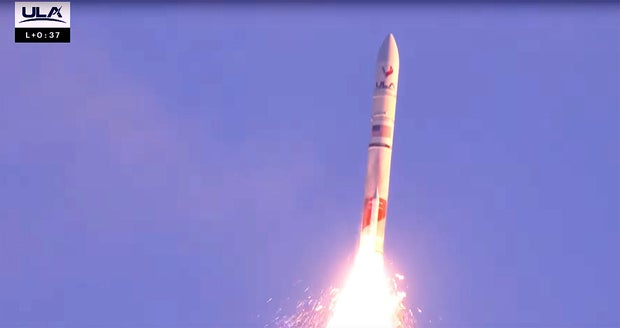
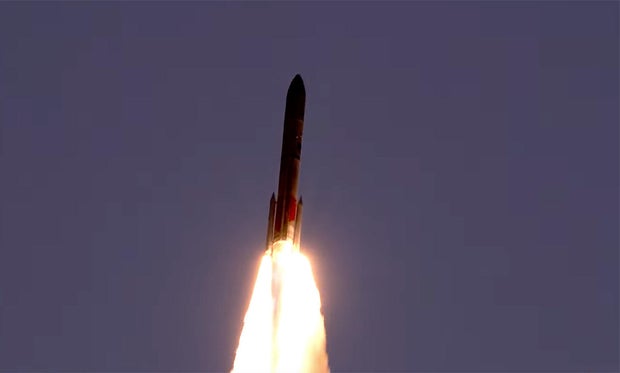
One of two solid-propellant strap-on boosters provided by Northrop Grumman appeared to suffer an anomaly of some sort during the climb out of the lower atmosphere, but the Vulcan was able to continue on into orbit. What impact the issue might have on the Vulcan’s certification is not yet known, but ULA CEO Tory Bruno said it will be investigated.
“The trajectory was nominal throughout,” he said on the company’s launch webcast. “We did, however have an observation on SRB No. 1, so we will be off looking at that after the mission is complete.”
ULA
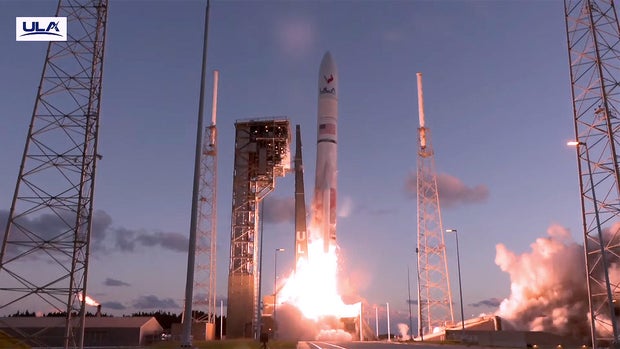
The Vulcan’s two Blue Origin-built BE-4 engines and twin solid rocket boosters, or SRBs, thundered to life at 7:25 a.m. EDT, shattering the morning calm with the crackling roar of 2 million pounds of thrust.
The 202-foot-tall, 1.5-million-pound rocket, decked out in a swirling red-and-white livery, climbed skyward from launch complex 41 at the Cape Canaveral Space Force Station, rapidly accelerating out of the dense lower atmosphere on an easterly trajectory.
The apparent booster anomaly could be seen in long-range tracking camera views when a shower of sparks and what looked like debris fell away from the right-side SRB. The exhaust plume from that booster changed dramatically, but the rocket was able to continue its climb to space.
Spaceflight Now
Both strap-on boosters burned out and were jettisoned as planned one minute and 48 seconds after liftoff. The methane-burning BE-4s, each one generating 550,000 pounds of thrust, continued boosting the rocket out of the lower atmosphere for another three minutes or so before shutting down.
The non-reusable stage then fell away to crash into the Atlantic and the flight continued on the power of the Centaur 5 upper stage’s two Aerojet Rocketdyne RL10C engines.
The upper stage fired its engines a second time after reaching orbit to demonstrate its ability to restart in space, a key requirement for military payloads requiring complex “high energy” trajectories to reach their operational orbits.
The Vulcan’s maiden launch on January 8 went off without a hitch, successfully sending a commercially-built moon lander on its way. For its second flight, ULA initially planned to launch a Sierra Space’s winged cargo ship — Dream Chaser — on its maiden flight, but the spacecraft could not be delivered in time.
Instead, ULA put a dummy payload atop the Vulcan, a so-called “mass simulator,” added a few technology demonstration experiments to help enable long-during flights and installed extra instrumentation to record as much data as possible during the 54-minute demonstration.
The “cert 2” mission “has literally one primary objective, which is to go fly a second time and have another success,” Bruno said before launch. Assuming a review of the flight data confirms good performance, he added, “then you’re ready to fly national security” payloads.
How the solid fuel booster issue might play into that data review and the rocket’s eventual certification is not yet known.
But two such missions are planned later this year, which Bruno described as “urgent.” While he did not mention any possible Space Force or NRO payloads, national security missions typically launch satellites capable of optical and radar imaging, electronic eavesdropping, encrypted communications relay and other top-secret payloads.
Because the Vulcan did not carry an active payload for its second flight, ULA added “more instrumentation that we’re able to use for just characterizing a vehicle,” Bruno said.
“We’re putting all kinds of other instruments (in) just to help us better understand how the rocket works as we go forward. So that’s the mission, a second flight to become certified, and then some technology experiments of our own.”
ULA managers describe the Vulcan as “the future of our company.” It is replacing the Delta 4 family of rockets, which have already been retired, and the venerable Atlas line that dates back to the early days of the U.S. space program.
ULA still has 15 Atlas 5 rockets in its inventory. Eight will be used to launch Amazon Kuiper internet relay satellites, six are reserved to launch Boeing’s Starliner crew ferry ship to the International Space Station and one is earmarked to boost a Viasat communications satellite into orbit.
Once those missions are flown over the next several years, the Vulcan will be the company’s sole launcher.
“The system that we’ve developed is really positioning us for a very bright, prosperous future for many, many years to come,” Mark Peller, ULA’s vice president of Vulcan development, said before the rocket’s maiden flight. “It has proven to already be an extremely competitive product in the marketplace, having an order book of over 70 missions before first flight.”
Unlike the Atlas 5, which uses Russian-built RD-180 engines to power the rocket’s first stage, the all-American powered Vulcan relies on two BE-4 first stage engines built by Blue Origin, the space company owned by Amazon founder Jeff Bezos.
At liftoff, the twin BE-4s generate a combined 1.1 million pounds of thrust. The two strap-on solid-propellant boosters generate another 919,200 pounds of push, providing a total thrust of just over 2 million pounds. The Vulcan can be launched with up to six strap ons depending on mission requirements.
The hydrogen-fueled Centaur 5 upper stage engines generates 23,825 pounds of thrust, enabling launch of heavy military payloads to so-called high-energy orbits that can’t be easily reached by rockets optimized for low-Earth orbit.
Bruno would not reveal the cost of a Vulcan rocket, other than to say it was less than $100 million, making it competitive with SpaceX’s Falcon 9 and Falcon Heavy rockets.
“Next up after the after this mission will be a couple of missions for the Space Force,” Bruno said. “We expect those to be ready to go this year, hence the urgency and not being able to wait any longer for the Dream Chaser.”