Excessive light pollution may increase our risk of Alzheimer’s disease, new research has warned. These associations are particularly pronounced among younger members of the population and emphasize the importance of avoiding light exposure at night.
Alzheimer’s affects roughly 5.8 million Americans, according to the U.S. Centers for Disease Control and Prevention. The progressive disease is the most common form of dementia and is associated with memory loss and cognitive decline in regions of the brain involved in thought, memory, and language.
“There are numerous factors that contribute to the development of Alzheimer’s disease,” Robin Voigt-Zuwala, an associate professor at Illinois’ Rush University Medical Center and lead author on this research, told Newsweek. “It is the constellation of these factors in totality that determine the risk of Alzheimer’s disease.”
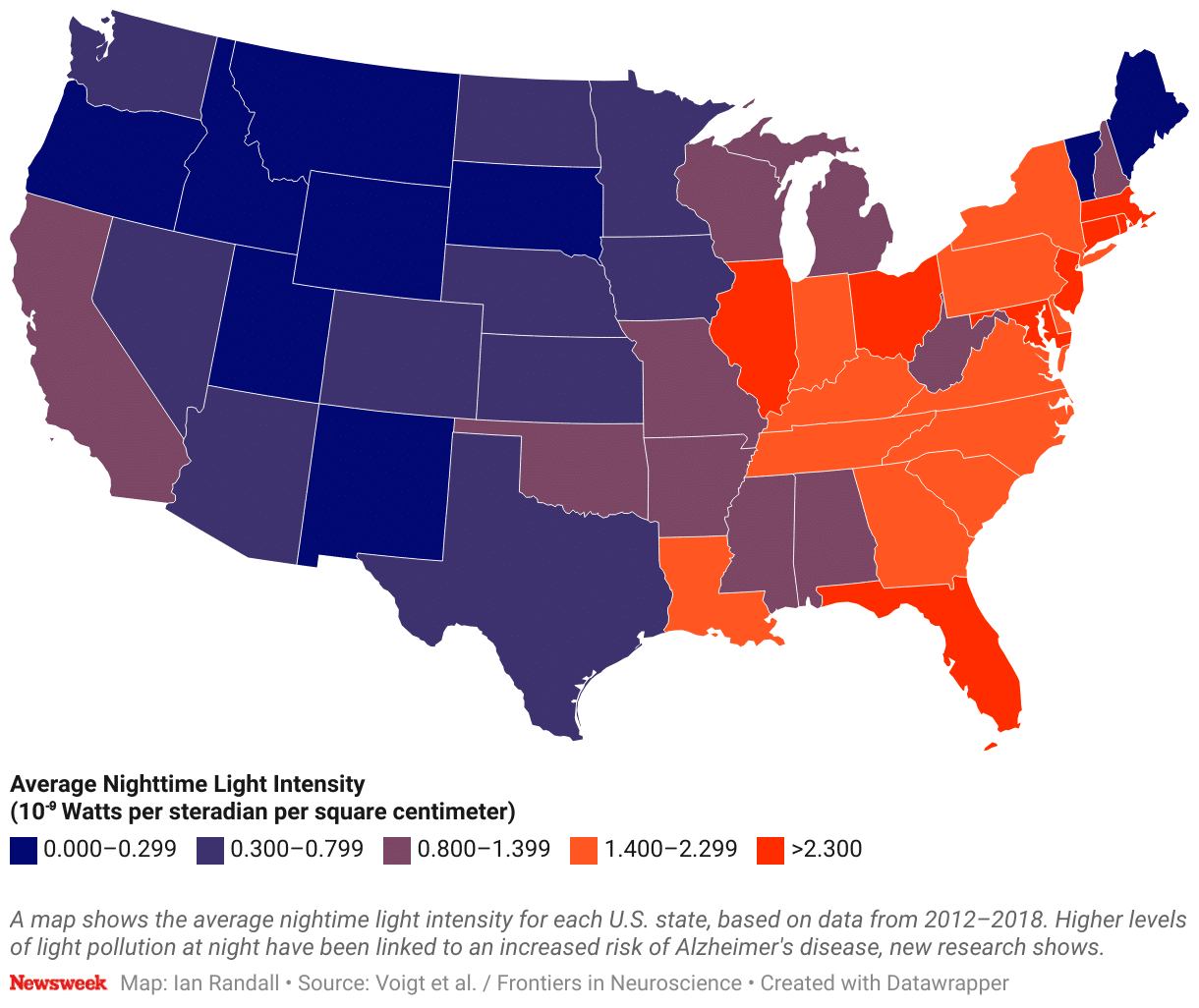
In a new study, published in the journal Frontiers in Neuroscience, Voigt-Zuwala and colleagues studied light pollution levels across 48 U.S. states and its association with Alzheimer’s disease. What they found was that high levels of nightly light pollution were strongly associated with Alzheimer’s prevalence—more so than alcohol abuse, depression and obesity, which have all been shown to increase our risk of developing Alzheimer’s.
The map below shows which states saw the highest levels of light pollution:
“I believe that light pollution impacts health generally, including cognitive health, via disruption of circadian rhythms,” Voigt-Zuwala said. “Our group has shown that disruption of circadian rhythms disrupts the intestinal microbiome and promotes inflammation, which can drive neurodegeneration. However, more research is needed to test this hypothesis.”
Those under 65 appeared to be particularly vulnerable to the effects of light pollution levels, with light pollution intensity showing a stronger association with Alzheimer’s disease than any other risk factors studied.
“Certain genotypes, which influence early-onset Alzheimer’s disease, impact the response to biological stressors which could account for increased vulnerability to the effects of nighttime light exposure,” Voigt-Zuwala said. “Additionally, younger people are more likely to live in urban areas and have lifestyles that may increase exposure to light at night.”
These findings are based on associations and do not confirm that light pollution causes neurodegeneration. However, this research highlights a need for further investigation into these effects.
In the meantime, what can you do to minimize your exposure to nighttime light pollution?
“There are a lot of ways to minimize light exposure at night,” Voigt-Zuwala said. “Inside the home, one could install dimmers (light switch or smart bulbs), use lightbulbs with warm tones (as opposed to LED bulbs which emit harsh blue light), use blue light filters on phones, tablets, and computers, or wear blue light blocking glasses when watching TV.
“To mitigate light from outside the home, remove any unnecessary lights outside the home (or swap the type of lightbulb for a warmer variety), install black-out curtains in the bedroom and/or wear eye shades (this one is especially good if a person shares a bed with someone who watches TV or uses light emitting devices. Generally speaking, limit or avoid exposure to light in whatever ways work for a given individual.”
Voigt-Zuwala said that he also follows this advice: “If reducing exposure to light at night reduces the risk of Alzheimer’s disease then we should all implement strategies to do so! There are a variety of approaches to reduce light exposure at night and the peace of mind in knowing you are protecting your health in future decades is worth the investment!”
Brain damage from light pollution is harming spiders, too
Humans aren’t the only ones who are being impacted by light pollution, either. New research published in the journal Biology Letters has found that exposure to night-time light pollution affects brain development in the Australian garden orb weaving spider.
The most significant effects are seen in the regions of the spiders’ brains involved in visual processing.
It is unclear how these changes in brain structure affect the spiders’ behavior, which may have knock-on effects on their surrounding ecosystem.
Is there a health problem that’s worrying you? Let us know via health@newsweek.com. We can ask experts for advice, and your story could be featured in Newsweek.
References
Voigt, R. M., Ouyang, B., & Keshavarzian, A. (2024). Outdoor Nighttime Light Exposure (Light Pollution) is Associated with Alzheimer’s Disease. Frontiers in Neuroscience. http://dx.doi.org/10.3389/fnins.2024.1378498