As more than 30 million American elementary schoolchildren pack their backpacks to head back to school this fall, one subject just might be the most dreaded of all—mathematics. A distaste for arithmetic, calculations, and numbers in general starts young in America, where it’s socially acceptable to claim to “hate math” or simply “be bad with numbers.” By the time U.S. students hit middle school, our educational system has already failed them. American 15-year-olds score far behind their peers from Canada, Japan, Germany, and Australia in mathematical literacy and are well on their way to full participation in a society that abhors illiteracy but accepts—and even at times seems to celebrate—innumeracy.
I will meet many of these students a few years later in my college classroom, where they will react with dismay at encountering calculus-based modeling in biology class, a subject which, in their prior experience, was virtually a math-free zone. While math is a key tool of modern biology—allowing us to predict how diseases spread or calculate the sustainability of our food supply—it’s usually avoided in introductory classes, where it’s viewed as “too complicated” even as students memorize the anatomy of the cell and endless biochemical reactions. My students’ surprise is the expected outcome of an American educational system that is failing to prepare its citizens to face mathematical challenges with confidence.
Aside from the professional futures of aspiring doctors and scientists, this “math anxiety” (and its consequence, innumeracy) has serious social and political consequences. In personal finance, Americans typically struggle to scale expenditures with income, then accept the nonsensical argument that an avocado toast habit excluded millennials from the housing market. More dangerously, innumerate people may become data-avoidant, assessing risk and quality of arguments based on “gut feelings” rather than numerical facts. But regardless of our emotional stance on an issue, or politicians’ wordsmithing, guns in homes are more likely to kill someone who lives in that home than an intruder. The year 2023 was the hottest on record. COVID-19 vaccines remain safe and effective at reducing severe illness and hospitalization.
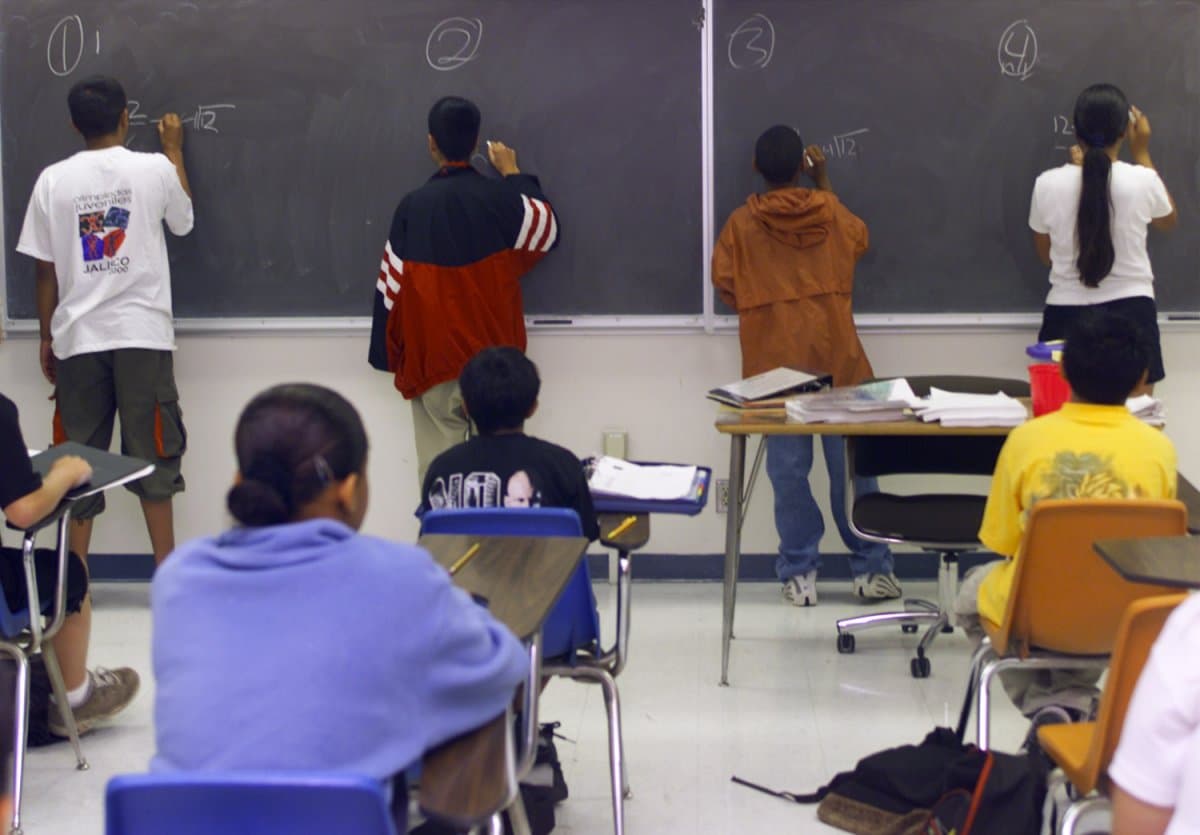
Seventh and eighth graders in the Jose Valdes Summer Math Institute divided into four groups to play math games in their basic arithmetic class.
LIZ HAFALIA/San Francisco Chronicle via AP Images
In contrast, math (and statistics) classes provide us with the logic frameworks we need to assess risk and link the magnitudes of cause and effect, making us better decisionmakers. There’s still a role for experts and pundits, who help us make sense of a world far more complex than any one individual can understand. But as an American voting public, we should strive for better mathematical reasoning skills to supplement these expert analyses.
Educators have shown that it’s possible to build strong math skills from Day 1 by investing more time on mathematical reasoning in our elementary school classrooms. And for those who remember math as boring or recall struggling to learn something wholly disconnected from daily life, there’s a solution—applied math. As recommended by the U.S. National Academy of Sciences and education experts around the U.S., applied math grounds math concepts in real-world examples. It’s the difference between saying, “X is equal to x-zero times 0.715 raised to the t power,” and “With this population growth rate, elephants are at risk of extinction.” You can imagine which resonates most with my biology students.
These examples can start early. When our research team visits second-grade classrooms, we use “helpful” and “harmful” relationships between animals and humans to introduce number lines with positive and negative values. Similarly, elementary school educators have shown time and again that music lessons improve student math scores by introducing students to this note-based arithmetic in a non-threatening environment. The same concepts apply for little girls curious about engineering and little boys helping parents measure ingredients in the kitchen.
Even after we’ve left the classroom, let’s challenge ourselves to stop flinching away from numbers or blindly trusting (or mistrusting) those reciting them. When hearing a number or statistic, let’s adopt a “stop and study” approach, asking what’s being argued, by whom, using what rationale. I also implore my colleagues in science to stop apologizing for equations or describing the math in your work as “hard” or “scary!” Just as there are poets among us, there will be some more gifted at geometry. But everyone can appreciate the resultant art.
Mathematical reasoning gives us a core, common set of facts that we can interpret together. By building math skills—in the classroom and in adulthood—we can be part of an American public that prides itself in mathematical exceptionalism, not mathematical avoidance.
Holly V. Moeller is a Public Voices Fellow of The OpEd Project and an associate professor of ecology, evolution, and marine biology at the University of California Santa Barbara.
The views expressed in this article are the writer’s own.