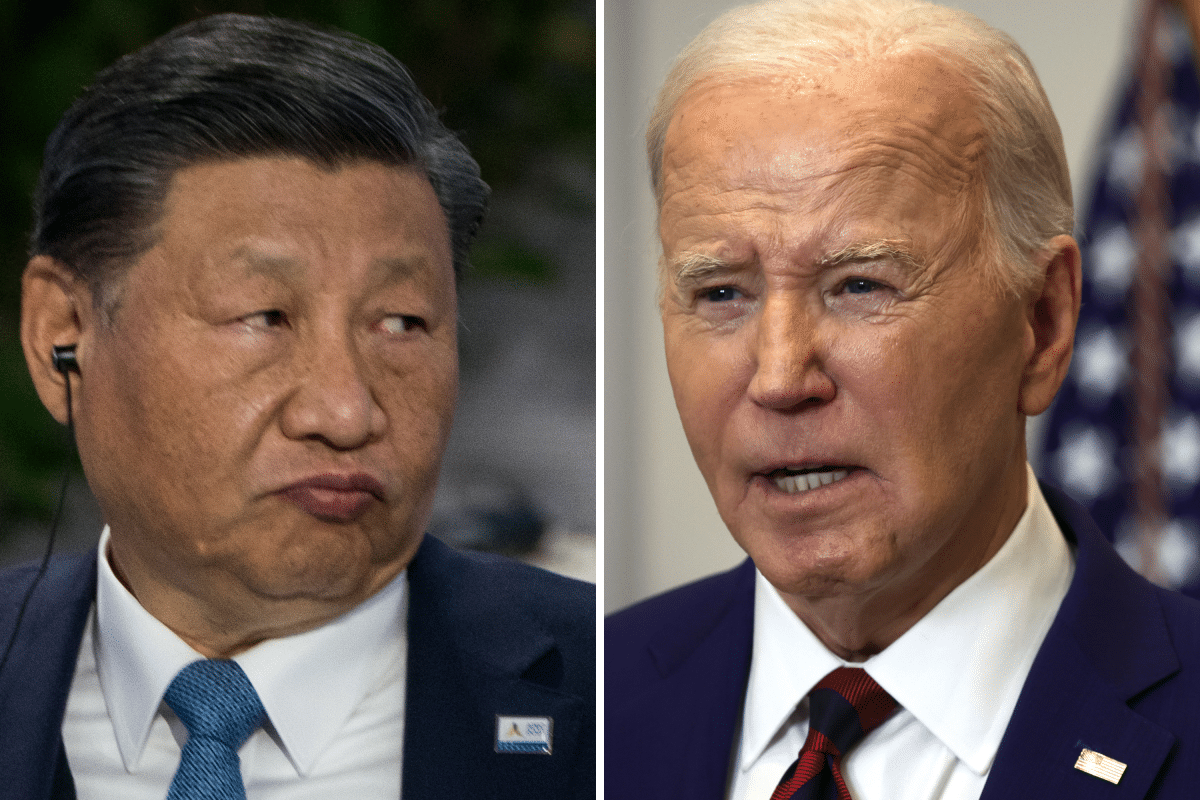
Vice President Kamala Harris is looking to offer economic relief for Americans priced out of their dreams, but her ambitious housebuilding target could leave her open to attacks on her greatest political vulnerability—immigration.
For the first time since the 1990s, housing is a prominent campaign issue. Both Harris and former President Donald Trump have put the nation’s affordable housing crisis at the forefront of their campaigns, offering promises to solve a shortage that has left many voters feeling as though the American dream is out of reach.
Nearly nine out of 10 Americans say that owning a home is essential or important to their vision of the future, but only one-in-10 say it’s easy to achieve, according to a Wall Street Journal/NORC poll from July. Indeed, just 4.09 million homes were sold in the U.S. last year, the fewest since 1995.
It’s clear that America needs more houses. What is less clear is who will build them.
Industry insiders speak of a “broken” system, telling Newsweek that a labor shortage is the biggest obstacle to housebuilding. With a visa cap of 66,000 for skilled workers and an aging domestic population, something has to give if Harris wants to get America building.

Kamala Harris wants to build 3 million homes, but the sector’s prominent labor shortage begs the question: Who will build those houses?
Photo-illustration by Newsweek/Getty
The issue of housing is especially important to young voters, who both candidates are seeking desperately to appeal to. A survey released by Voters of Tomorrow last week found that 39 percent of Gen Z voters support making it easier for first-time homebuyers to purchase a home, making it the second-most popular economic proposal for those aged 18 to 29.
It’s not just first-time home buyers who are worried about the housing market. Americans hoping to upgrade from a starter home to a larger home haven’t been able to because there’s not enough of them at affordable rates. Older Americans who live in more expensive, larger houses can’t free up their homes because the smaller units they want to downsize to aren’t available either.
“The whole chain has really broken,” Jenny Schuetz, a senior fellow at Brookings and the author of “Fixer Upper: How to Repair America’s Broken Housing Systems,’ told Newsweek. “There aren’t enough homes altogether.”
Harris is hoping to appease economic anxieties by targeting the supply side of the crisis, calling for the construction of 3 million new housing units by 2029. Because the federal government doesn’t build houses, Harris would need to pull the limited levers she has on the private sector to deliver on that promise. So far, those ideas have included a tax-incentive for homebuilders who build starter homes sold to first-time homebuyers, a $40 billion federal fund to empower local governments to finance local solutions and an expansion of the Low-Income Housing Tax Credit.
None of those proposals, however, address the biggest obstacle to home construction: the industry’s labor shortage. In any given month, there is a shortage of roughly 400,000 construction workers, the National Association of Home Builders found. To keep up with current demand, home builders would need to add 2.2 million new workers over the next three years.
“A shortage of entitled land and skilled labor is already constraining the industry from building more than the 1.5 million homes per year it is currently building,” John Burns, the CEO of housing group John Burns Research and Consulting, told Newsweek.
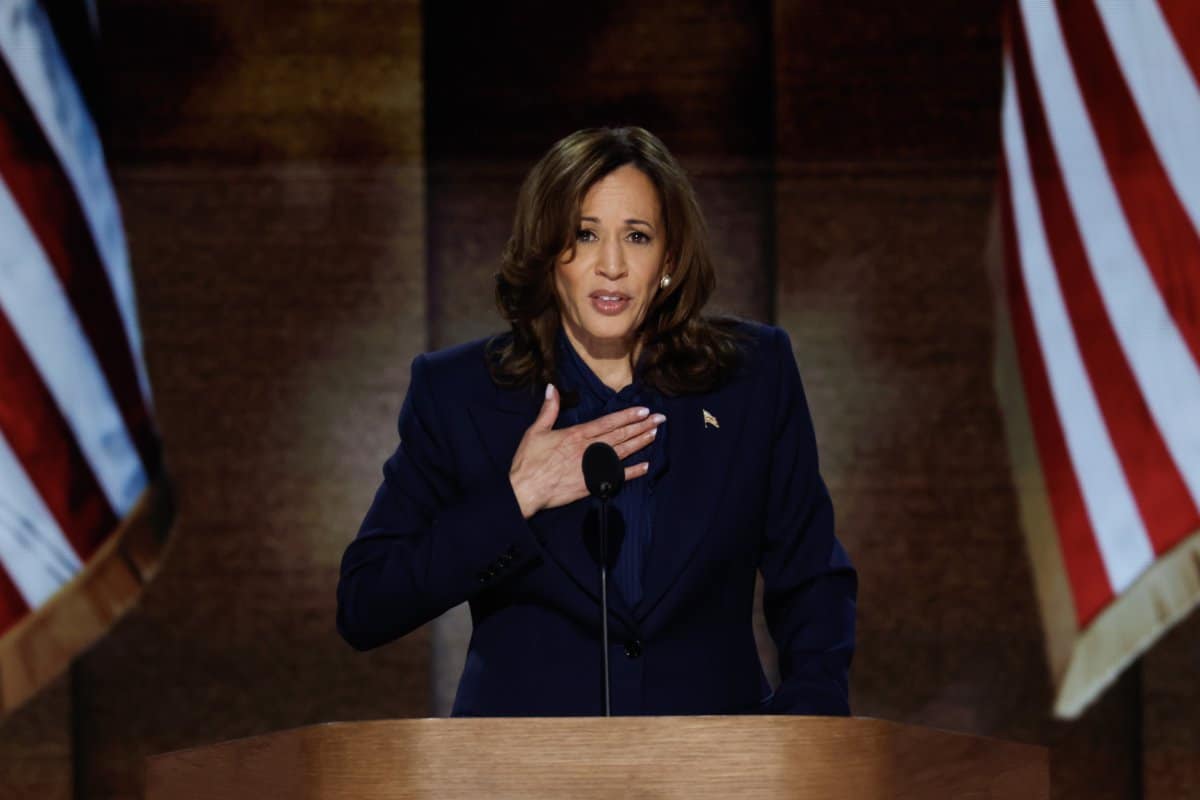
Kamala Harris at the Democratic National Convention on August 22, 2024, in Chicago, Illinois. Harris wants to build 3 million homes before 2029.
Chip Somodevilla/Getty Images
One of the most obvious solutions to that gap, industry experts say, is immigration.
“About a quarter of the jobs in construction are from across our borders,” NAHB President and CEO James Tobin told Newsweek. “We’re just not doing a good job training our domestic workforce or attracting the next generation into the trade. So, until we do a better job of that, we need to fill that gap with immigrant labor.”
The Harris campaign didn’t immediately respond to Newsweek‘s request for comment.
Jack Malde, who works on immigration and workforce policy at the Bipartisan Policy Center, told Newsweek the industry’s severe labor shortages could “hinder ambitious housing plans,” like Harris’. He pointed out that the Associated General Contractors of America (AGC) found that 94 percent of contractors have reported difficulties filling positions.
“With an aging workforce and fewer young people entering skilled trades, immigration reforms are needed,” Malde said.
Brian Turmail, AGC’s vice president of public affairs and workforce, called Harris’ 3 million houses goal “both desirable and achievable,” but cautioned that it’s imperative for those plans to address the lack of workers.
“There is a clear need for additional housing in this country,” Turmail told Newsweek. “However, given the significant workforce shortages that exist in construction, any new investments in housing construction should be coupled with policies to expand the number of people working in high-paying construction careers. This includes boosting funding for construction education and training programs and supporting programs to allow more people to lawfully enter the country and work in construction.”
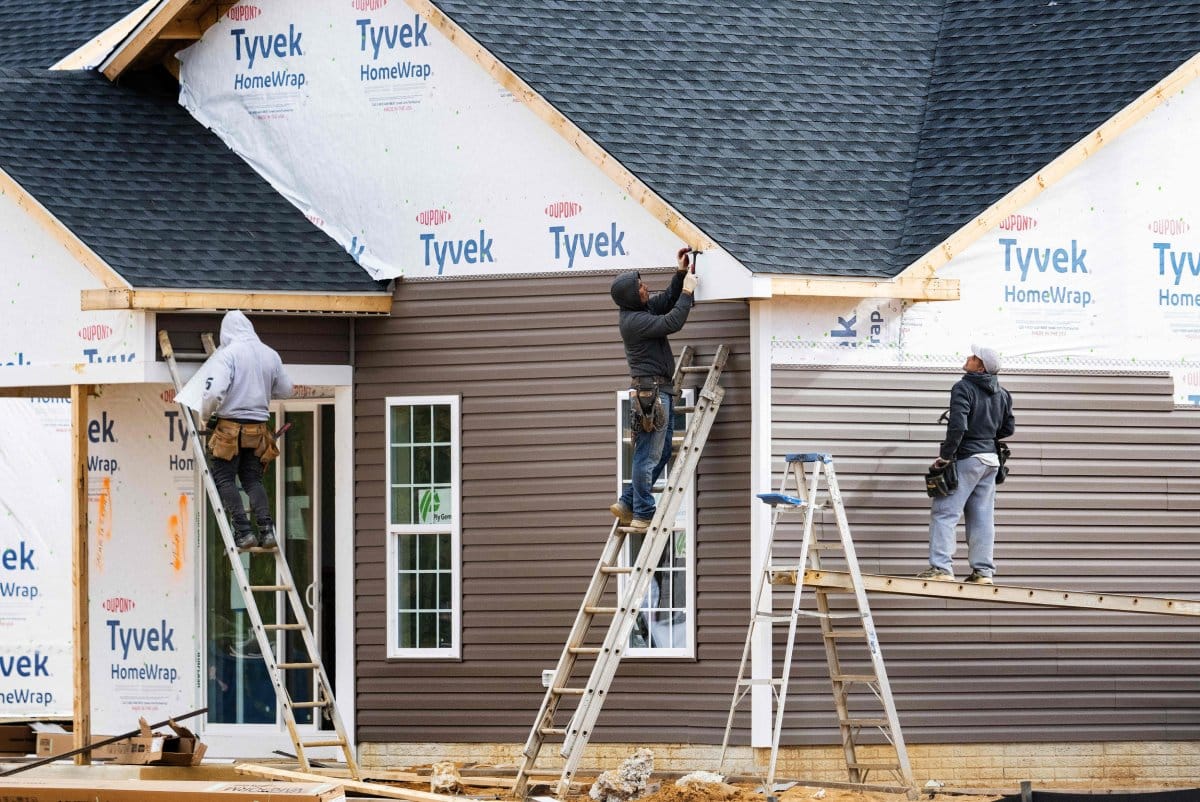
Workers attach siding to a house at a new home construction site in Trappe, Maryland, on October 28, 2022. For the first time since the 1990s, housing is a prominent campaign issue.
Jim Watson/Getty Images
Congress could also raise the current visa cap for skilled, non-agricultural workers from 66,000 as well as speed up work authorizations for asylum seekers, who could fill critical roles within the sector, Malde said.
“Clearing the backlog of 7.6 million people waiting for green cards could generate $3.9 trillion in GDP over 10 years, while increasing the supply of skilled workers in trades crucial to housing construction like plumbing, electrical and carpentry,” he said.
Norm Miller, the University of San Diego’s Ernest W. Hahn chair of real estate finance, told Newsweek that immigration reform and temporary work permits would help the problem “tremendously,” pointing to policies in places like Canada or Singapore that make it easier for employers to recruit the skills they are short.
“The U.S. seems intent on offshoring and the political gridlock and naivete about the net benefits of immigrants to our economy are part of the problem,” Miller said. “Here in California, it is very obvious we could not pick our crops without temp workers and immigrants, some undocumented. I’d be that few roofs in Texas could be built or replaced without these undocumented laborers doing jobs Americans don’t want to do.”
Though immigrant reform would be a simple way to address the labor obstacle in Harris’ path, it would force the vice president to come face-to-face with a major political weakness.
Confronted with a political nightmare two months into his presidency, President Joe Biden tasked Harris to lead the diplomatic efforts to reduce the influx of migrants illegally crossing the U.S.-Mexico border. Republicans quickly nicknamed her the “border czar,” blaming Harris for the spike in border crossings.
As Trump’s campaign spends tens of millions attacking her on her immigration record, Harris has moved to the right on the issue, embracing more hawkish policies. In her speech to the Democratic National Convention last month, Harris vowed to sign the recent bipartisan border security bill that Trump had his congressional allies kill and which included hundreds of millions of dollars for Trump’s border wall.
Trump, on the other hand, is proposing the opposite: mass deportation. The former president’s campaign is promising to lower housing costs by stopping the “unsustainable invasion of illegal aliens which is driving housing costs,” his national press secretary Karoline Leavitt said.
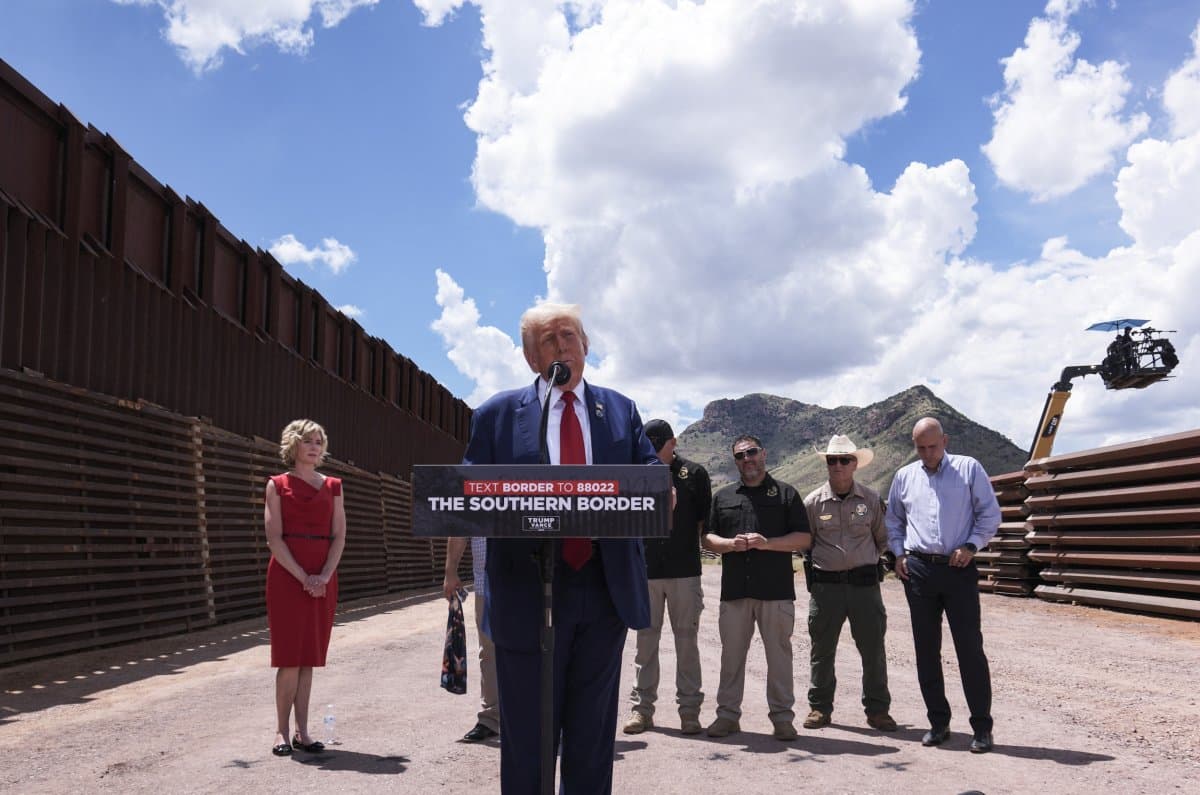
Donald Trump speaks about immigration and border security near Coronado National Memorial in Montezuma Pass, Arizona, on August 22, 2024. Immigration is Harris’ greatest political liability.
Olivier Touron/AFP
It’s unclear whether deporting immigrants would put a dent in the housing crisis, seeing that more than two-thirds of the 6.3 million households with undocumented immigrants also contained American-born or lawful residents, data from Pew Research shows.
“The broad flow of immigration is going to be—politically—the hardest one to [handle],” Schuetz said. “Construction is often one of the first jobs that migrants take because it’s something that doesn’t necessarily require them to speak English, doesn’t require a specialized degree, getting into the trades is available fairly early.”
“Kamala Harris’ proposal would likely continue the open border policies of the Biden-Harris administration and will be hugely controversial,” GOP strategist Matt Klink told Newsweek. “If elected, she would also likely push for immigration reform’ that includes broad amnesty for millions of people here illegally with a pathway for citizenship – a nonstarter for most Republicans and many independents and Democrats.”
Non-union workers and immigrant workers, however, are also often paid badly, treated poorly and lack safety protections. So, if Harris decides to address the immigration reform necessary to achieve her housing plans, it’s likely she’d face pressure to address those concerns.
“As our country moves forward to address the issue, we must make sure that the workers who build new housing have basic rights on the job, safe working conditions and the kind of wages and benefits that allow them to also afford decent housing,” Brent Booker, the general president of the Laborers’ International Union of North America, told Newsweek.
At the end of the day, the immigration question that arises out of Harris’ housing plans could give Republicans a line of attack that detracts from her broader goal of building more affordable homes. And without a Democratic trifecta, it’s unlikely she could deliver on those promises.
“[The GOP] will argue that the only solution to a labor shortage is to create a new set of immigration laws because otherwise her initiative will spawn more migrant border crossings beyond the legal process,” political expert Steve Schier told Newsweek. “Her prospects of this reform becoming law will be very low if at least one Congressional chamber is under Republican control in 2025.”
Klink said Republicans should frame Harris’ housing policy as “an open invitation to more illegal immigration and remind voters of the Biden-Harris immigration failure.”
“This proposal is enigmatic of most of Ms. Harris’ proposals—an audacious goal that sounds great, but with even a minimal amount of scrutiny becomes fraught with flaws, unintended consequences and politically infeasible,” Klink said.
Keep up with the latest U.S. Election news on Newsweek’s Election Live Blog.