In a tightening race for the White House, Vice President Kamala Harris‘ odds of winning the presidency have slightly decreased, according to the latest forecast from renowned pollster Nate Silver.
The updated projections, released Saturday morning, show Harris’ Electoral College chances dipping from 58.1 percent to 57.3 percent over the past 24 hours, while former President Donald Trump‘s prospects improved from 41.7 percent to 42.5 percent.
This shift comes as new polls show Trump gaining ground in crucial swing states. According to the latest New York Times/Siena College polls, conducted from September 21 to 26 and considered the most accurate by FiveThirtyEight, Harris has 48 percent of voter support in Michigan, with Trump slightly behind at 47 percent. In Wisconsin, Harris leads Trump by just 2 points (49 to 47 percent).
Both results fall well within the polls’ margin of error of plus or minus 4 percentage points. The surveys included 688 likely voters in Michigan and 680 in Wisconsin.
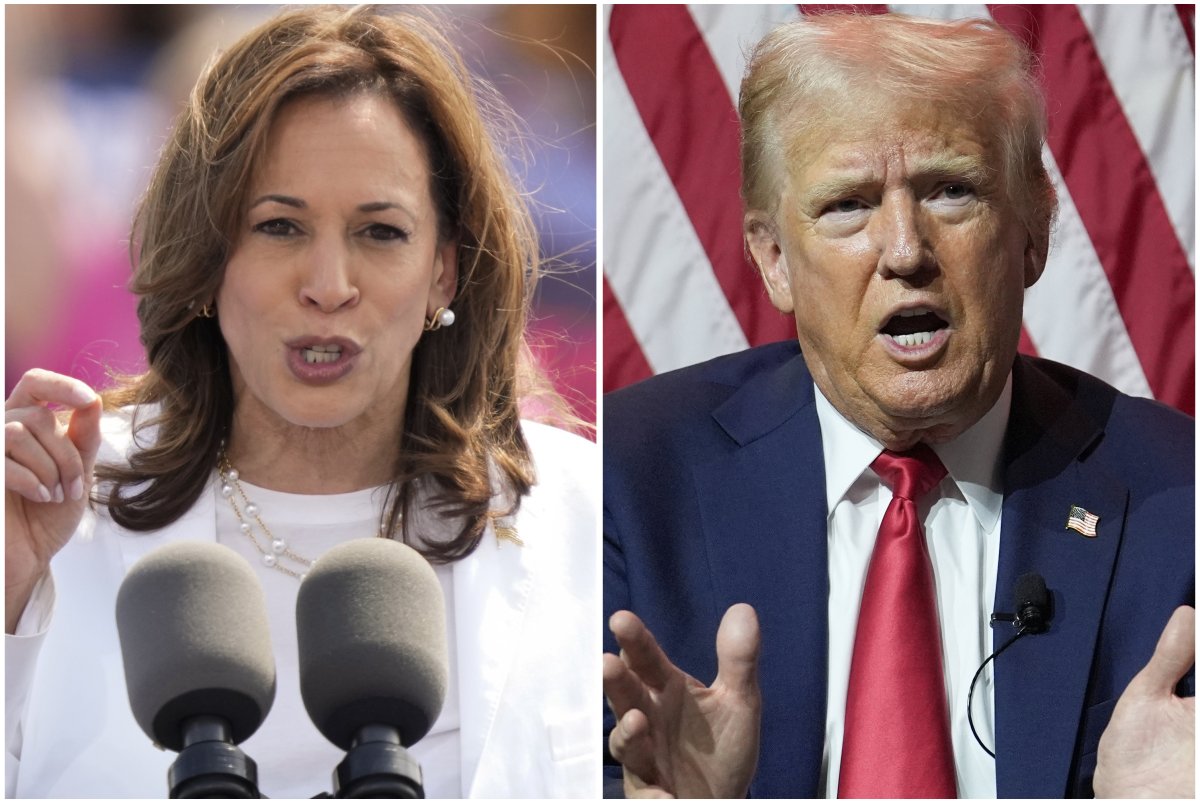
This combination of photos shows Vice President Kamala Harris, left, on Aug. 7, 2024 and Republican presidential candidate former President Donald Trump on July 31, 2024. The updated projections, released Saturday morning, show Harris’ Electoral College chances dipping from 58.1 percent to 57.3 percent over the past 24 hours, while former President Donald Trump’s prospects improved from 41.7 percent to 42.5 percent.
AP Photo/Charles Rex Arbogast
Newsweek contacted Harris and Trump’s campaign via email on Saturday for comment.
Despite this tightening, Silver’s analysis still gives Harris a slight edge over Trump. The FiveThirtyEight polling average shows Harris leading nationally by about 3 points (48.6 to 45.7 percent), with her advantage extending to most swing states, including the crucial battleground of Pennsylvania, where she leads by 1.3 points (48.2 to 46.9 percent).
Silver’s model, known as the Silver Bulletin, provides a comprehensive analysis of the 2024 presidential election landscape. The forecast, which builds upon the methodology of the former FiveThirtyEight election model, integrates polling data, economic indicators, and historical trends to estimate each candidate’s likelihood of victory.
As of Friday, September 27, Silver noted that Harris’ national lead had grown since his previous update. He outlined two potential paths to an Electoral College victory for Harris: winning Pennsylvania, Michigan, and Wisconsin, or securing North Carolina and Georgia, or both.
“The forecast is still in toss-up range, but we’re getting to the point where we’d say we’d rather have Harris’s hand to play,” Silver wrote on Friday.
However, the race remains remarkably close, with Harris’ lead generally within the margin of error in most polls. Silver acknowledges that “stranger things have happened” than an underdog candidate winning, especially given Trump’s history of outperforming polls on Election Day.
Recent trends show Harris gaining minimal momentum nationally and in key states like Pennsylvania, Wisconsin, Michigan, Florida, and Nevada. Meanwhile, Trump has made slight gains in North Carolina, Minnesota, and Texas. According to FiveThirtyEight’s polling averages, Trump leads Harris in Georgia by 0.9 points (48.3 to 47.4 percent), in North Carolina by 0.4 points (47.8 to 47.4 percent), and in Arizona by 1.3 points (48 to 46.7 percent).
Minnesota, traditionally a Democratic stronghold, has shifted from “leans Harris” to a “toss-up” according to Real Clear Politics. This development could be significant for Trump, who hasn’t been able to win the state since his first run in 2016. A Republican victory in Minnesota would be historic, as the state hasn’t voted for a GOP presidential candidate in the last 12 elections.
Larry Jacobs, director of the Center for the Study of Politics and Governance at the Hubert H. Humphrey School and the Department of Political Science at the University of Minnesota, commented on the situation, previously telling Newsweek, “It’s quite possible—in Minnesota and elsewhere—that two-thirds of the 5 percent to 10 percent undecided will break in favor of Trump and tilt the race.”
Current projections from 270toWin give Harris 226 electoral college votes and Trump 219, with several key states still undecided. The outcome in states like Arizona, Nevada, Pennsylvania, Wisconsin, Michigan, Georgia, and North Carolina could ultimately determine the winner.
One bright spot for the Harris campaign emerged in Nebraska’s 2nd Congressional District, which awards one electoral vote separately from the state’s overall results. Recent polling shows Harris as a 91 percent favorite to win the district, potentially providing a crucial buffer in a tight race.
The importance of Pennsylvania in this election cannot be overstated. As a potential tipping point state, it could be the key to either candidate’s path to victory. If Harris secures Pennsylvania along with other likely Democratic states, Trump would need to win a combination of Minnesota, Arizona, North Carolina, and Georgia to clinch the presidency.
Recognizing Pennsylvania’s crucial role, Trump is intensifying his campaign efforts in the state. He is scheduled to hold a campaign rally in Erie on September 29, followed by another in Butler on October 5. These rallies mark Trump’s return to the campaign trail in Pennsylvania following the assassination attempt he survived in July.
Harris and running mate Tim Walz are scheduled make their first joint campaign appearance in central Pennsylvania next week. Details have not yet been released from the campaign, but they expect to make multiple stops to meet voters on Wednesday.
Silver’s model takes into account various factors beyond traditional polling, including economic indicators and historical voting patterns. The forecast also considers potential “nightmare scenarios,” such as a repeat of the contentious 2000 Florida recount, which Silver suggests is more likely than many might assume.
As November approaches, both campaigns are likely to intensify their efforts in these battleground states. With less than six weeks until the presidential election, the candidates’ ability to sway voters is getting down to the wire.