A Philippine coast guard cutter has departed waters near a contested South China Sea feature following a months-long standoff with China, with Chinese state media boasting the country had “thwarted” its neighbors’ aims at a contested feature.
The BRP Teresa Magbanua (Philippine Coast Guard ship 9701), one of the largest vessels in the U.S. ally’s coast guard fleet, was forced to leave the Spratly Islands’ Sabina Shoal after Chinese forces blocked attempts to replenish the ship, in what Manila characterized as a humanitarian disaster.
The uninhabited low-tide feature sits within the Philippines’ internationally recognized exclusive economic zone and just 75 miles from Palawan. According to the United Nations Convention on the Law of the Sea, which is ratified by both countries, an exclusive economic zone is a 200-nautical-mile (230-mile) area extending from the coastline, within which a state has sole rights to natural resources.
The Teresa Magbanua initially deployed to the feature in April after large amounts of crushed coral were discovered there, sparking concerns that China aimed to build an artificial island similar to several it constructed and militarized in the late 2010s. Ship-tracking data cited by U.S. Naval Institute News showed the ship withdrew from the atoll on Friday before sailing east into the Sulu Sea, on the other side of Palawan.
Recent weeks have seen China deploy its coast guard and paramilitary “Maritime Militia” ships to uphold its blockade. Footage released by both countries has shown Chinese ships ramming not only vessels attempting supply missions but also the 318-foot Teresa Magbanua itself.
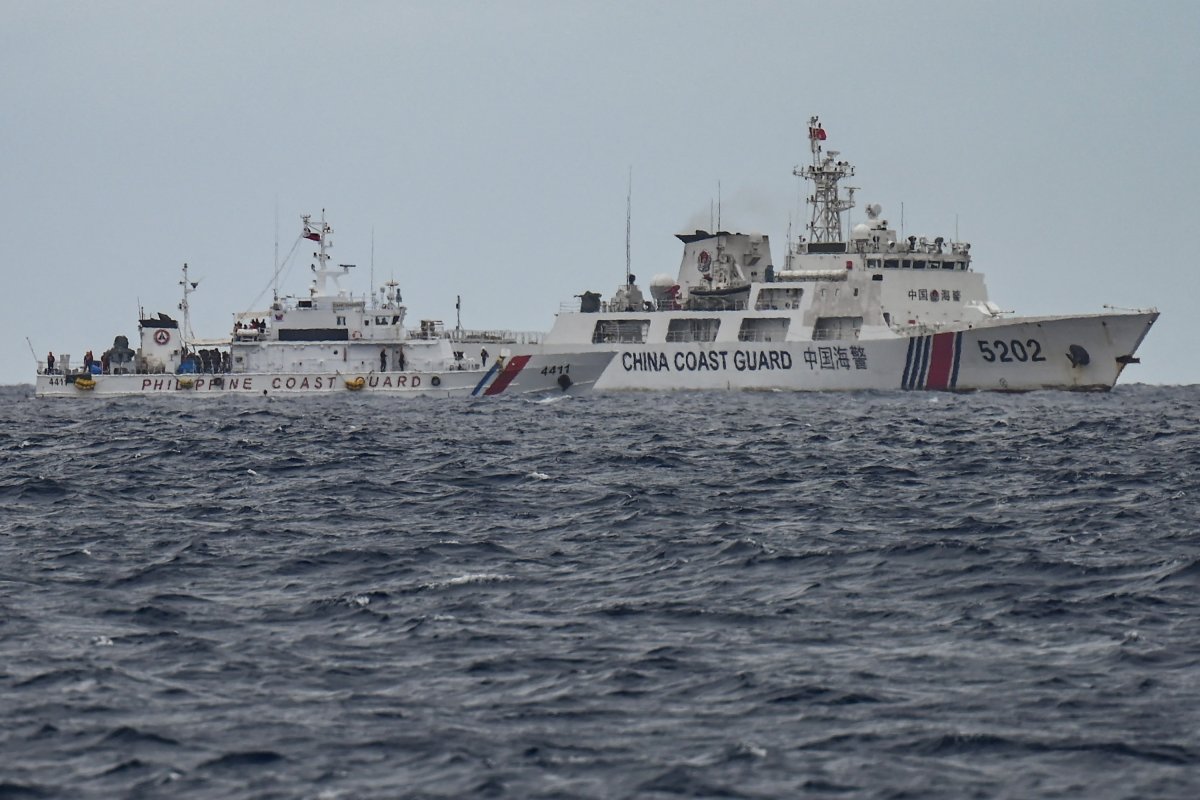
A China Coast Guard ship (R) is seen past the Philippine Coast Guard ship BRP Cape Engaño (L), as photographed from the BRP Cabra during a supply mission to Sabina Shoal in disputed waters of the South China Sea on August 26, 2024. (Photo by Jam Sta Rosa / AFP) (Photo by JAM STA ROSA/AFP via Getty Images)
Jam Sta Rosa/AFP via Getty Images
“While committed to her mission at Escoda Shoal, BRP Teresa Magbanua was compelled to return to port due to unfavorable weather conditions, depleted supplies of daily necessities, and the need to evacuate personnel requiring medical care,” Philippine Coast Guard spokesperson Jay Tarriela wrote on X (formerly Twitter) Sunday, using the Philippine term for Sabina Shoal.
In the comments of the post, it was pointed out that the Philippines had also cited “bad weather” when it withdrew from Scarborough Shoal, where China seized effective control in 2012.
At a press conference Monday, Tarriela detailed some of the hardships the crew reportedly endured, including running out of drinking water. “In cases when there is no rain, they even have to gather water from the air-conditioning units and then boil it,” local media quoted him as saying.
Tarriela shared photos taken by local media showing coast guard members being taken off the ship in stretchers by medical personnel, reportedly suffering from dehydration after the extended period of critical supply shortage.
“We have not lost anything. We did not abandon anything. Escoda Shoal is still part of our exclusive economic zone,” Tarriela said.
China’s nationalistic tabloid the Global Times cited experts hailing the country’s “successful response thwarted the Philippines’ goals.”
“If the Philippines tries to package 9701’s withdrawal as a ‘victory’ after completing its ‘mission,’ it would be absurd,” the state-controlled outlet quoted Xue Chen, a research fellow at the Shanghai Institutes for International Studies, as saying.
The Global Times said the ship’s withdrawal came just three days after the two countries held their latest round of bilateral talks on South China Sea disputes. The meeting focused on Sabina Shoal, and representatives from both sides agreed to keep lines of communication open through the mechanism, China’s Foreign Ministry said.
The outlet added that according to its sources, the Philippines did not notify China in advance of the withdrawal.
Xue warned that the Philippines could try the same tactic of long-term deployment at other South China Sea features. He also predicted the Philippines would adopt the approach of “playing victim” and accusing China of blocking humanitarian aid, reiterating China’s claim over the area.

Recent trends mark the closest example of major sustained Chinese Coast Guard activity near Palawan and have opened what analysts consider to be a new front in the long-running territorial dispute, in addition to Scarborough Shoal and another flashpoint at the Spratlys’ Second Thomas Shoal, just 40 miles to the west.
For its part, Beijing has repeatedly accused the Southeast Asian country of attempting a long-term “illegal” occupation of Sabina Shoal, echoing China’s claims over Second Thomas Shoal, where the Philippines stations a handful of marines aboard a warship grounded there in 1999 to stake the country’s claim.
An international tribunal in 2016 dismissed China’s sweeping claims in the South China Sea, where it is at odds with claims by the Philippines, Vietnam, Indonesia, Malaysia, Brunei, and Taiwan.
The Philippines shares a seven-decade-old Mutual Defense Treaty with the U.S., which President Joe Biden and other administration officials have repeatedly called Washington’s “ironclad” commitment to its oldest Asian ally.
Newsweek contacted the Philippine coast guard and Chinese foreign ministry with written requests for comment.