An Iraqi militia that has played a leading role in attacks against U.S. troops in an effort to expel them from the nation has told Newsweek that the group was skeptical of recent reports suggesting President Joe Biden‘s administration had reached a deal with Baghdad to withdraw forces.
Reuters first reported on the purported arrangement two weeks ago. The outlet cited unnamed sources saying that the drawdown would involve hundreds of the roughly 2,500 U.S. troops stationed in Iraq leaving the country by next September and the last remaining forces exiting by the end of 2026.
While the deal was said to still require a final green light, similar reporting appeared in The Washington Post and was later hinted at openly by Iraqi Prime Minister Mohammed Shia al-Sudani.
Speaking to Bloomberg on Sunday, the Iraqi premier confirmed that a bilateral military committee formed by the two sides last year to discuss a U.S. exit had “reached an understanding to arrange for that withdrawal,” and that a formal announcement would come during an upcoming international conference against the Islamic State militant group (ISIS).

U.S. soldiers perform a live fire exercise with Iraqi counterparts on July 31, 2024, in western Iraq. An Iraqi militia is skeptical of reports that the U.S. has reached a deal with Baghdad to withdraw forces from the country.
Staff Sergeant Bruce Daddis/Combined Joint Task Force – Operation Inherent Resolve/U.S. Army
While Sudani asserted that “the justifications ended” for the U.S.-led coalition presence given the degradation of ISIS over the past decade, militias opposed to both ISIS and U.S. military presence continue to cast doubt that Washington was truly ready to leave.
“First, the Iraqi government, through all its political and military bodies that are related to the dialogues with the American side, did not give a clear and explicit position on the outcome of its agreements and dialogues with the American side,” Nujaba Movement spokesperson Hussein al-Musawi told Newsweek, “and everything was vague about those bilateral meetings and their results are not known to the Iraqis, on the one hand.”
“On the other hand, regarding the movement’s position,” Musawi said, “we still say that we are not convinced by the American promises and that America will not fulfill its promises and will continue to evade in order to remain in the region for the longest possible period by stirring up sedition and destabilizing the political and economic stability in Iraq and the region in general.”
Newsweek has reached out to the Iraqi government and the U.S. State Department for comment.
The Nujaba Movement, also known as Harakat Hezbollah al-Nujaba, emerged in 2013 as part of a mass mobilization of largely Shiite Muslim militias deployed with aid from Iran to battle ISIS as it swept through Iraq and Syria. As the jihadis’ self-proclaimed caliphate fell to an array of local, regional and international powers, a number of Iraqi militias demanded U.S. forces withdraw from the nation.
These demands swelled after violence between U.S. soldiers and Iraqi militias came to a head with the U.S. killing of Iran’s Islamic Revolutionary Guard Corps Quds Force chief Major General Qassem Soleimani and Iraqi Popular Mobilization Forces deputy commander Abu Mahdi al-Muhandis in January 2020.
Today, the war in Gaza has emerged as yet another catalyst for unrest in Iraq. Since the conflict erupted last October, the Nujaba Movement and other top Iraqi militias such as Kataib Hezbollah have waged attacks on both Israel and U.S. troops in Iraq and Syria under the collective banner of the Islamic Resistance in Iraq.
The Iraqi militia campaign against U.S. forces has slowed significantly since the Biden administration ordered a comprehensive series of airstrikes in response to the deaths of three U.S. soldiers at the border between Jordan and Syria in January. But militia leaders have repeatedly warned the offensive would resume in full force if ongoing U.S.-Iraq talks did not produce a timely deal for the withdrawal of U.S. forces.
These warnings, including those from the Nujaba Movement, intensified in July after the U.S. conducted a preemptive airstrike against Iraq’s Babil province, followed by a rocket attack that wounded seven U.S. personnel at the Ain al-Asad Airbase in the province of Anbar.
In the midst of the instability, the Iraqi government has been under considerable pressure to prevent a wider escalation and Prime Minister Sudani has previously voiced his desire for both sides to produce a timeline for the U.S. exit sooner than later.
U.S. officials, however, have yet to confirm any updates on the talks. Speaking to reporters on Monday, State Department spokesperson Matthew Miller declined to provide any new developments and referenced the Biden administration having “held a number of discussions with the government of Iraq this year on the future of our forces there.”
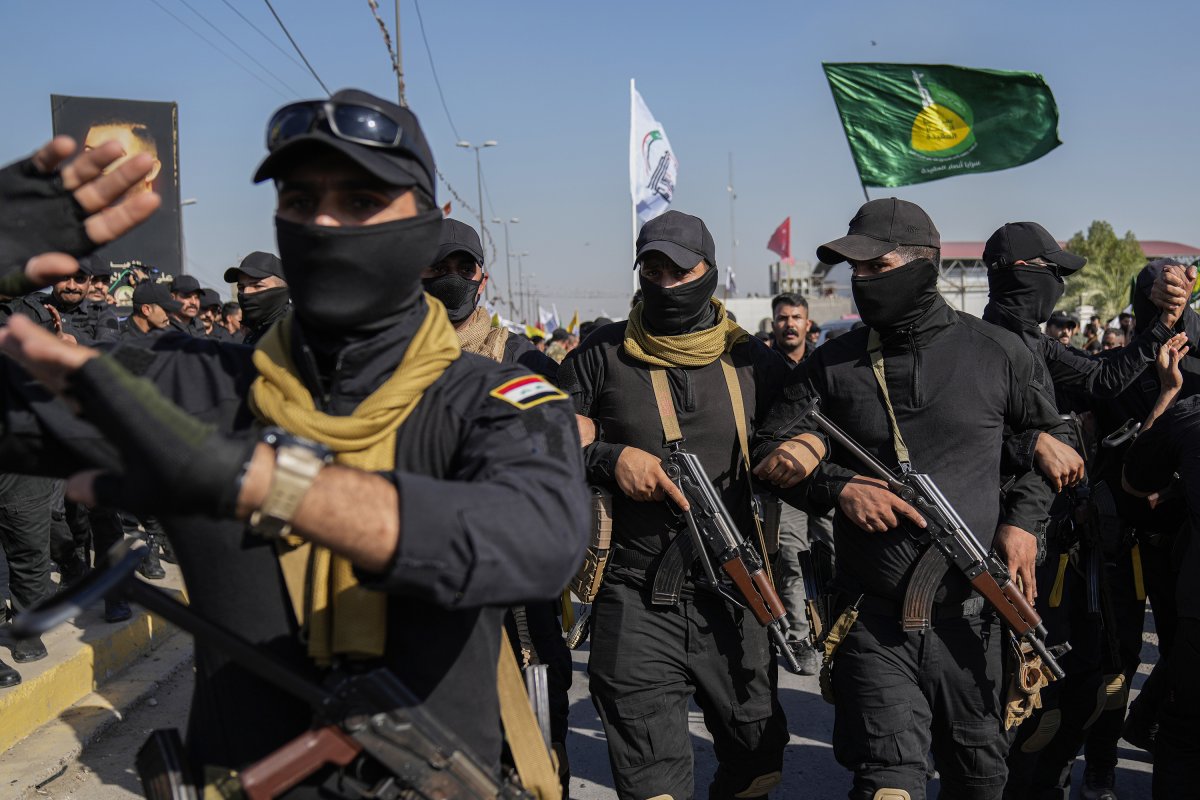
Members of the Popular Mobilization Forces, which includes the Nujaba Movement, at the funeral of fighters killed in a U.S. airstrike on July 31. Militia leaders have warned that the offensive against the U.S. will return in full force without a timely deal for the withdrawal of forces.
Hadi Mizban/AP
“We have made clear with them that we would review with the government of Iraq a number of factors to determine when and how the mission of the Global Coalition in Iraq would end and transition in an orderly manner to an ongoing bilateral security partnership in accordance with Iraq’s constitution and the U.S.-Iraq Strategic Framework Agreement,” Miller said. “And those conversations are ongoing.”
The following day, Pentagon Press Secretary Air Force Major General Patrick Ryder similarly declined to discuss any agreements at a press briefing.
“As we’ve talked about in the past,” Ryder said, “the United States and Iraq, at the most senior levels from the prime minister and the president, have highlighted the fact that we are in discussions to look at how we transition from the global coalition to an enduring U.S.-Iraq bilateral security cooperation relationship.”
Meanwhile, the security situation across the Middle East continues to deteriorate due to soaring tensions surrounding the war in Gaza. Iran has continued to threaten retaliation against Israel over the unclaimed assassination of Hamas Political Bureau chief Ismail Haniyeh in late July, and tensions between Israel and the Lebanese Hezbollah movement have escalated as a result of intensifying cross-border attacks and two deadly series of blasts that swept through communications devices in Lebanon and Syria this week.
As a fellow member of the Iran-aligned Axis of Resistance, the Islamic Resistance in Iraq has vowed to sustain and expand direct attacks on Israel. The Iraqi militias most recently claimed on Wednesday to have launched a drone attack against Israel’s port city of Haifa “in continuation of our approach to resisting the occupation, and in support of our people in Gaza, and in response to the massacres committed by the usurping entity against Palestinian civilians, including children, women and the elderly.”
“The Islamic Resistance confirms the continuation of operations to destroy the strongholds of the enemies at an increasing pace,” the militia coalition said in a statement.
That same day, the Israel Defense Forces announced “a hostile aircraft infiltration” over the northwestern Sea of Galilee and stated that a drone “approaching from Iraq was intercepted by IAF [Israel Air Force] fighter jets.”