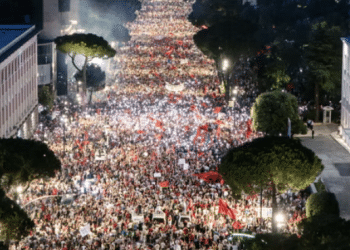
A senior Hamas official told Newsweek that the killing of Hezbollah Secretary-General Hassan Nasrallah may only empower the Lebanese group amid conflicting reports over his fate following massive airstrikes in Beirut.
The Israel Defense Forces (IDF) conducted an intensive series of strikes Friday against what was described as Hezbollah’s “Central Headquarters” in the southern Beirut suburb of Dahiye. The operation came amid worsening cross-border violence that has accompanied the ongoing war between Israel and the Palestinian Hamas movement in the Gaza Strip since last October.
While Nasrallah was not specifically mentioned in the statement, widespread reports indicated that the longtime Hezbollah chief was the target of the operation, which followed the killing of several senior group officials in recent months. Hezbollah has yet to issue official news regarding Nasrallah’s well-being.
Speaking to Newsweek as the world awaited information regarding the outcome of the Israeli attack and its potential ramifications, Hamas Political Bureau member and spokesperson Basem Naim stated, “First, we wish safety and security for Sayyed Hassan and all the leaders of the resistance in Lebanon and abroad.”
“The most important question is: Will the assassination of any leader from Hamas or from the party [Hezbollah] make Israel more secure?” Naim asked. “Is Israel’s problem with armed groups with limited agendas that can be eliminated by killing their leaders, or with peoples who have rights that they have been striving to achieve for decades and have not stopped or surrendered despite the killing of many leaders? Has any resistance group disappeared after the assassination of the leaders?”
“They have all become stronger and more widespread,” the former Palestinian Health Minister added. “Israel may achieve tactical achievements in its military operations, but it loses the strategic battle, or as we say in the world of medicine, the surgery succeeded, but the patient died.”

A man waves a flag of Hezbollah Secretary-General Hassan Nasrallah at a funeral for members of the Lebanese movement who were killed in an Israeli strike on September 21.
ANWAR AMRO/AFP/Getty Images
Newsweek reached out to Hezbollah and the IDF for comment.
Reuters and Agence France-Presse cited sources described as close to Hezbollah saying that Nasrallah was alive after the strike. Iran’s semi-official Tasnim News Agency also reported neither Nasrallah nor other senior officials of the group were killed in the Israeli strike, citing sources described as being informed on the matter.
Several Israeli outlets, however, have cited Israeli officials indicating that Nasrallah had likely been killed in the attack.
Lebanese health officials have placed the death toll of the attack so far at two, with dozens more wounded. Israeli newspaper Haaretz reported that the IDF estimates the number of those killed in the strike that caused widespread destruction in a residential area could reach 300.
“Hezbollah’s central headquarters was intentionally built under residential buildings in the heart of the Dahieh, in Beirut, as part of Hezbollah’s strategy of using Lebanese people as human shields,” IDF Rear Admiral Daniel Hagari said in a statement.
He pointed out that Hezbollah began its campaign of firing rockets, missiles and drones toward Israel a day after Hamas led an unprecedented surprise attack on Israel on October 7, 2023, sparking the longest and deadliest-ever war in Gaza. Clashes between the IDF and Hezbollah have forced tens of thousands to evacuate from both sides of the border and have racked up a growing number of casualties in the worst violence since the two sides last went to war in 2006.
Nasrallah has led Hezbollah since 1992, succeeding former chief Abbas al-Musawi following his assassination by Israel about a decade after the group was established to battle a previous Israeli invasion conducted amid Lebanon’s 15-year civil war that ended in 1990. Hezbollah would go on to emerge as the most powerful militia in Lebanon, retaining its weapons after the civil war and acquiring new capabilities with support from Iran.
Nasrallah would also go on to assume a dominant position in Lebanese politics despite not holding any official government position other than the head of Hezbollah, whose political wing is a member of the March 8 Alliance alongside the fellow Shiite Muslim Amal Movement and largely Christian Free Patriotic Movement. Nasrallah’s influence extends beyond Lebanon, counting numerous supporters across the region and abroad.
Israel has succeeded in killing a number of senior Hezbollah officials over the years, including deputy leader Imad Mughniyeh in a joint CIA-Mossad operation in Syria in 2008. More recently, the IDF assassinated top military commander Fouad Shukr in July and special forces chief Ibrahim Aqil last week, both in airstrikes in Beirut.
Israel has also taken aim at Hamas’ top command. This year, the IDF claimed the killing of the group’s military chief, Mohammed Deif, as well as his deputy, Marwan Issa.
Meanwhile, Hamas Political Bureau chief Ismail Haniyeh was killed in an unclaimed explosion in Tehran that has been widely attributed to Israel as well, sparking threats of revenge from Iran. His successor, former Gaza chief Yahya Sinwar, is believed to still be alive in the war-torn Palestinian territory the group has controlled since 2007.
Hamas officials previously told Newsweek that the killing of leaders would have only limited effects on the battlefield and that others would rise to take their place.
This is a developing news story. More information will be added as it becomes available.