Our central nervous system is made up, it turns out, of gray and white matter, but it is the gray matter, which makes up the outer layers of our brain, that plays the most important role in the functions of normal daily life.
In a new book by Theodore Schwartz, Gray Matters: A Biography of Brain Surgery, readers are taken on a journey through the history of neurosurgery by the very best tour guide imaginable: a real-life brain surgeon. Schwartz is a neurological surgeon at Weill Cornell Medicine in New York City, one of the busiest and highest-ranked neurosurgery centers in the world. He’s also a heck of a storyteller.
The book begins with a bit of Schwartz’s own history: His father was a psychiatrist and his mother a Holocaust survivor. “I realized there was a lot going on in the brain about which we are unaware,” he told the nationally syndicated radio show and podcast Our American Stories, speaking about what he had learned from his father. “My mother’s war experiences lent an air of gravity to my childhood, a sense that no matter how well things were going, tragedy lurked around every corner.”
Soon thereafter, we meet another father of sorts in Schwartz’s line of work: the father of neurosurgery, Harvey Cushing. “Thanks to his efforts, operative mortality rates went from 50 percent to under 10 percent,” Schwartz said about Cushing’s impact on the field. “He was actually the father of effective neurosurgery because ineffective neurosurgery had many fathers.”
What does it take to become a brain surgeon? Schwartz covers that ground too, in a book that’s as much a work of history as it is a memoir. “I wanted to deconstruct the myth that brain surgery is hard, because it isn’t hard the way rocket science is hard, with all those convoluted calculations that are so hard to wrap your head around.
“What makes neurosurgery difficult, first of all, is the psychological and emotional fact that you are taking another human’s life into your hands, their most precious possession they’re handing to you, which is essentially their brain, all their memories, all their future goals, everything that they are, they’re putting in your curatorship for about four hours and you can really damage them.”
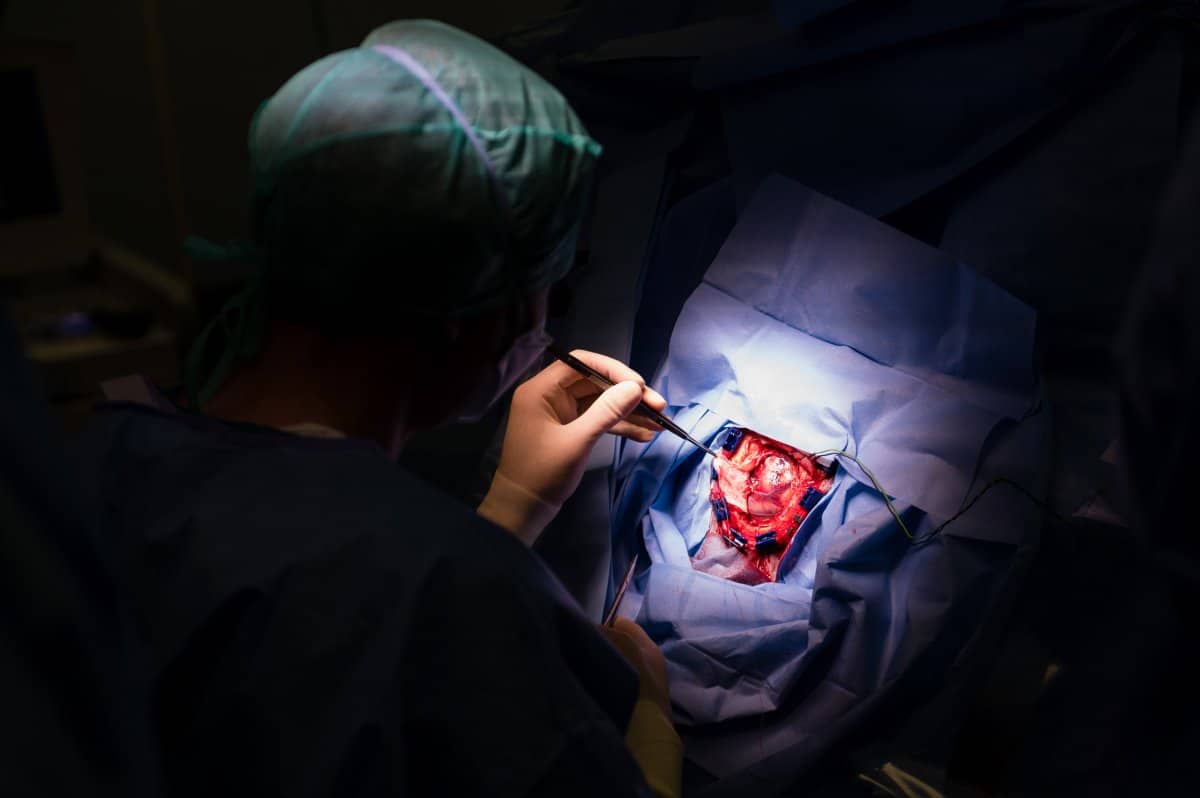
A neurosurgeon exposes the brain during surgery on May 25, 2020, in Cremona, Italy.
Photo by Marco Mantovani/Getty Images
Schwartz was just getting started, moving next to the technical difficulty of brain surgery. “We have to work under a microscope in a realm that’s on the order of millimeters and less and move things around arteries and blood vessels and nerves and dissect them off tumors very meticulously over hours and hours, and one wrong move and someone will not be able to move their face or speak again, or maybe be paralyzed and be in a wheelchair.”
The profession, Schwartz added, also requires an enormous amount of sacrifice, and there are also the physical demands. “You basically give up your 20s to train. It takes 15 years to train to be a neurosurgeon. And you need physical stamina to sit and do these operations for hours on end, which can be exhausting.”
One mentor, Dr. Paul Russell, gave Schwartz some advice that would change the arc of his life. “He was a transplant surgeon at Massachusetts General Hospital near the end of his storied career, and I was nervous about choosing neurosurgery as a specialty,” Schwartz said. “And he said this one sentence I’ll never forget: ‘Ted, if you want people to depend on you, you have to be dependable.’ I started thinking about what that meant, and it really rang true to me.”
In the book, we learn a lot about the common problems neurosurgeons face in their practice: head trauma, gunshot wounds, tumors, strokes and aneurysms (“time bombs in the head”), told through the stories of real patients.
We also learn about the internal psychological conflict between confidence and humility that neurosurgeons face. “You have to be both at the same time because you have to believe in your heart that you’re the best person to do this operation. And you have to become the best person you can be to do that operation. And with that training and experience comes a certain amount of arrogance. You have to convince the patient you can do this too. That you can take care of them,” he explained.
“But at the same time, every neurosurgeon who does complex neurosurgery will have complications and failures. And that creates a lot of humility because you can’t lose your focus. You can’t assume that things are going to go well. I’m always thinking: What can I do to prevent this from going wrong? And it makes you very, very humble. And by being humble, that’s how you get better.”
We discover that neurosurgeons learn their trade not through formal training but real-life experience. “Experience in medicine is one of our most powerful diagnostic tools,” he said. “The more variations of each disease we see, the more likely we are to make the correct diagnosis the next time we see it. These skills can’t be learned in a book, nor can they be taught.”
Schwartz, who has removed nearly 10,000 brain tumors, writes about the very worst variety—glioblastoma multiforme—with force. “These tumors tear through the brain like a swarm of locusts devouring everything in their path, moving so quickly they outrun their blood supply, as if growth were more important than life itself. They say that sharks die if they don’t keep moving. Malignant brain tumors are worse. They keep moving until you die.”
Schwartz also described the difficulty of sharing with patients the news that a tumor is malignant. “A frequent question they ask is ‘Why me? Was it anything I did?’ It’s human nature to attempt to find cause for suffering, to create order out of chaos, to shake their fist at the randomness of fate,” Schwartz said.
“I try to emphasize to my patients that they did nothing to bring this upon themselves. There is no one to blame or resent. As scientifically unsatisfying as the answer may be, the cause for most brain tumors is just plain old bad luck.”
Watching patients struggle with a terrible diagnosis, one with a slim chance of survival, is perhaps the worst part of the neurosurgeon’s job. And hardest.
“I see the mother of three young children who will not make it to their high school graduation. I see the father and sole provider for a family of teenagers with college payments looming who will not be walking his daughter down the aisle. I see the hedge fund manager who is sitting on top of the world, planning his retirement and next lavish vacation, who will soon be closing his fund,” Schwartz said.
“He’s about to lose not only his long-anticipated opportunity to spend his money but his ability to bathe and feed himself. And yes, thinking of others’ deaths can be debilitating to even the most hardened of us surgeons: giving bad news, seeing families crumple from the oncoming train bearing down on them.”
How does Schwartz cope? “As I stare into the void imagining their future, I want to stand up and scream at the top of my lungs or collapse on the ground in a flood of tears,” he admitted. “I do none of this, of course. My job is to fight this battle with every fiber in my body and shepherd these victims of nature’s callous and indifferent design.”
Though this remarkable book focuses mostly on the brain, it is the heart of the men and women in operating rooms across the country, fighting to save their patients’ lives, that most stands out.
Schwartz ends things with these words: “Neurosurgery, like all fields of medicine, is, at its heart, a service industry. Like a priest or a nun, we swear an oath to dedicate ourselves to a higher purpose far greater than ourselves: the health of our patients. The soldier’s creed holds true for neurosurgery as well: ‘I will always place the mission first. I will never accept defeat. I will never quit.'”