A Republican sheriff in Maryland has told a county election board that it might not be complying with the state’s law because of an “uneven representation” of political parties when it comes to election judges.
Writing to the Talbot County Board of Elections, Sheriff Joseph J. Gamble said residents had complained about the number of Democratic judges (62) compared to Republicans (50).
“Complaints received highlight a clear disparity among one party over another and in this current instance, registered Republican voters are not being equally represented,” Sheriff Gamble wrote.
He said that this violated Maryland election laws, but local and state officials have denied these claims.
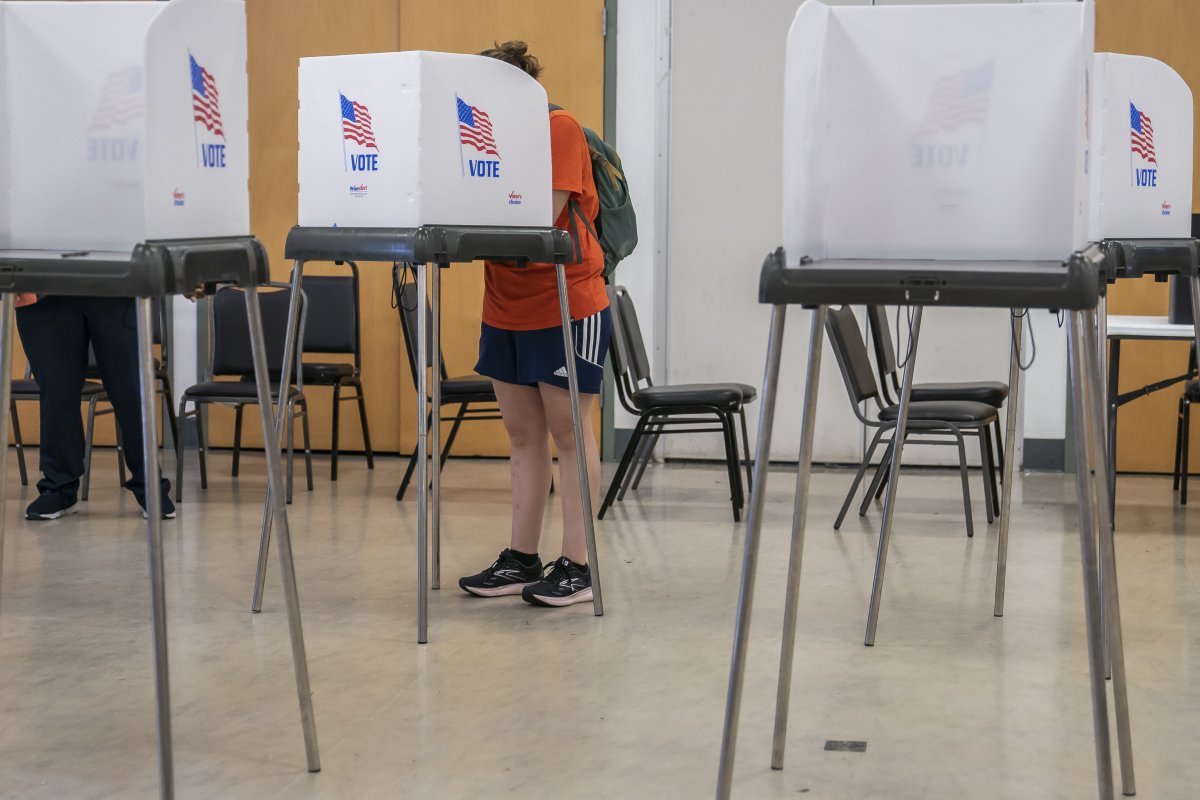
A voter casts their ballot at a polling place at The League for People with Disabilities during the midterm primary election on July 19, 2022, in Baltimore, Maryland. A sheriff has raised concerns over an imbalance of election judges from each party in Talbot County.
Nathan Howard/Getty Images
“Our election judges check politics at the door, and that the no-electioneering zone around a polling place applies to everyone inside it,” State Elections Administrator Jared DeMarinis said in an emailed statement to Newsweek.
“It is imperative for the integrity of the electoral process and important to stress, election judges operate and are trained to conduct the election in a nonpartisan manner and fashion.”
Newsweek also reached out to the Talbot County Board of Elections for comment via email Friday afternoon.
Election judges are responsible for administering the voting process in each precinct, with duties including making sure voters are registered and can cast their ballot in a trouble-free environment.
Maryland has often struggled to recruit election judges, who have to undergo training before starting work early on election day, working through polls closing.
In Talbot County, applicants are being offered $100 for those who attend training and go on to fulfill the role, with additional compensation for different jobs on election day—from Chief Judge ($300) to a standby ($100).
Maryland state law says that each polling place must have an equal number of judges from the majority party and the principal minority party. If needed, a local board can offer additional judges not affiliated to either party or a minor.
Those who complained to Sheriff Gamble were concerned about the imbalance between the two main parties, however.
“As you know, my office will be conducting security checks of the polling places and escorting ballots to your office to ensure we have a safe and fair election,” the sheriff said in his letter. “I strongly urge you to comply with Maryland law. Talbot county citizens and election workers, need to feel safe and secure that the law is being followed.”
DeMarinis disputed local law enforcement’s role, saying that it was the election judge’s job to ensure security in polling places and that law enforcement officers have to listen to them.
Sheriff Gamble told Newsweek via phone Friday that he was confused by DeMarinis’ response, as he understood what was required of his office. Talbot County Sheriff’s Office had been asked to help with security outside venues and with escorting ballots for the past five elections, he said.
The sheriff also said that any law enforcement officer in Maryland can investigate election law violations, and it was his job to act on reports made.
“Do I think there’s anything nefarious going on, no,” Gamble told Newsweek, adding that he was addressing issues raised by residents. “My concern is there are citizens who are frustrated, and they don’t understand why there isn’t a 50/50 split.”
DeMarinis said in his statement that voters could be sure that their ballot would be counted, and that state and local election boards were complying with the law.