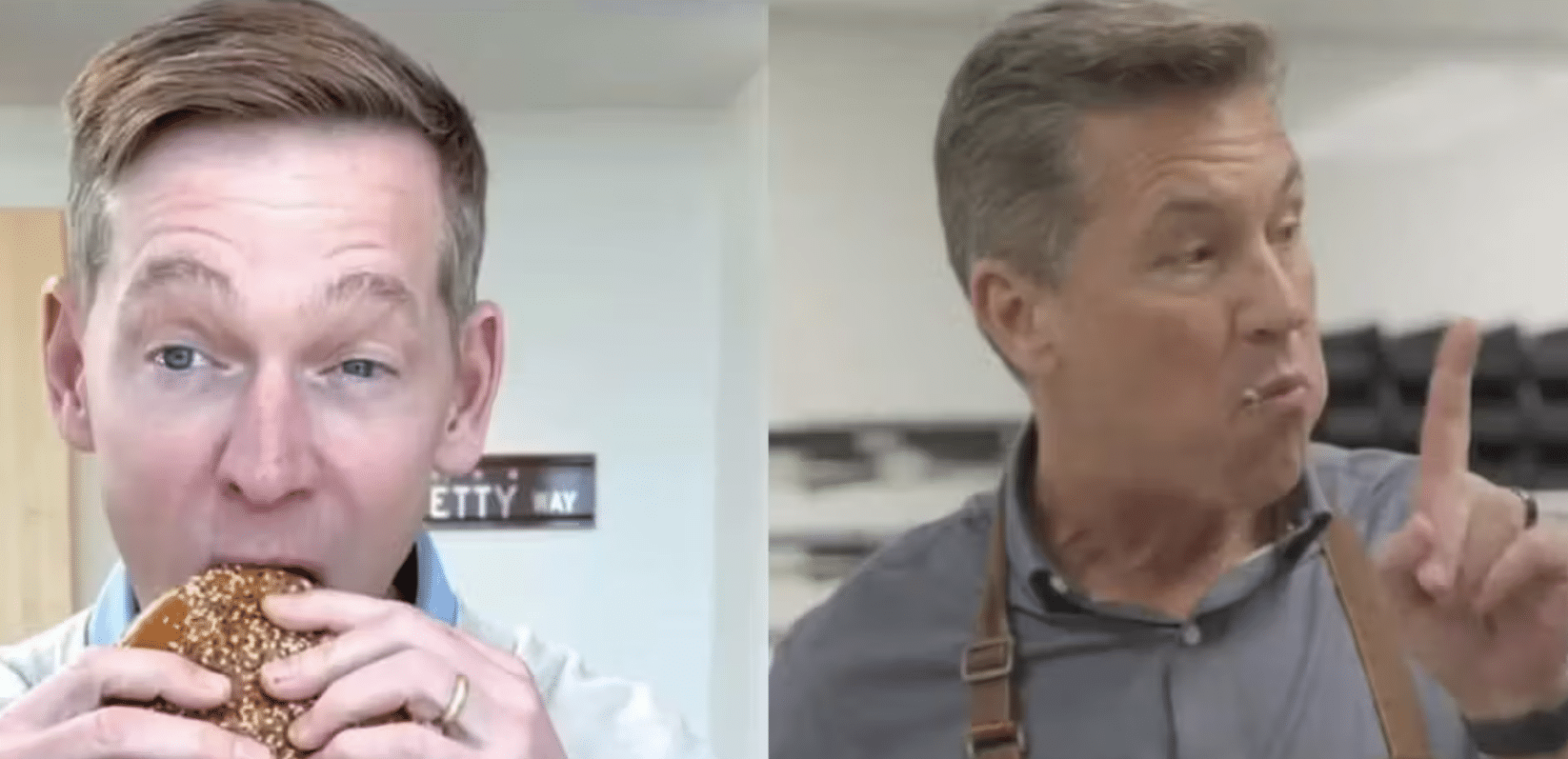

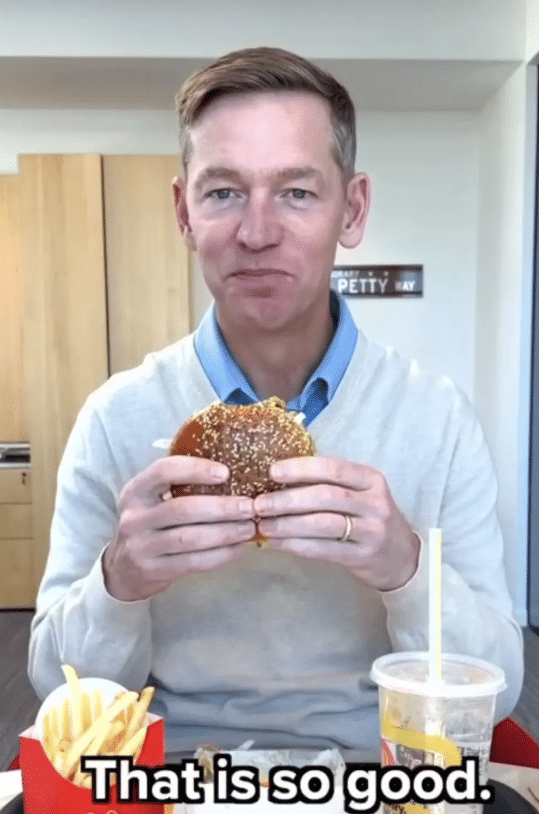
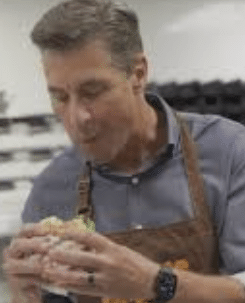
3/5/25 8:05 AM Cynthia McCallum breaks down the viral clip of McDonald’s CEO Chris Kempczinski taking what he proudly called a “big bite” of the new burger. The problem? The moment looked misleading from the start.
McDonald’s didn’t expect a burger bite to become a case study in corporate miscommunication, but here we are. When CEO Chris Kempczinski took what he confidently labeled a “big bite” of the company’s new burger, the internet immediately called foul. His stiff posture, careful hand placement, and tiny, hesitant nibble made it clear he doesn’t exactly live on Quarter Pounders. Viewers saw right through it. Instead of selling the burger, he sold the idea that he’s never actually eaten one. And in a world where authenticity is currency, the moment felt misleading from the first frame.
The most surprising part wasn’t the awkward bite itself—it was the silence around him. No one at McDonald’s stepped in to say, “Let’s try that again,” or “Maybe take an actual bite this time.” The whole performance was unconvincing, a corporate theater piece that forgot to rehearse. It was wide open for competitors, and Burger King didn’t miss the opportunity. They pounced with the kind of speed that only comes when your rival hands you a marketing gift wrapped in sesame seeds.
But Kempczinski’s viral nibble isn’t just a funny internet moment. It’s part of a larger pattern: CEOs stepping into the spotlight and unintentionally revealing just how disconnected they are from the products, customers, or realities they’re supposed to represent. These moments aren’t just embarrassing—they’re misleading. They create a false image of leadership, one where executives pretend to be “one of the people” while broadcasting the exact opposite.
Consider the infamous Pepsi ad featuring Kendall Jenner. While not a CEO moment, it was greenlit by executives who believed a can of soda could solve social unrest. The backlash was immediate and brutal. Pepsi’s leadership had to apologize, but the damage was done. The ad wasn’t just tone‑deaf—it was misleading in its attempt to position a soft drink as a unifying force in moments of real conflict. It showed how far removed decision‑makers can be from the world their customers actually live in.
Then there’s Mark Zuckerberg’s metaverse demo, where he appeared as a floating cartoon avatar with dead eyes and no legs. The presentation was meant to showcase the future of digital connection, but instead it highlighted how disconnected the company was from what people actually wanted. The visuals were mocked, the concept was questioned, and the whole thing felt misleading—an overpromised vision delivered with underwhelming execution. It was a reminder that even tech giants can misread the room when they’re too busy selling the future to notice the present.
Elon Musk has had his share of misleading CEO moments as well. The Cybertruck window demonstration—where the supposedly unbreakable glass shattered twice—became an instant meme. Musk had promised durability, strength, and innovation. What the world saw was a truck with broken windows and a CEO trying to pretend it wasn’t happening. The moment didn’t just undermine the product; it undermined the message. It showed how quickly confidence can turn into contradiction when reality refuses to cooperate.
Howard Schultz of Starbucks also stepped into misleading territory during his attempts to position the company as a champion of social issues. His “Race Together” campaign encouraged baristas to write the phrase on cups and spark conversations about race relations. The intention may have been sincere, but the execution was misguided. Customers didn’t want a lecture with their latte, and employees didn’t want to be thrust into complex conversations they weren’t trained to navigate. The campaign felt performative, a corporate attempt to appear socially conscious without doing the deeper work required. It was another example of leadership misreading the moment and misleading the public about the company’s role in larger societal issues.
Even outside the food and tech industries, CEOs have stumbled into misleading territory. When BP’s Tony Hayward famously said, “I’d like my life back” during the Deepwater Horizon disaster, the comment wasn’t just insensitive—it was misleading in its attempt to shift focus away from the environmental catastrophe and toward his personal inconvenience. The backlash was swift, and the comment became a symbol of corporate detachment. It showed how a single sentence can reveal more about a leader’s priorities than any press release ever could.
These moments all share a common thread: leaders trying to project confidence, relatability, or control, only to reveal the opposite. They’re not just PR blunders—they’re misleading performances that expose the gap between corporate messaging and corporate reality. And in the age of social media, that gap is impossible to hide.
Which brings us back to Kempczinski and his now‑famous “big bite.” The moment wasn’t catastrophic. It didn’t harm anyone. It didn’t trigger a boycott or spark a national conversation. But it did reveal something important: people can spot inauthenticity instantly. They know when a CEO is faking it. They know when a performance is staged. And they know when a company is trying to sell them a story instead of a product.
The irony is that McDonald’s didn’t need a CEO to take a bite at all. The company has millions of customers who eat their food every day. They have real people with real reactions. They didn’t need a staged moment—they needed an honest one. Instead, they got a misleading performance that became a punchline.
The lesson for CEOs is simple: stop pretending. Stop staging. Stop trying to be relatable in ways that feel forced. If you don’t eat the food, don’t pretend you do. If you don’t understand the product, don’t fake expertise. If you’re not comfortable in the spotlight, don’t step into it without preparation. Because the moment you try to perform authenticity instead of embodying it, the audience will see right through you.
Burger King’s response worked because it didn’t try to be anything other than what it is: a fast‑food chain that knows how to seize a moment. They didn’t overthink it. They didn’t overproduce it. They simply pointed out what everyone else was already laughing at. And in doing so, they reminded the world that authenticity—real, imperfect, human authenticity—wins every time.
Kempczinski’s misleading “big bite” will fade, but the pattern it represents won’t. As long as CEOs keep trying to manufacture relatability instead of earning it, these moments will keep happening. And the internet will keep calling them out.
In the end, the bite wasn’t the problem. The performance was. And in a world that values transparency more than ever, misleading performances don’t just fail—they backfire. We want to hear from from YOU!