Japan’s Parliament has elected Shigeru Ishiba, the new leader of the ruling liberal Democratic Party (LDP), as the country’s prime minister.
Former Prime Minister Fumio Kishida stepped down earlier in the day to make way for the new leader.
The previous administration has struggled with corruption scandals leading to the resignation of the former Prime Minister.
Ishiba’s policies have focused on defense and security as an increasing concern.
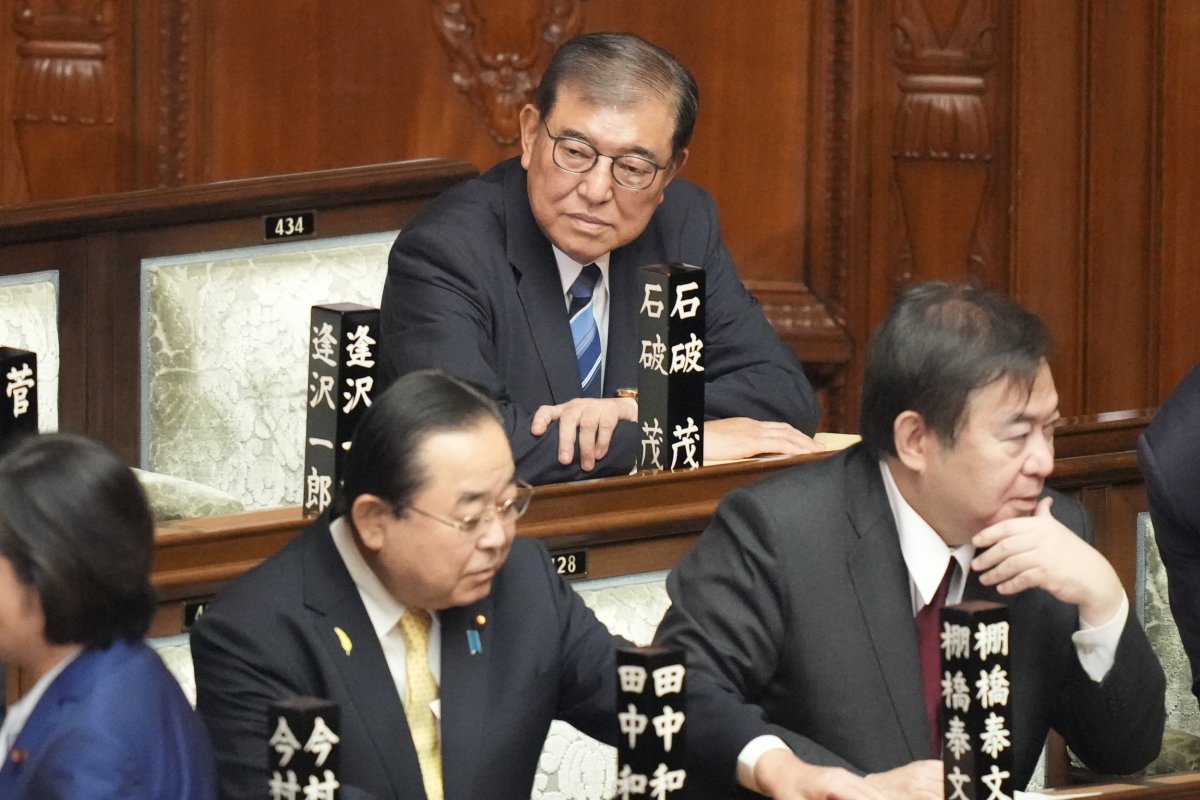
Shigeru Ishiba, top, sits ahead of the extraordinary session of parliament’s lower house Tuesday, Oct. 1, 2024, in Tokyo. On Tuesday, Ishiba was elected as the country’s new prime minister.
Eugene Hoshiko/AP
Ishiba, standing in the lower house of Parliament, acknowledged his nomination with a bow before leaving to form his Cabinet.
He is expected to hold a news conference later on Tuesday to introduce his Cabinet members and outline his policy priorities.
Kishida, who assumed office in 2021, resigned to allow his party to rejuvenate its image ahead of the next parliamentary election.
Ishiba quickly announced plans to hold an election on Oct. 27, stating his intention to seek “the people’s judgment” on his new administration as soon as possible.
Opposition leaders have criticized Ishiba’s swift move to announce a new election date, arguing that the brief time frame does not allow for adequate debate over his policies.
Tensions were evident as opposition protests delayed the start of the parliamentary vote by half an hour.
Ishiba appointed two former defense ministers, Takeshi Iwaya as foreign minister and Gen Nakatani as defense chief, to his Cabinet.
Kishida, who announced his intention to resign in August to facilitate a change in leadership ahead of the next election, held a final Cabinet meeting on Tuesday morning before departing his office.
In a farewell ceremony, he was presented with a bouquet of red roses and applauded by his staff.
“As we face a critical moment both domestically and internationally, I earnestly hope key policies that will pioneer Japan’s future will be powerfully pursued by the new Cabinet,” Kishida stated.
In an interview with Newsweek in April, Kishida emphasized the security risk facing Japan.
The country faces threats and tensions from China, North Korea and Russia.
“I think we are facing the most challenging and complex security environment since the end of World War II,” he said. “In such a situation, we have to protect our people’s lives and livelihoods.”
Ishiba’s foreign policy agenda includes proposals to address security challenges, including an “Asian NATO,” enhanced regional defense cooperation, and a redefined security alliance with the United States.
In an article for the Hudson Institute, Ishiba suggested the joint management of U.S. military bases in Japan and the placement of Japanese Self-Defense Force bases in the United States.
He has floated the idea of shared control of U.S. nuclear weapons in Asia as a countermeasure against potential threats from China, North Korea, and Russia.
Domestically, Ishiba pledged to continue Kishida’s economic policies aimed at ending deflation and increasing real wages.
He also emphasized addressing Japan’s declining birthrate, population issues, and disaster resilience.
This article includes reporting from The Associated Press