For several years, Kelsey Pomeroy had searched for a diagnosis to explain the plethora of symptoms that were plaguing her daily life. Despite many tests and appointments, she was left without answers—until the internet stepped up to help.
Pomeroy, 33, of Kansas City, Missouri, recalls the difficulty of living with nausea, dizziness, sensitivity to light, neck pain, and fatigue for many years. But in May of this year, her symptoms began to escalate, and she tells Newsweek that she “felt like a walking zombie” most days.
Simply moving her head made her feel dizzy, and she’d have to take regular breaks throughout the day to deal with the insufferable pain. Even a relatively easy task such as cooking felt impossible, as Pomeroy’s symptoms left her completely helpless.
“I had to rest during the day due to constant headaches and neck pain. Tasks like cooking or cleaning made me dizzy, and visually stimulating places like IKEA, restaurants, and aquariums became unbearable,” she said.
“I had nausea, dizziness, sensitivity to sunlight, heat intolerance, fatigue, neck and shoulder pain, headaches, difficulty concentrating, and brain fog. I had many of these symptoms for years, but I didn’t realize they were connected.”
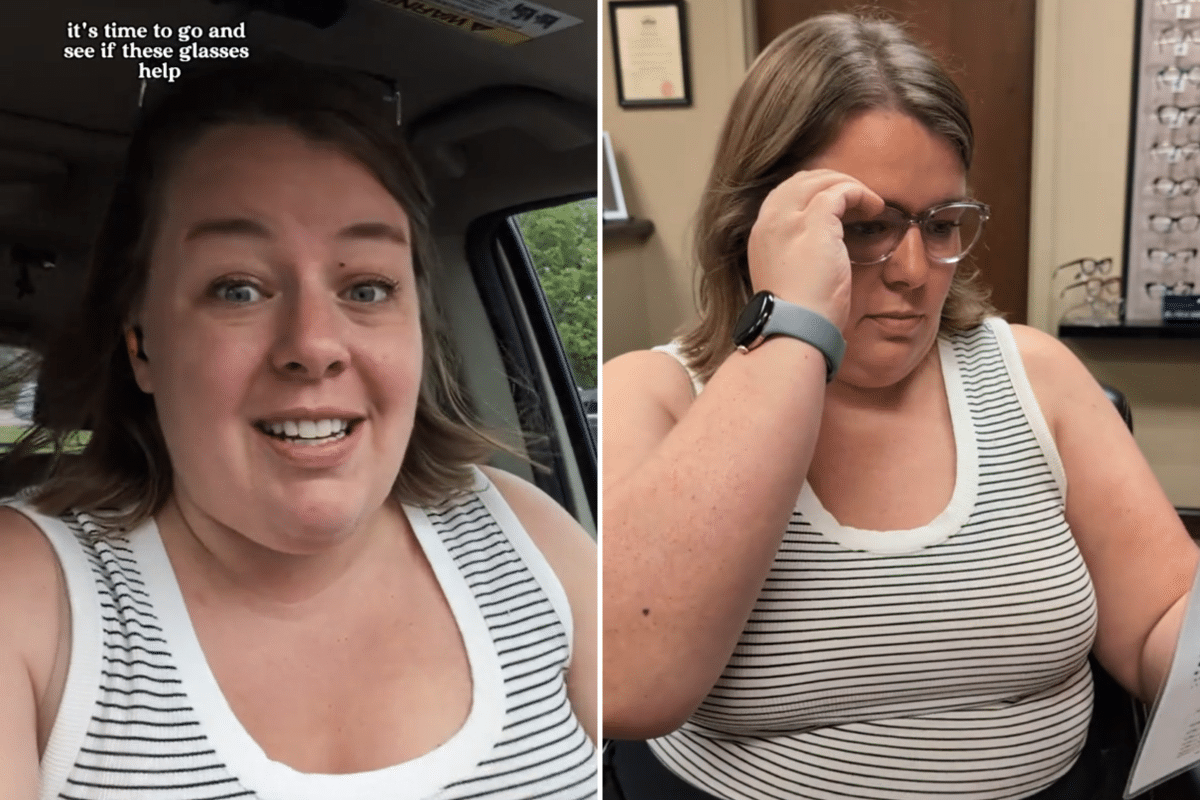
Kelsey Pomeroy, 33, being tested for BVD and trying on her new prism glasses. The glasses help the eyes work together to form one 3D image, rather than competing images that overlap.
@kelsewhatelse / TikTok
Throughout this time, Pomeroy saw two optometrists, but there didn’t seem to be an answer as for why she felt all these symptoms.
Pomeroy had been documenting the experience on TikTok (@kelsewhatelse), and after learning her symptoms and that she often wore sunglasses indoors to alleviate them, many social media users urged her to ask about binocular vision dysfunction (BVD). This is an umbrella term that refers to a multitude of conditions preventing people from seeing the world as one single picture. Instead, people will see two images that overlap.
Dr. Jovi Boparai, an ophthalmic surgeon and CEO of CorneaCare, tells Newsweek that while most people’s eyes work together in unison, BVD can cause “ocular misalignment” whereby the eyes send “mismatching images” to the brain.
The strain of this can lead to a variety of symptoms, including headaches, blurred vision, light sensitivity, trouble seeing screens, eye strain, disorientation, dizziness, fear of public settings, and eye fatigue.
However, identifying BVD can be challenging, as Dr. Boparai told Newsweek that it’s very difficult to diagnose. If the misalignment between the eyes is subtle, this can be particularly difficult to detect in a routine eye exam and would need more thorough testing to find.
Dr. Boparai said: “It’s typically tested by using a cover-uncover test, alternate cover test, and alternate prism cover test. These tests attempt to elicit the misalignment and correct it if possible with prisms, which bend light to account for the ocular misalignment.”
Finally Reaching A Diagnosis
When Pomeroy first saw TikTokers suggesting that it could be BVD, she was doubtful how accurate a bunch of social media users could be.
“At first, I didn’t think I had BVD because I have good hand-eye coordination and reading skills, which are often affected by the condition. But after more and more comments, I took the BVD questionnaire and scored high, which prompted me to make an appointment specifically for a BVD test,” Pomeroy continued.
Although she’s worn prescription glasses for the last four years, the BVD diagnosis led her to get new ones with prisms in the lenses. This helps to keep the eyes focused and working together to form one whole image.
As a result, Pomeroy says her symptoms have reduced by 80-90 percent, and she feels like “a completely different person.”
She told Newsweek: “I can cook and clean again without needing to rest, my balance is better, and the headaches and neck pain are virtually gone. I can shop, eat out, and drive without feeling anxious. My brain fog has cleared, and my personality is back.
“I didn’t realize my symptoms were connected, so I wasn’t describing them properly to my doctors. I also didn’t know I had double vision because my brain worked so hard to merge the images together, which is why I had the other symptoms because it was straining to create that image. Now, with my prism glasses, I can briefly see the double vision when I take them off, before my brain compensates and merges the images again.”
Pomeroy will continue to have regular checks to see she’s getting on with her new glasses, but she’s hopeful that this will be the end of this painful chapter.
The Social Media Reaction
After posting about her medical mystery on TikTok in July, Pomeroy’s video went viral with 979,600 views and 116,600 likes on TikTok. Days later, she posted an update showing the moment she finally tried on her prism glasses to help with BVD, and the clip generated over 813,300 views and 50,700 TikTok likes.
If it wasn’t for the help of the social media users who suggested she seek a BVD test, Pomeroy told Newsweek that she certainly doesn’t think she’d have gotten a diagnosis.
“I didn’t know my symptoms were connected, and none of my doctors knew about BVD either. Thanks to comments online, I was diagnosed quickly,” she added.
“I’ve had people message me saying they suffered for over 20 years and been tested by so many doctors with no answers, but because of my videos, they finally got a diagnosis and a sense of relief.”
Pomeroy’s journey has resonated with many people, leading to over 700 comments on the video showing the moment she tried on her new glasses and felt instant relief.
One comment reads: “getting prism lenses saved me so much frustration at the world!”
Another person responded: “I’ve been waiting for your update! I’m so happy you finally have some relief!”
While another wrote: “Your video is what made me make an appointment with the BVD doctor. Thank you for posting.”
Is there a health issue that’s worrying you? Let us know via health@newsweek.com. We can ask experts for advice, and your story could be featured on Newsweek.