In his first gathering with foreign press since taking office in August, Iranian President Masoud Pezeshkian offered Israel an armistice amid worsening tensions gripping the Middle East, but at the same time warned Israel was attempting to instigate a broader conflict in the region.
Pezeshkian told reporters at a gathering on the sidelines of the United Nations General Assembly in New York that “we are willing to put all of our weapons aside, so long as Israel is willing to do the same, but we cannot have outside actors come in, arm one side to the teeth and prevent the other side from having the means to defend themselves.”
The remarks came as Iran continues to vow vengeance over the killing of Hamas Political Bureau Chief Ismail Haniyeh, who was slain in Tehran just hours after Pezeshkian was sworn into office. The attack, Pezehskian affirmed, “will not go unanswered,” though he cautioned against actions that could be viewed as escalatory on the part of his government as “we do not wish to be the cause of instability in the region” and “everyone loses” if such a war erupts.
He argued that Haniyeh’s killing and other actions attributed to Israel “were traps laid by Israel in order to cowardly drag us in” to a regional conflict looming over the ongoing war in Gaza. The Iranian president also cast blame on the United States for its repeated promises of peace despite Israel-Hamas negotiations apparently remaining deadlocked.
“We tried to not respond [to Haniyeh’s killing],” Pezeshkian said. “They kept telling us we are within reach of peace, perhaps in a week or so. But we never reached this elusive peace. Everyday Israel is committing more atrocities and killing more people, old, young, men, women, children, hospitals, other facilities.”
And while Pezeshkian argued Iran had displayed restraint in its previous, unprecedented strike against Israel in April in response to the killing of senior Iranian military officials at a consular building in Syria, he asserted that Iran remained capable of thwarting Israel’s defense systems, including the Iron Dome, to inflict even wider destruction.
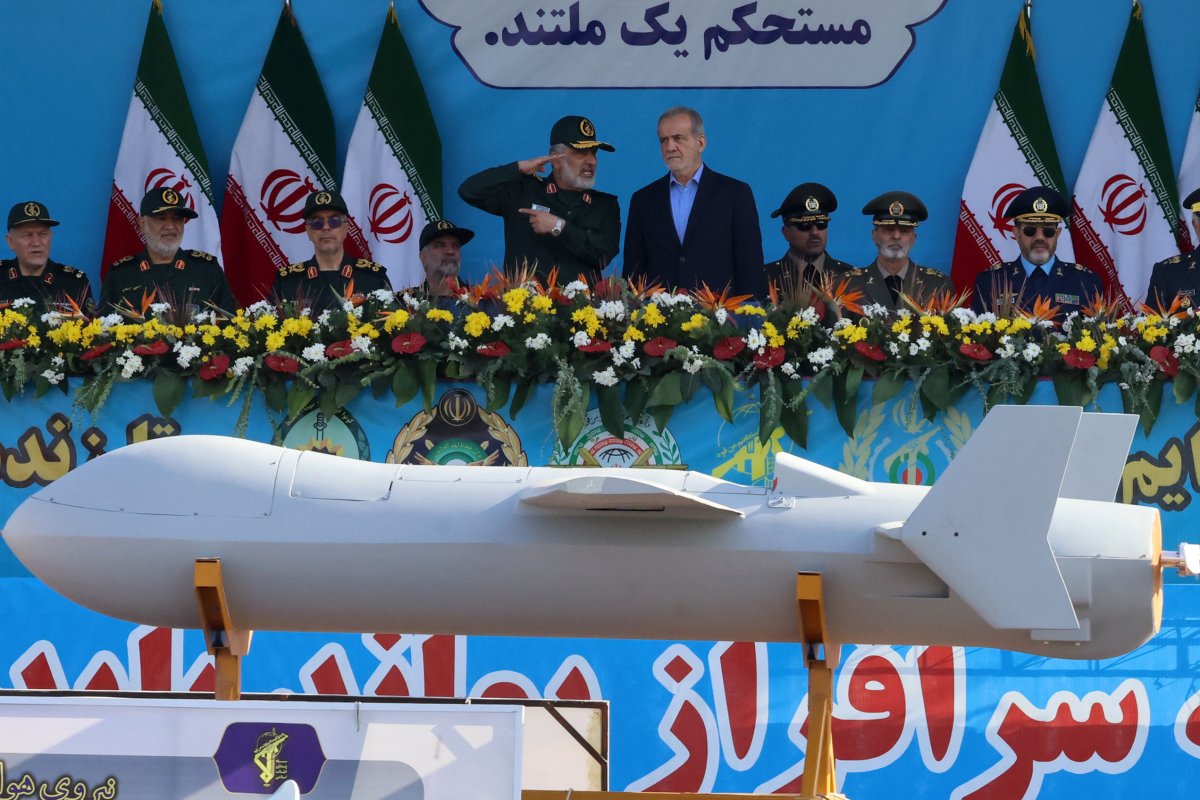
Iranian President Masoud Pezeshkian (R) and Islamic Revolutionary Guard Corps’ Aerospace Force commander Amir Ali Hajizadeh look on as Iran’s new Shahed 136-B drone is displayed during the annual military parade marking the anniversary of the outbreak of the 1980-1988 war with Iraq, in Tehran on September 2.
ATTA KENARE/AFP/Getty Images
Responding to Newsweek‘s question regarding Iran’s deterrence in the face of Israeli attacks on the Islamic Republic and its Axis of Resistance allies, including Lebanon’s Hezbollah, Pezeshkian said, “Do we need to hit something with these capabilities in order to prove we are capable?”
“When it comes to the Iron Dome built in Israel, America, France, a lot of other countries were helping that so-called Iron Dome and it was penetrated anyway,” Pezeshkian said. “What else do we need to show them?”
“It wasn’t Israel alone; everyone was supporting Israel. We never wanted to target heavily populated civilian centers. We proved that we could, but we didn’t,” he added. “Now they are saying that we lack such capabilities because we chose to conduct ourselves in a certain way, in a humane and human way? This doesn’t make sense.”
Israeli officials hailed a high rate of interception against a barrage of hundreds of missiles and drones launched by Iran and its Axis of Resistance allies against Israel. Other nations also supported the operation, including the U.S., France and Jordan.
Now, with the region again on edge since Haniyeh’s death nearly two months ago and a deepening conflict between Israel and Hezbollah, Pezehskian reaffirmed that “we will give our answer in the appropriate time, in the appropriate place.”
“Now, I hope that the world does not seek to drag us into a place where we are forced to show a reaction that is not worthy of us,” Pezeshkian said.
Pezeshkian denied having direct control over Hezbollah and other allied militias, such as Yemen’s Ansar Allah, or the Houthi movement, but expressed support for “any group that wishes to defend her right rights.”
He denied, however, reports citing U.S. intelligence suggesting Iran had recently agreed to provide ballistic missiles to Russia for use in its war in Ukraine, saying his administration “has not and will not” do so and that “we have not approved of Russian aggression against Ukrainian territory.”
In both the cases of Gaza and Ukraine, Pezeshkian argued that resolution must come “through dialogue” and such issues “cannot be resolved through killing.”
This is a developing news story. More information will be added as it becomes available.