The Orionids meteor shower hit its peak on Monday, with shooting stars lighting up the night despite the brightness of the nearly full moon.
Stargazers who missed this shower have plenty of other opportunities to catch a glimpse of meteors, however, with the Taurids meteor shower due to peak in a few weeks time.
The Taurids are actually two separate showers—northern and southern—with the Southern Taurids running between September 23 and December 8 and peaking on November 4, and the northern shower being visible between October 13 to December 2 and peaking on November 11, according to the American Meteor Society.
How to watch the Taurid meteor shower
The Taurids are named for their radiant—the part of the sky where the meteors appear to originate—which is the constellation Taurus, and are visible from anywhere in the sky.
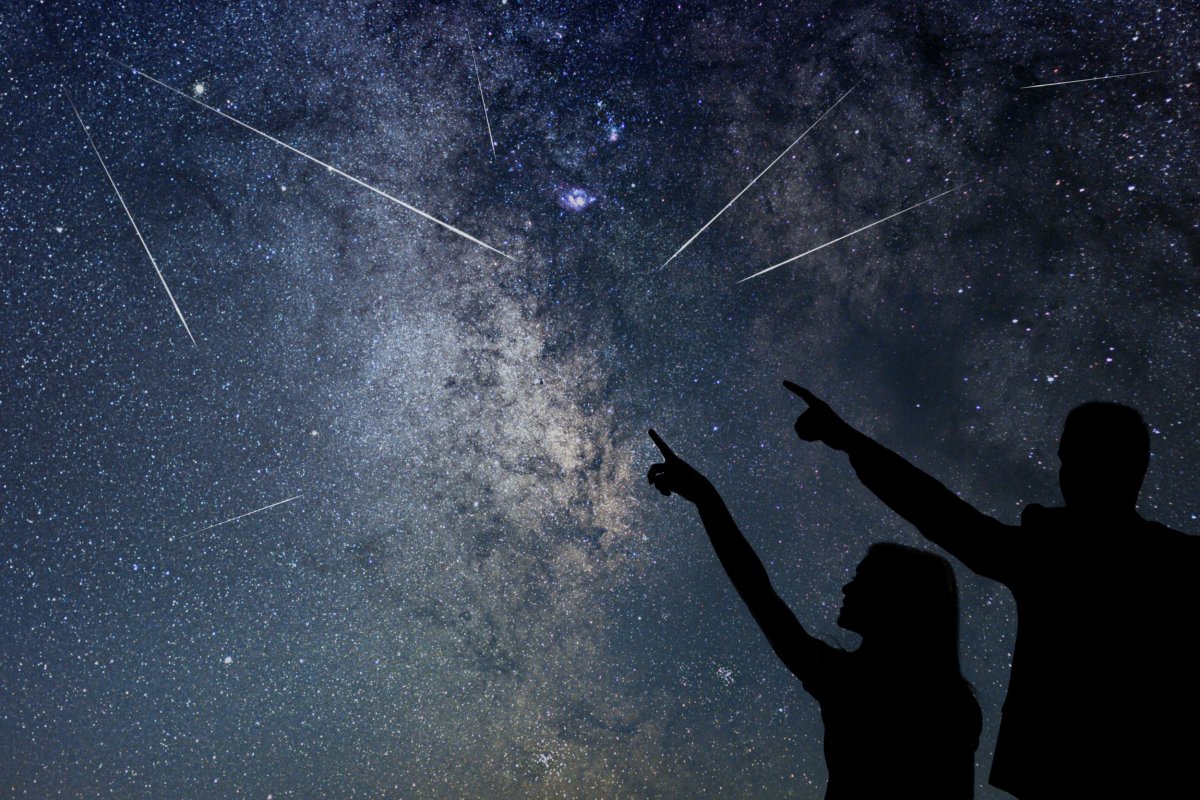
Stock image of people watching a meteor shower. The next meteor shower after the Orionids will be the Taurids.
ISTOCK / GETTY IMAGES PLUS
The best viewing time is usually after midnight, when Taurus is higher in the sky. Stargazers will have the best chance of spotting the meteors as far away from city lights as possible, so rural areas, national parks, or dark sky reserves are ideal.
Allow your eyes to adjust to the darkness for at least 20 to 30 minutes, and bring a reclining chair or a blanket to lie on to look up at the sky without straining your neck. Warm clothing, blankets, or even a sleeping bag can help keep you warm during the cold October and November nights.
The moon’s light may drown out the meteors, so if a shower’s peak coincides with a fuller moon, it may be less easy to spot the shooting stars. The moon will be 79 percent full on the night of November 11 when the Northern Taurids are due to peak, but will be 11 percent full on November 4 when the Southern Taurids peak.
What Does a Meteor Shower Look Like From Earth?
Meteors appear as a bright streak of light in the night sky which quickly fades away. While the term “meteor shower” implies that the objects are raining down toward Earth, most showers usually only result in a maximum of one or two meteors every minute.
The Taurids in particular are not known for high counts, producing about five to 10 meteors per hour during the peak. However, they are famous for producing bright fireballs, which are large and bright and can light up the sky. This is why the Taurids are often nicknamed the “Halloween fireballs”, and they are considered more spectacular to watch despite their lower meteor rate compared to other showers like the Perseids or Geminids.
“One of the reasons that the Taurids have found fame is that they’re viewed by many as a bit of a fireball shower – that is, while their rates are low, they seem to produce a large number of bright meteors—fireballs are meteors that are brighter in the sky than the planet Venus appears. So even though people don’t see huge numbers of Taurids they can still be eye-catching,” Jonti Horner, an astrophysics professor at Australia’s University of Southern Queensland, told Newsweek.
“This is a reflection of the fact that the debris stream contains a relatively large amount of larger fragments, not just pieces the size of grains of dust or sand, but rather chunks as big as your fist, or a football!”
What Causes the Taurids?
The Taurids are a result of the Earth passing through a trail of debris left behind by the comet 2P/Encke. This comet, named after German astronomer Johann Franz Encke, has a short orbit around the sun of about 3.3 years. As it gets close to the sun, its surface heats up, causing some of the comet’s material to vaporize and break off in the form of small particles, which are left behind in its orbit.
Every year, Earth’s orbit crosses through this trail of debris, and as the particles collide with our atmosphere, they enter at high speeds, causing them to heat up and vaporize. This produces the bright streaks of light we see as meteors.
“As it happens the Taurids are two overlapping showers—not that anyone but an expert would notice, the southern shower is associated with comet Encke and the northern shower associated with the asteroid 2004 TG10 although it I likely that 2004TH was once part of Encke,” Mark Gallaway, an astronomer and science educator at the Royal Observatory in Greenwich, London, told Newsweek.
What is the Difference Between a Meteor and a Meteoroid?
Meteoroids are small rocks or particles in space, usually originating from a comet or asteroid. The trail of debris left by Enke and other comets are mostly comprized of meteiroids. Meteoroids are smaller than asteroids, typically ranging in size from tiny grains to objects about a few feet across.
When a meteoroid enters the Earth’s atmosphere and burns up due to friction with the air, it creates a streak of light in the sky, which is called a meteor. A meteorite, however, is the name for the object after it hits the ground.
When are the Next Meteor Showers?
After the Taurids, stargazers can spot the Leonids, running from November 3 to December 2 and peaking on November 17, the Geminids between November 19 and December 24, peaking on December 13, and the Ursids between December 13 and December 24, peaking on December 21.
Do you have a tip on a science story that Newsweek should be covering? Do you have a question about meteor showers? Let us know via science@newsweek.com.