China is set to launch its latest crewed mission to the Tiangong space station early Wednesday.
The mission, which is expected to lift off from the Jiuquan Satellite Launch Center at 4:27 a.m. local time, will transport two men and one woman to the orbiting station.
The three astronauts will replace the crew currently aboard Tiangong, who have spent the last six months conducting scientific research and maintenance on the station.
Leading the new mission is Cai Xuzhe, who previously flew on the Shenzhou-14 mission in 2022.
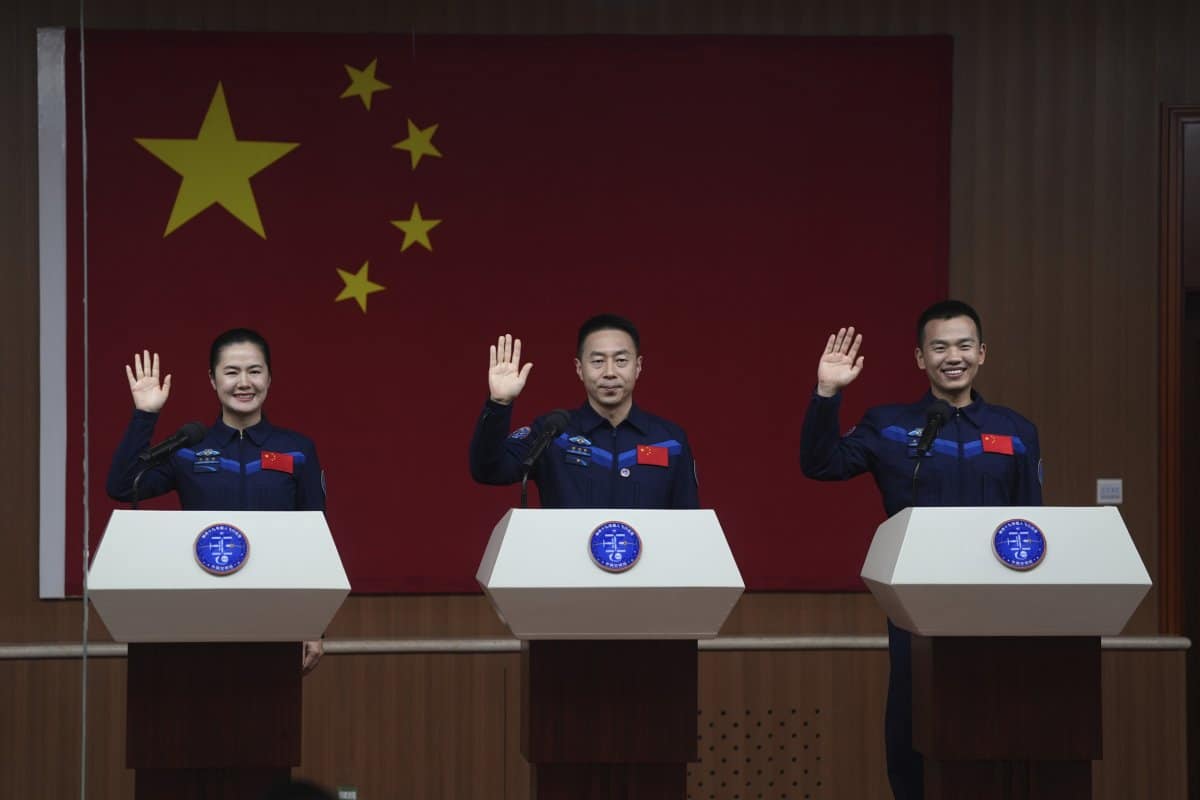
From left, Chinese astronauts Wang Haoze, Cai Xuzhe and Song Lingdong wave while they meet the press ahead of the Shenzhou-19 mission at the Jiuquan Satellite Launch Center in Jiuquan, northwestern China Tuesday, Oct. 29, 2024. The launch, scheduled for Wednesday, will transport the three astronauts to the Tiangong space station.
Ng Han Guan/AP
Joining him are Song Lingdong and Wang Haoze, both first-time space travelers born in the 1990s.
Song is an ex-air force pilot, and Wang is an engineer with China Aerospace Science and Technology Corporation, and will serve as payload specialist.
Wang will be the third Chinese woman to participate in a crewed mission.
What is China’s Space Program Plan?
At a brief news conference on Tuesday, the trio appeared behind protective glass, expressing their commitment to advancing scientific projects on the station and “bringing pride to the fatherland.”
Their spacecraft, the Shenzhou-19, will launch atop a Long March-2F rocket, which has served as the workhorse of China’s crewed space program.
Lin Xiqiang, a spokesperson for the space agency, confirmed the launch details.
Is China Leading in Space Exploration?
China’s exclusion from the International Space Station due to U.S. security concerns led Beijing to build its own station.
In addition to establishing Tiangong, China’s space agency has successfully landed a rover on Mars and aims to send astronauts to the moon by 2030.
If successful, China would become only the second country, after the U.S., to achieve this milestone.
Plans are also in motion to establish a lunar research base. The moon program is part of a growing rivalry with the U.S. and others, including Japan and India. The United States is leading a multinational effort to return astronauts to the moon by 2026.
Since launching its first crewed mission in 2003, China has made significant strides in space exploration, becoming only the third country, after the former Soviet Union and the United States, to achieve human spaceflight.
The success of the Tiangong station and other missions has fueled national pride.
Looking ahead, China aims to expand its international partnerships in space, Lin said, and talks are underway with potential partners to train and transport astronauts to Tiangong.
What Will the Astronauts Do?
The station is expected to receive supplies from an uncrewed ship.
During their six-month stay on Tiangong, the new crew will conduct a range of scientific experiments, install protective devices against space debris, and perform spacewalks to upgrade and maintain the station.
The Shenzhou-19 crew will also engage in public outreach activities and conduct spacewalks to install and recycle various equipment.
Is NASA Threatened By China’s Space Effort?
NASA has previously raised concerns over space debris, highlighting incidents involving satellite explosions and collisions.
In 2007, China drew criticism for firing a missile to destroy a defunct weather satellite, creating a significant amount of orbital debris.
Concerns were also raised in 2009 when an accidental collision between American and Russian satellites added to the growing amount of space junk.
The mission is set to conclude in late April or early May 2025, with the crew returning to China’s Dongfeng landing site in Inner Mongolia.
However, Lin assured that contingency plans are in place for an earlier return if necessary.
This article includes reporting from The Associated Press