Secretary of the U.S. Air Force Frank Kendall has warned that the threat posed by China to the U.S. and its allies in the Pacific is growing, and will continue to do so.
Kendall made the remarks during a keynote address at an Air & Space Forces Association convention just outside of Washington on Monday.
“I’ve been closely watching the evolution of [China’s] military for 15 years. China is not a future threat; China is a threat today,” he told an audience of predominantly of Air and Space Force personnel.
The secretary said the Chinese Communist Party (CCP) has continued to invest in capabilities, operational concepts and organizations that are “specifically designed to defeat the United States and its allies’ ability to project power in the Western Pacific region,” including weapons targeting U.S. land and sea assets, such as air bases and aircraft carriers.
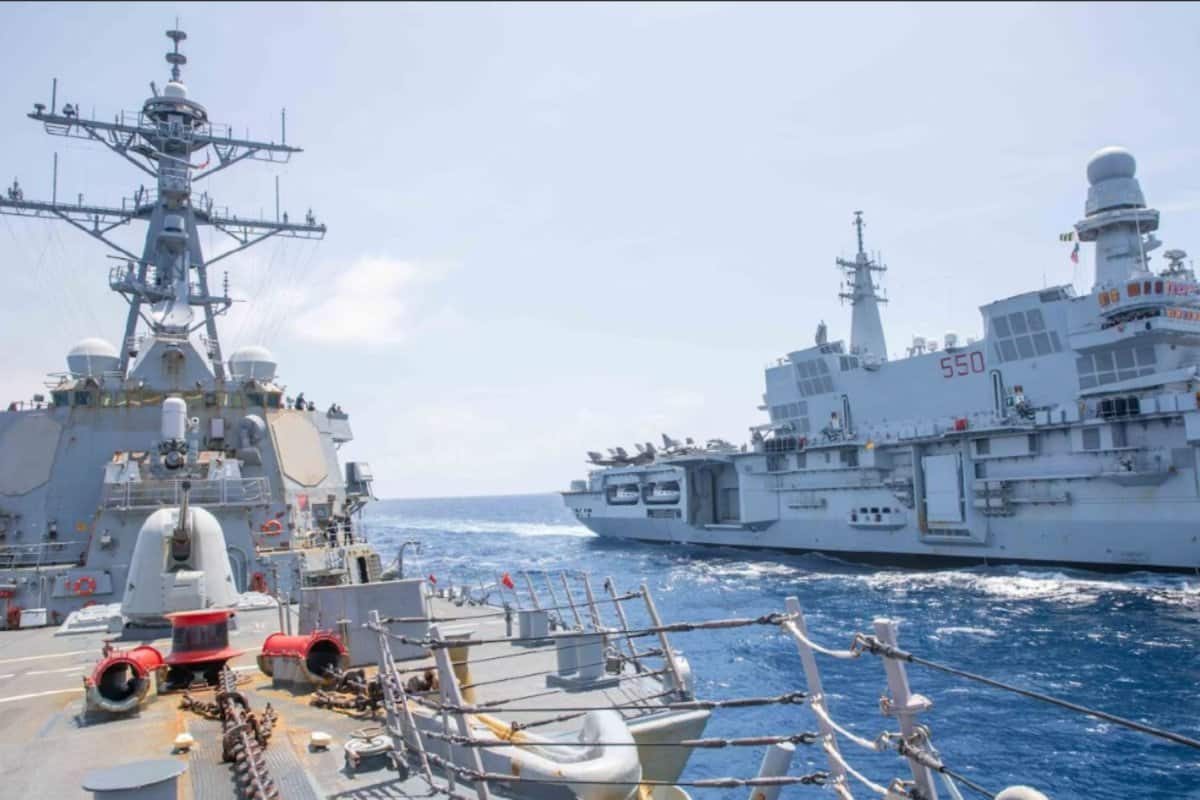
The USS Russell (DDG 59) sails past the flagship of an Italian navy aircraft carrier during maneuvers in the South China Sea, Sept. 10, 2024. The Russell is an Arleigh Burke-class guided-missile destroyer. Secretary of the Air Force Frank Kendall has warned that the threat posed by China to U.S. and allied interests in the region is increasing.
DOD
“In addition, China continues to expand its nuclear forces and its ability to operate in cyberspace,” Kendall said. “We can expect all these trends to continue.”
Kendall said he had noted a growing concern over the past 15 years from other nations concerning China’s capabilities and intentions, such as with exercises for a potential invasion and blockade of Taiwan.
“I am not saying war in the Pacific is imminent or inevitable. It is not,” Kendall said. “But I am saying that the likelihood is increasing and will continue to do so.”
Newsweek has contacted the Department of Defense (DOD) and China’s foreign ministry for comment.
The secretary’s remarks come as geopolitical tensions grow not only in Pacific region, but across the globe.
After a months-long standoff with China, a Philippine coast guard cutter withdrew from waters in a contested zone of the South China sea.
One of the largest vessels in the U.S. ally’s fleet, the Teresa Magbanua, was deployed to the Spratly Islands’ Sabina Shoal, which has been claimed by both countries, after suspicions grew that China was planning to construct an artificial island—accusations China rejected at the time.
“While committed to her mission at [Sabina Shoal], BRP Teresa Magbanua was compelled to return to port due to unfavorable weather conditions, depleted supplies of daily necessities, and the need to evacuate personnel requiring medical care,” Philippine Coast Guard spokesperson Jay Tarriela wrote on X, formerly Twitter, Sunday.
Kendall also discussed the ongoing conflict in the Middle East.
“The efforts of our national security teams and our allies and partners across the world have been successful, so far, in limiting the scale of conflict,” Kendall said. “That success has come as a direct consequence of the U.S. military, including—importantly—U.S. Air Force presence throughout the region.”
As for the war in Ukraine, the secretary said Russia would continue to remain a threat in the region but would be “weakened from years of war” whilst NATO “will be even more resilient.”
Do you have a story we should be covering? Do you have any questions about international relations? Contact LiveNews@newsweek.com