China quietly marked 75 years of Communist Party rule on Tuesday with a flag-raising ceremony in Tiananmen Square.
Unlike previous milestones, no grand celebrations were planned.
The anniversary was overshadowed by ongoing economic troubles and mounting security concerns within China.
The flag-raising ceremony was the only official event, featuring an honor guard marching from the Forbidden City, once the home of Chinese emperors.
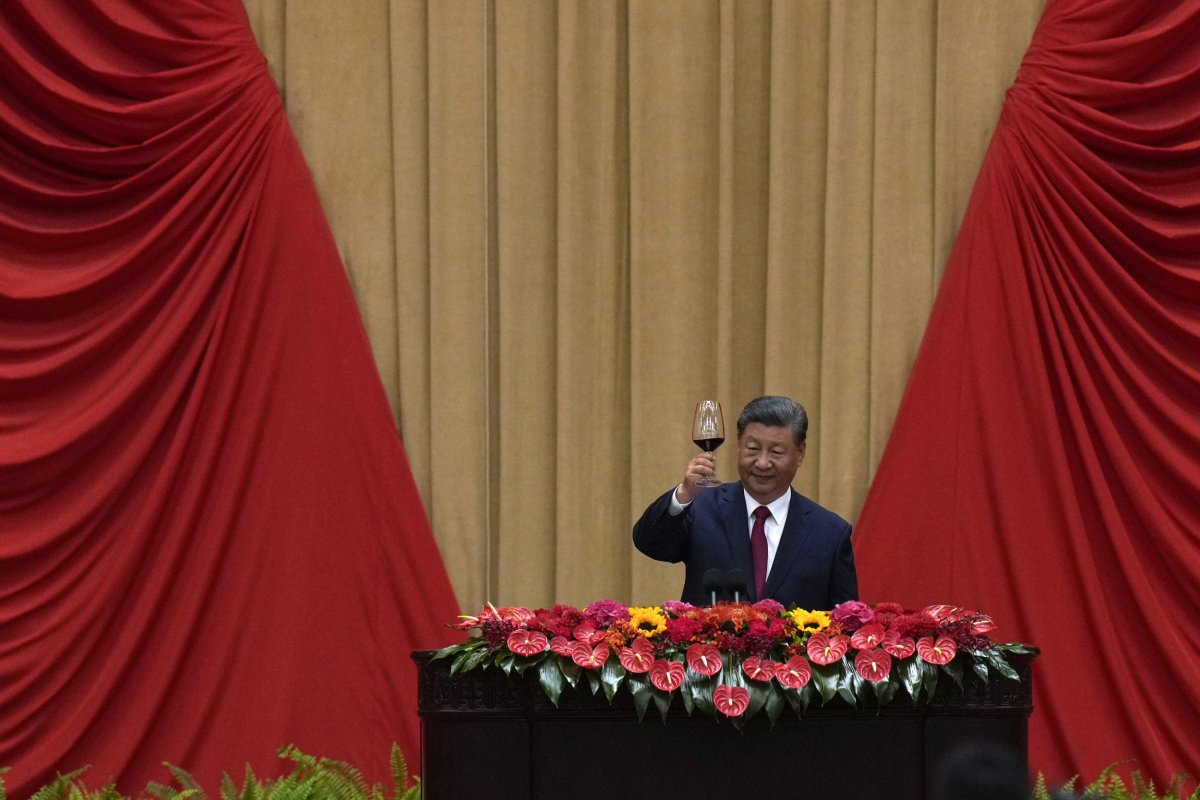
Chinese President Xi Jinping makes a toast on stage after delivering his speech at a dinner marking the 75th anniversary of the founding of the People’s Republic of China, at the Great Hall of the People in Beijing, Monday, Sept. 30, 2024. Unlike previous milestones, no grand celebrations were planned.
Andy Wong/AP
State-controlled media were filled with reports touting China’s economic progress and social stability.
Mention of the nation’s pressing challenges was avoided, including a declining birth rate and disrupted supply chains that have hit the export-driven economy.
In Hong Kong and Macao, both former European colonies returned to Chinese sovereignty in the late 1990s, commemorations were also held.
China avoided the military parades and grand displays of economic power that marked past decades, like the 60th and 70th anniversaries.
This more subdued approach reflects the reality of the world’s second-largest economy, which has struggled to regain momentum post-COVID-19.
A prolonged property slump has rippled through the economy, affecting everything from construction to the sales of home appliances.
In response, Beijing recently announced several measures to spur economic activity, including lowering interest rates and reducing mortgage down payment requirements.
President Xi Jinping, who has limited his overseas travel since the pandemic, continues to focus on internal consolidation of power.
He has intensified purges of officials deemed insufficiently loyal or suspected of corruption.
On the eve of the anniversary, Xi delivered a sober message at a banquet, warning of difficulties ahead.
“The road ahead will not be smooth; there will definitely be difficulties and obstacles,” Xi said.
“We may encounter major tests like high winds and rough seas, or even stormy waves.”
He called for vigilance, urging reliance on “the entire Party, the entire army, and people of all ethnic groups across the country.”
The muted celebration comes amid rising tensions with neighboring countries, including Japan, South Korea, and the Philippines, over territorial disputes.
China’s claims in the South China Sea and over islands held by Japan and other nations have sparked friction.
China’s recent launch of a nuclear-capable ballistic missile into the Pacific Ocean has further heightened concerns.
China’s Communist rule dates back to 1949 when Mao Zedong’s forces defeated the Nationalists (KMT) led by Chiang Kai-shek, who fled to the now self-governing island of Taiwan.
Beijing continues to assert that Taiwan must be annexed, by force if necessary, while the U.S. has provided arms to support its defense.
Domestically, Xi has tightened his grip on power, effectively making himself leader for life by abolishing term limits.
The Communist Party maintains near-total control over China’s 1.4 billion citizens, with no competitive elections and strict media censorship.
This article includes reporting from The Associated Press