As conservatives rage at the Biden-Harris administration’s response to Hurricane Helene, the voice of JD Vance might seem surprisingly absent from the criticism, especially as his home region of Appalachia has been hit hard.
As the Republican vice presidential candidate prepares for the Tuesday TV debate with his opposite number, Democrat Tim Walz, folk in the Appalachia region of North Carolina have been particularly badly affected by flooding.
The apparent political opportunity for Vance to wade in to support Appalachia might seem too good to miss. But, at the time of writing, he has said very little of note publicly.
The hurricane made landfall in Florida on Thursday before devastating several southeastern states. Republican presidential nominee Donald Trump was quick to announce a visit to a storm-battered part of Georgia, where he criticized President Joe Biden for “sleeping” and not communicating with Georgia Governor Brian Kemp — a claim denied by the governor and Biden.
Democratic presidential nominee Harris canceled campaign plans to return to Washington, D.C. to take part in briefings about the disaster response. An unnamed official told Reuters that the vice president plans to visit the affected region “as soon as it is possible without disrupting emergency response operations.” Biden has said he will visit North Carolina on Wednesday.
Several conservatives have taken to social media to criticize Biden and Harris for not yet visiting and accusing them of neglecting the region. Trump political adviser Stephen Miller wrote on X: “What can you say about a federal government that will fly Haitian illegals to Ohio but won’t fly Americans safely out of Asheville?”
William Wolfe, the executive director of the Center for Baptist Leadership, claimed in a post on X: “You think the Biden Administration or the liberal media cares about Appalachia? That’s where white people live. And they hate white people.”
Another conservative commentator on X, Greg Price, wrote that the “entire city of Asheville, North Carolina is under water,” adding: “Why isn’t the media talking about this? Where is Biden and Kamala?”
Vance, who grew up in Ohio and has family roots in eastern Kentucky, has made his Appalachian background a central part of his political identity, even penning a book about these communities in his best-selling book, Hillbilly Elegy.
But it remains to be seen whether the Ohio senator will join the criticism against the Biden-Harris administration and position himself as more concerned with these communities.
Carlos Eduardo Martín, a nonresident fellow at the Brookings Institution, noted to Newsweek that Vance’s political positions have not historically been particularly beneficial to these Appalachian communities.
“He talks about his Appalachian roots, but I don’t know if he’s delivered any specific assistance or family level assistance. I mean, the record has been him being in support of things like Big Pharma which actually have devastated Appalachian communities,” Martín said.
Vance has frequently derided the opioid crisis in Appalachia, but also once worked for a law firm that lobbied for Purdue Pharma, the maker of OxyContin.
And Vance’s anti-drug charity Our Ohio Renewal, formed after the 2016 election, reportedly achieved little during its years of operation and was closed shortly after he clinched the state’s Republican nomination for U.S. Senate.
Newsweek reached out to Vance’s campaign for comment.
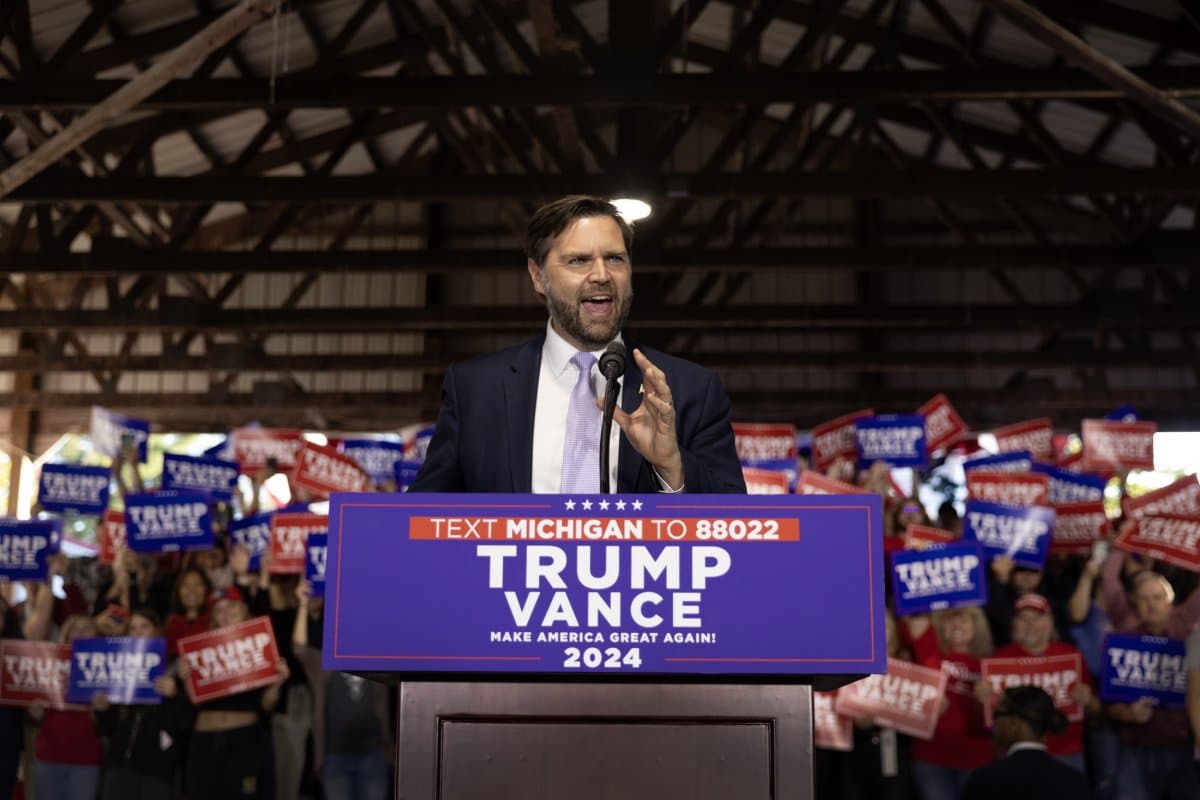
Republican vice presidential nominee U.S. Sen. JD Vance (R-OH) speaks to supporters during a campaign event at the Northwestern Michigan Fair grounds on September 25, 2024 in Traverse City, Michigan.
Scott Olson/Getty Images
Martín added that while Trump is positioning himself as the candidate more focused on disaster response, he has a history of politicizing natural disasters.
Martín pointed out that during his presidency, Trump often politicized the presidential disaster declaration process, one example being when he threatened to withhold federal money from California as wildfires raged in the state.
As for the “outrage” that Biden and Harris have not yet visited storm-ravaged areas, Martín noted that the administration will likely be coordinating with local governors to determine the best time for a visit, as is typical to do following a natural disaster.
Martín also pointed to the fact that Trump and Vance have both previously expressed skepticism about human-driven climate change, which experts widely cite as a key factor in the rise of extreme weather events.