The Biden administration has imposed new sanctions on Georgian officials and media figures, accusing them of undermining democracy and violating human rights.
On Monday, the U.S. State and Treasury departments announced asset freezes on four individuals, including two high-ranking Interior Ministry officials and two media figures.
The sanctions target those “violently suppressing the exercise of the freedom of peaceful assembly of Georgians engaged in the democratic process and peaceful expression.”
Among those sanctioned are Zviad ‘Khareba’ Kharazishvili, chief of the Interior Ministry’s special task department, and his deputy, Mileri Lagazauri.
The Treasury Department stated that both officials played key roles in the violent crackdown on demonstrators earlier this year.
“Today’s action underscores our concern about the consequences of anti-democratic actions in Georgia and efforts by key individuals to use violence and intimidation to achieve their aims,” said Acting Under Secretary of the Treasury for Terrorism and Financial Intelligence Bradley Smith in a statement.
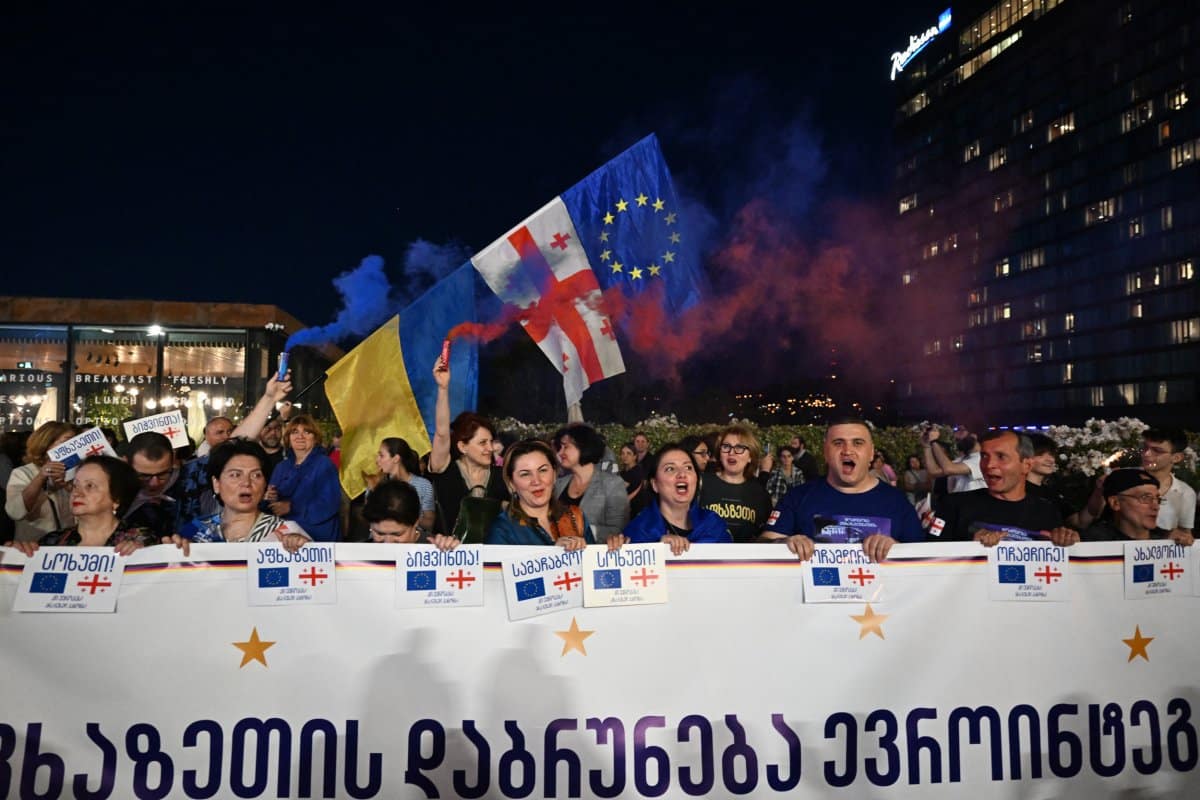
Demonstrators protesting the “foreign influence” law attend a concert aimed at raising funds to pay police fines of their fellow protesters, at Tbilisi’s Republic Square on June 2, 2024. Critics compare this law to Russian legislation used to crack down on dissent. The law forces media outlets and NGOs to register if they receive more than 20% of their funding from abroad.
VANO SHLAMOV/AFP via Getty Images
Media company Alt-Info founder Konstantine Morgoshia was also targeted, along with Zurab Makharadze, an Alt-Info personality.
The Treasury Department said that Morgoshia’s platform amplified disinformation and spread hate speech, while Makharadze encouraged violence against minorities and journalists.
Alt-Info has been linked to far-right movements in Georgia and has promoted nationalist rhetoric that critics argue fuels divisions in the country.
In addition to the asset freezes, the State Department announced visa bans on more than 60 Georgian government officials, business leaders, law enforcement officers, and members of parliament.
The individuals, whose names were not disclosed, are accused of playing roles in the ongoing suppression of democracy.
Each visa ban comes as part of a broader U.S. effort to hold accountable those responsible for the violent response to protests over the foreign agent law.
Passed by the Georgian parliament in May 2023, the legislation requires media outlets and nongovernmental organizations (NGOs) to register as “pursuing the interests of a foreign power” if they receive more than 20% of their funding from abroad.
The law was passed despite widespread opposition and a presidential veto.
Protesters in Georgia’s capital, Tbilisi, have previously expressed concern that the law will hinder the country’s aspirations to join the European Union.

Demonstrators protest in front of the Georgian Parliament Building as the Georgian parliament overrides president’s veto on Foreign Influence Law on May 28, 2024 in Tbilisi, Georgia. The U.S. suspended $95 million in assistance to Georgia in July due to concerns over democratic backsliding.
Nicolo Vincenzo Malvestuto/Getty Images
Georgia has long sought closer ties with Europe, applying for EU membership in 2022.
However, democratic backsliding, including the foreign agent law, threatens its membership bid. The EU has consistently stated that Georgia must uphold democratic principles and press freedoms to be considered for candidacy.
Critics argue that it closely resembles a Russian law used to shut down civil society and restrict media freedoms.
Russia’s 2012 “foreign agent” law has been used by Moscow to target civil society, NGOs, and independent media by labeling them as foreign-funded entities.
In Russia, this has severely limited the ability of independent organizations to operate.
The sanctions follow previous U.S. measures, including the freezing of aid and the suspension of a $95 million assistance package, reflecting growing U.S. concerns over Georgia’s political trajectory.
This article includes reporting from The Associated Press.