Archaeologists working at the a World Heritage Site in Cambodia have unearthed 12 sandstone statues, some of which are over a thousand years old.
The discovery took place in Angkor—one of three Cambodian UNESCO sites—near the city of Siem Reap, officials announced on Wednesday.
Researchers confirmed the statues were found buried near the north gate of Angkor Thom, the 11th-century capital of the Khmer Empire.
Since then, the relics have been identified as “door guardians.”
Sorn Chanthorn, one of the leading archaeologists, says they were buried up to 4.5 feet below the surface. Despite this, some of the statues are in surprisingly good shape, according to Long Kosal, spokesperson for the Apsara National Authority, which oversees the archaeological site.
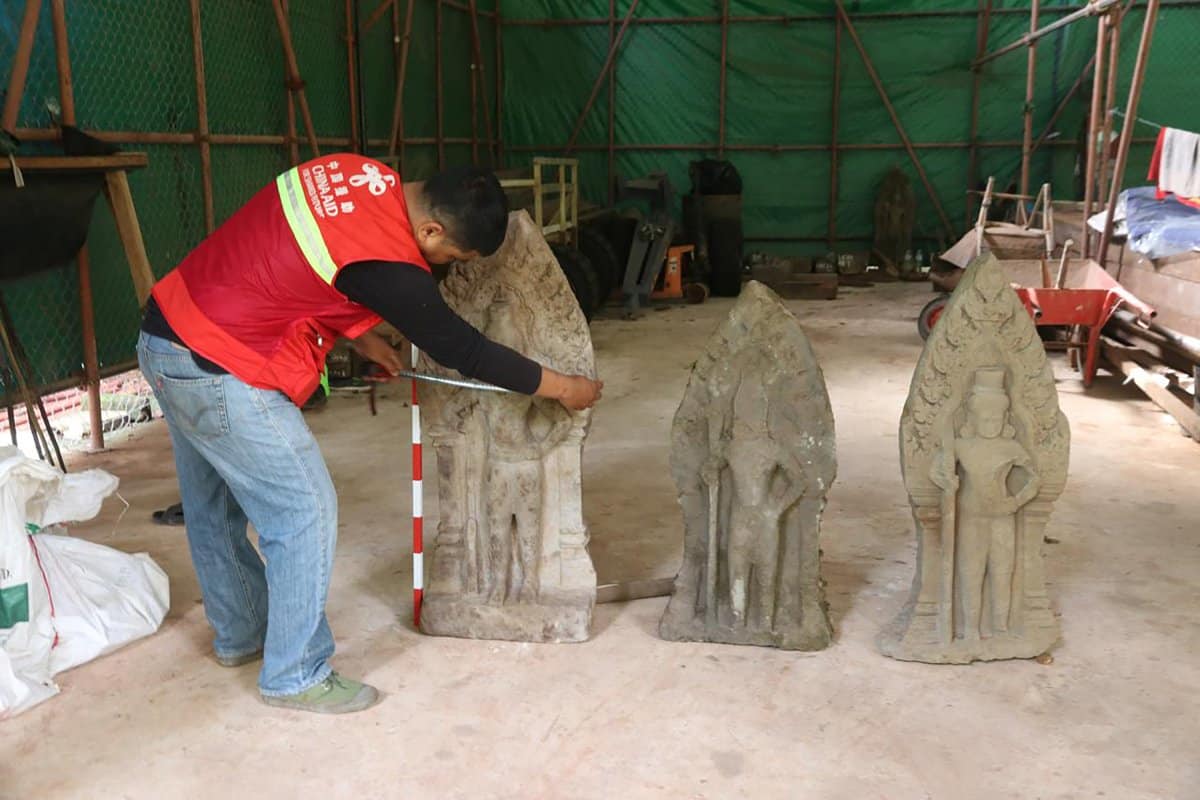
This handout photo provided by Apsaras National Authority shows centuries-old sandstone statues being arranged at Angkor Thom in Cambodia, Oct. 24, 2024. The statues vary in size, from 39 to 43 inches, and were found at burial depths reaching 4.5 feet.
Phouk Chea/Apsaras National Authority via AP
What Do the Cambodian Artifacts Look Like?
Each artifact is distinctive, measuring between 39 and 43 inches in height.
After documenting the precise positions of the statues, archaeologists removed them for cleaning and restoration. Authorities have planned for the statues’ eventual return to their original locations around the gate of the temple.
Unique facial hair ornamentation has allowed researchers to visually identify the works as Khneang Style, a hallmark of the Khmer period.
“Experts believe these door guardian statues exemplify the Khneang Style, aligning with the construction period of the 11th-century palace.” the Apsara National Authority said.
Angkor Thom lies within the sprawling Angkor Archaeological Park, a UNESCO World Heritage Site that covers roughly 154 square miles.
It is known as being the final capital of the Khmer Empire.
This recent find was part of a larger collaboration between Apsara and the China-Cambodia Government Team for safeguarding the area.
The complex draws hundreds of thousands of tourists annually—particularly to the Angkor Wat temple, an emblem of centuries-old design and urban planning.
Cambodia’s Tourism Ministry reported that in the first half 2024 alone, over 500,000 international visitors toured the historic site, located approximately 200 miles northwest of capital city Phnom Penh.
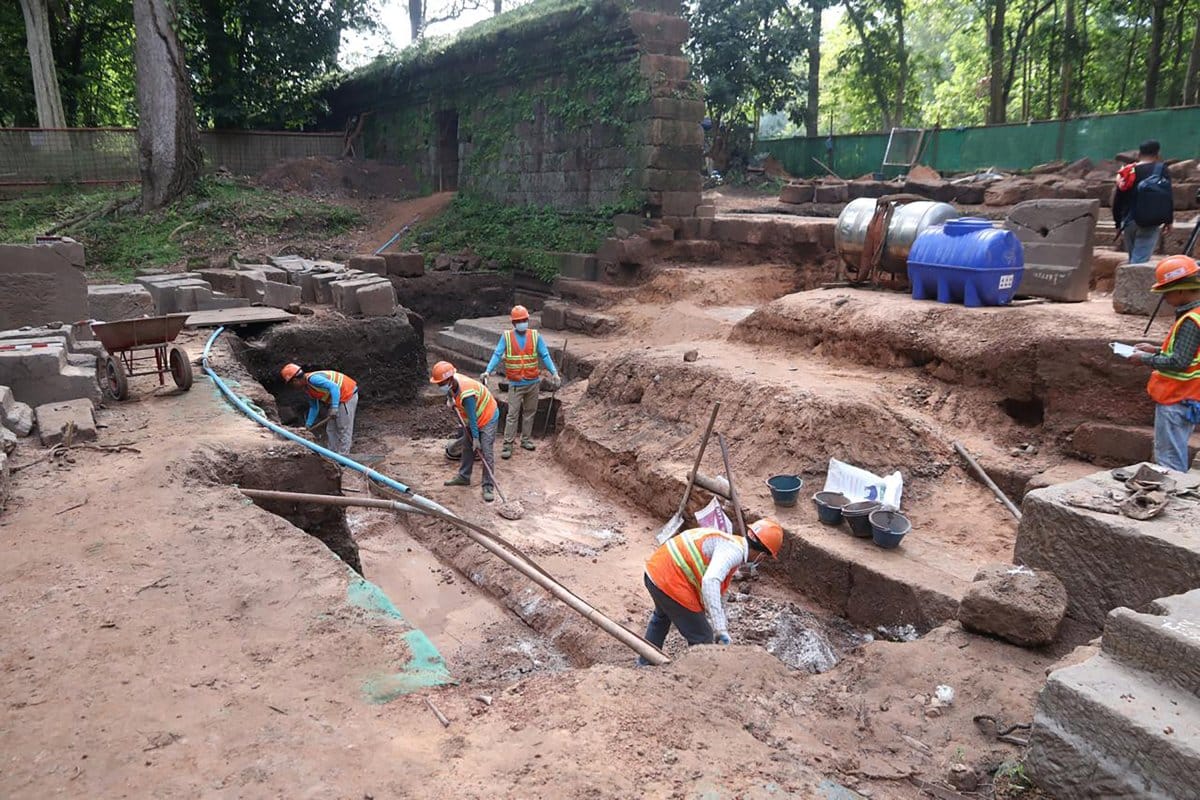
This photo shows centuries-old sandstone statues being arranged at Angkor Thom in Cambodia, Oct. 24, 2024. Each guardian statue displays unique facial ornamentation, including different beard styles and facial expressions, hinting at individualized craftsmanship by the Khmer artists of the 11th century.
Phouk Chea/Apsaras National Authority via AP)
Possible Human Rights Law Violations
UNESCO have worked extensively with Cambodian authorities on the conservation of Angkor since reopening its Phnom Penh office in 1991.
Angkor Wat was granted World Heritage status in 1992.
However, the site has been at the center of controversy over alleged forced evictions.
Cambodian authorities recently enforced relocations for thousands of residents living within the site’s borders in the name of protecting Angkor’s archaeological integrity.
An Amnesty International report from November 2023 condemned these actions, describing the relocations as a “gross violation of international human rights law.”
It detailed hardships faced by families who were forced from their homes, including lack of infrastructure and access to basic services at resettlement sites including Run Ta Ek.
Residents reportedly took on unsustainable debt to rebuild homes, with some resorting to using their social security cards as collateral.
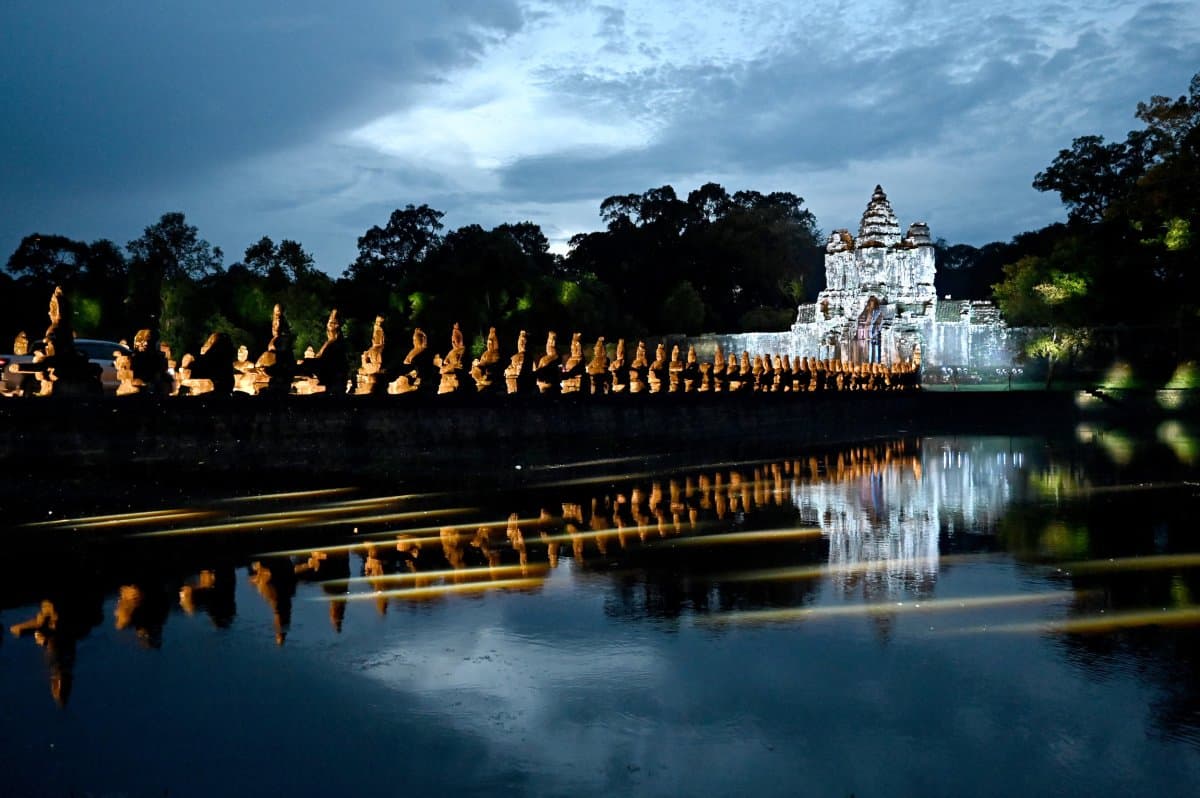
A general night view of the Angkor Thom south gate is pictured at the Angkor complex in Siem Reap province on Sept. 16, 2024. The World Heritage Site is under scrutiny due to alleged forced relocations of local residents to protect the area.
ANG CHHIN SOTHY/AFP via Getty Images
UNESCO’s Proposed Monitoring of Angkor Relocations
Mass relocation was supported by then-Prime Minister Hun Sen, who gave a speech warning the site risked losing the designation unless they moved residents away.
He confirmed those who failed to sacrifice their homes would get no compensation.
Amnesty’s report estimates 10,000 families were evicted from the site by Cambodian authorities, violating international and national law.
Further reporting urged those responsible to protect the rights of relocated communities, calling for a “commitment to ensuring that the conditions of relocated populations comply in all respects” with human rights.
The United Nations World Heritage Committee have since expressed “concern about possible forced population displacements” and requested Cambodia invite a joint monitoring team to assess the resettlement.
This article includes reporting from The Associated Press