Cookbooks, like memoirs and nonfiction novels, provide vital insight on how humans do what they do best—live their lives. The passing down of recipes, whether written or unwritten, is as old as time. A new cookbook, The Oldest Kitchen in the World, honoring one of the oldest cuisines in the world—Assyrian cuisine—highlights how ancient and unique this Middle Eastern gastronomy is and grants anyone the opportunity to enjoy over 4,000 years of rich culinary history in their very own kitchen.
Newsweek‘s Ramsen Shamon interviewed the cookbook’s author, Matay DeMayee, about the process of compiling his illiterate mother Smuni Turan’s recipes in hopes of safeguarding her cooking for generations to come. They discussed some of DeMayee’s favorite recipes, while also addressing the dark chapters of modern Assyrian history mentioned in the cookbook.
Assyrians are Indigenous to the Middle East and have been persecuted throughout their contemporary history due to their distinct ethnic identity and Christian religion. This historical family cookbook shares a matriarch’s story of leaving her homeland for Europe, while showcasing the originality of Assyrian cooking to the world—a cuisine that is seldom if ever given any attention on the international stage but has always been the blueprint for other cuisines. The time is ripe to celebrate and pass on Assyrian cooking with The Oldest Kitchen in the World, an essential addition to any kitchen. You can pre-order The Oldest Kitchen in the World: 4,000 Years of Middle Eastern Cooking Passed Down through Generations (A Cookbook) at Barnes & Noble.
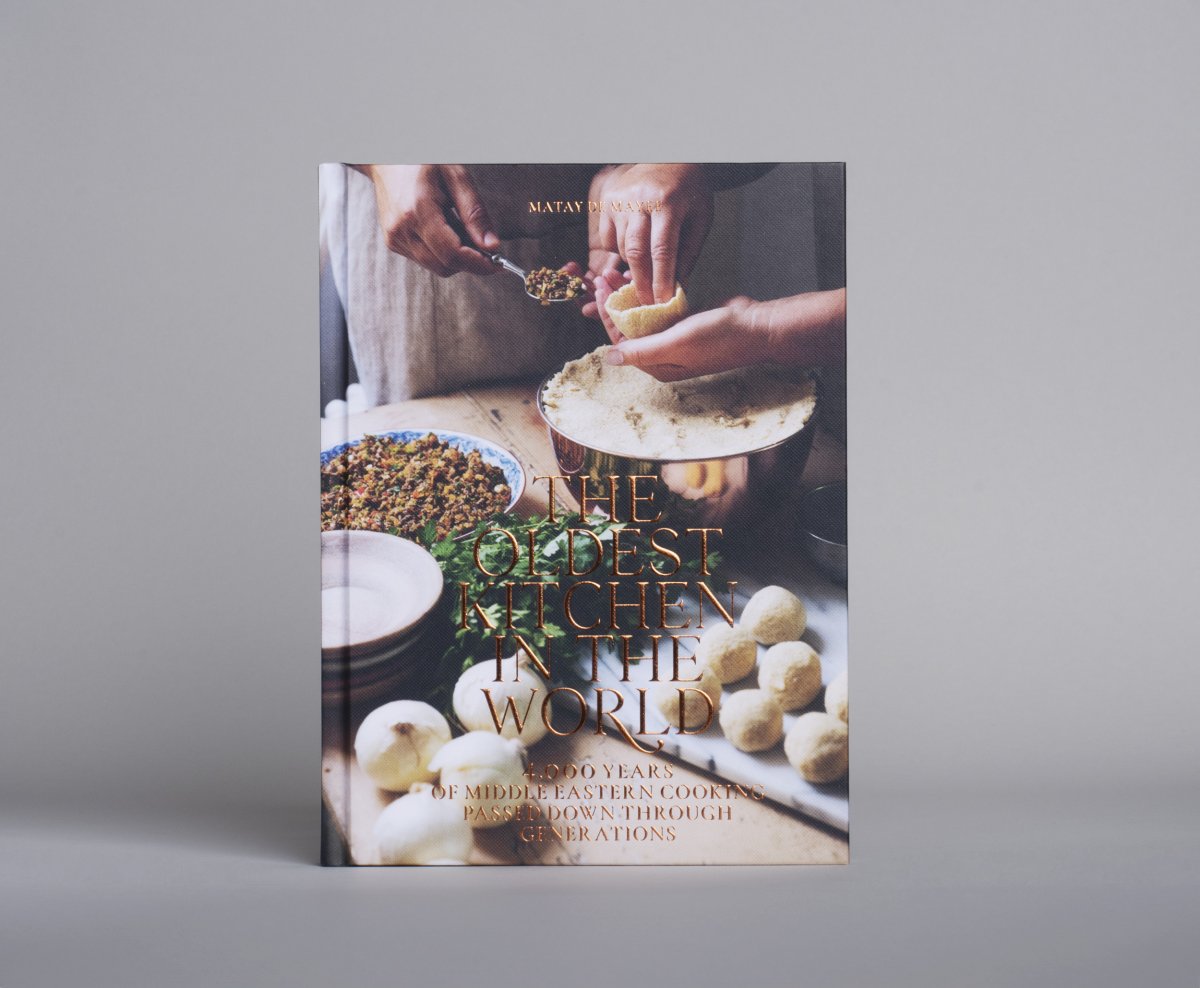
“The Oldest Kitchen in the World” is seen.
Courtesy of Emma Peijnenburg, Claire Witteveen, and Daan Heijbroek
Q_Why did you decide to make The Oldest Kitchen in the World?
A_It’s an introduction to the culture and history of the Assyrians, also known as Syriacs, Chaldeans, or Arameans. Our culture is very rich and comprehensive. Did you know that agriculture first developed in our homeland between the rivers of Tigris and Euphrates and the art of cooking almost immediately followed? But our history is also tragic, and unfortunately unknown to many people. In my cookbook, I share, through a large selection of delicious recipes, not only the culinary, but also the cultural and intellectual wealth of the people who’ve lived in the Middle East since ancient times—the people of our family.
You feature the ancient Akkadian words for ingredients along with the modern words used by Assyrians today. How hard or easy was it to find the words of ingredients in Akkadian—one of the earliest languages spoken in Mesopotamia?
A strong knowledge of the modern Aramaic dialects (spoken Surayt/Sureth), Syriac (especially reading literary Syriac) is required to navigate through the Akkadian dictionaries and to link the Akkadian words for certain ingredients to our modern Aramaic dialects. This proved to be a difficult and time-consuming part of writing this book.
Akkadian was gradually replaced by Aramaic, a dialect of which my mother and I speak and is presumed to be the language spoken by Jesus Christ. Aramaic adopted many words for recipes, ingredients, and techniques from ancient Akkadian.
Your mother’s recipes and life are beautifully highlighted in the cookbook. Which is your mother’s favorite recipe and why?
Stuffed wheat pouches, kötle, filled with minced meat and finely chopped onions and parsley. Brushed in beaten eggs and fried. It holds a special place in our [Assyrian] tradition as it is a popular and beloved dish that is often prepared for special occasions and family gatherings. Making the pouches requires time and nimble fingers, a kneading technique that she learned from her mother.
Which is your favorite recipe?
Kleicha, light and crunchy spice cookies. It is my favorite childhood cookie. These cookies are enjoyed especially during Easter and Christmas, when people bake them in vast quantities.
Which recipe is the easiest to make for those who don’t cook much? And which is the most difficult?
There are many easy dishes such as bulgur, salads, one-pot dishes, a lemony red lintel soup, or juicy orange almond semolina cake. Kötle, is the most difficult, these seemingly simple stuffed dough pouches require significant concentration and practice.
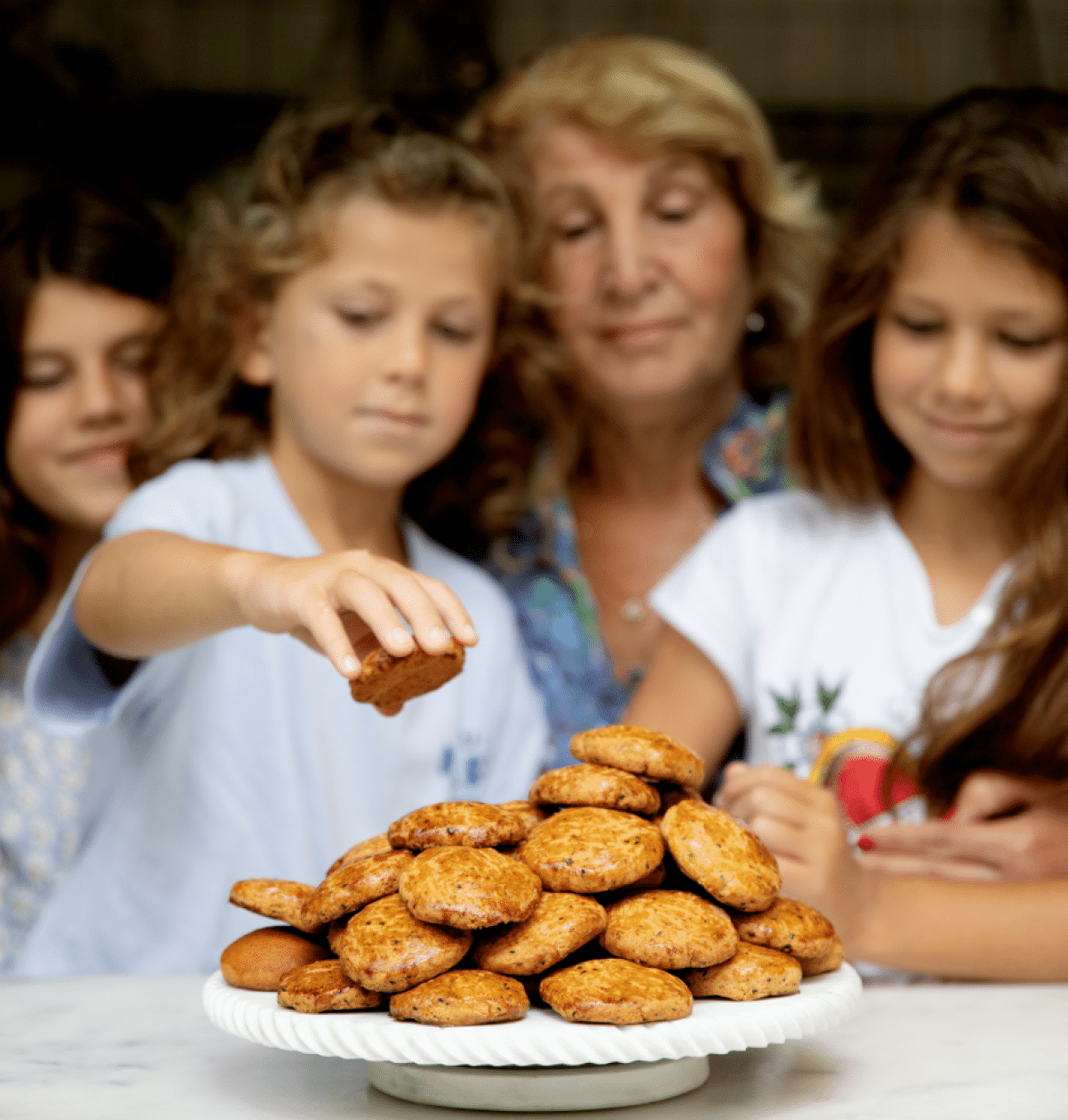
Smuni Turan and children are pictured.
Courtesy of Emma Peijnenburg, Claire Witteveen, and Daan Heijbroek
Which dish should every Assyrian learn how to make?
Easter is the most significant and oldest celebration for the Assyrian people. Naturally, good food and drink are integral. For my mother, this is the busiest time of the year. She makes everything herself, from yogurt and cheese to braided soft sweet rolls.
The most important dish to learn is [how to bake] bread, as there is no meal that is not accompanied by a slice of it. Traditionally bread was baked in a tanuro, a communal oven made from mud clay—an oven that’s been the same for thousands of years. It’s shaped somewhat like a giant beehive, and houses a wood fire. It has a small hole at the bottom for airflow and a larger one at the top for access. When the fire is reduced to smoldering embers, bread dough is adhered to the oven’s inner walls. The result is lahmo doe tanuro (bread from the oven), a bread with a light texture.
Which dish do you enjoy making with your mom the most?
Maqloubeh. The name translates to “flipped over.” It is a savory upside-down pie, bursting with herbs and spices. The preparation is straightforward, except for the very last part—flipping the pie onto a plate. This needs to be done in one swift move, and you only get one chance to get it right. This event always stirs much excitement and both my mother and I want to see if the maqloubeh keeps its shape. If it doesn’t, you would see the disappointment on our faces. But usually it goes well, and then we are very happy.
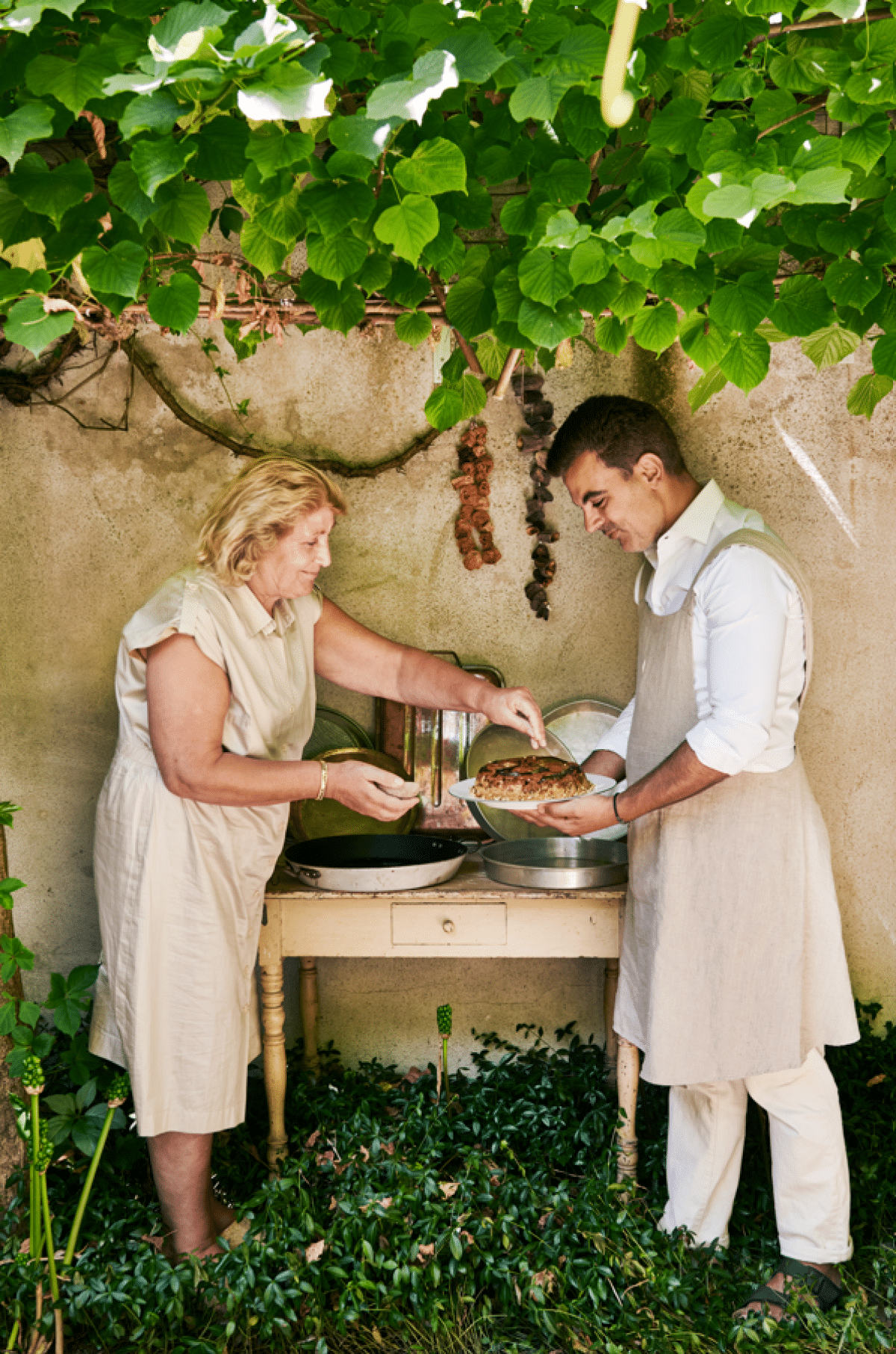
Cookbook author Matay DeMayee is pictured with his mother Smuni Turan.
Courtesy of Emma Peijnenburg, Claire Witteveen, and Daan Heijbroek
What was the most important thing you learned from your mom while making The Oldest Kitchen in the World?
The most important thing I learned was that my mother told me stories I’d never heard before. Stories about her childhood, the way she lived in Tur Abdin [modern Turkey], the way her family survived in a hostile world, and of course the way she cooked. So making this book was not only fun, but also moving and revealing.
Naturally it helps that we get along very well, especially in the kitchen. Cooking and telling stories simply go very well together. My mum is as good a listener as she is a storyteller. Maybe that’s enhanced by the fact that she can’t read nor write. It’s probably the beautiful side of illiteracy. All her stories and recipes have been passed on orally for centuries. And so I heard, while writing down the recipes, many old and new stories. And I learned much more about myself and our history.
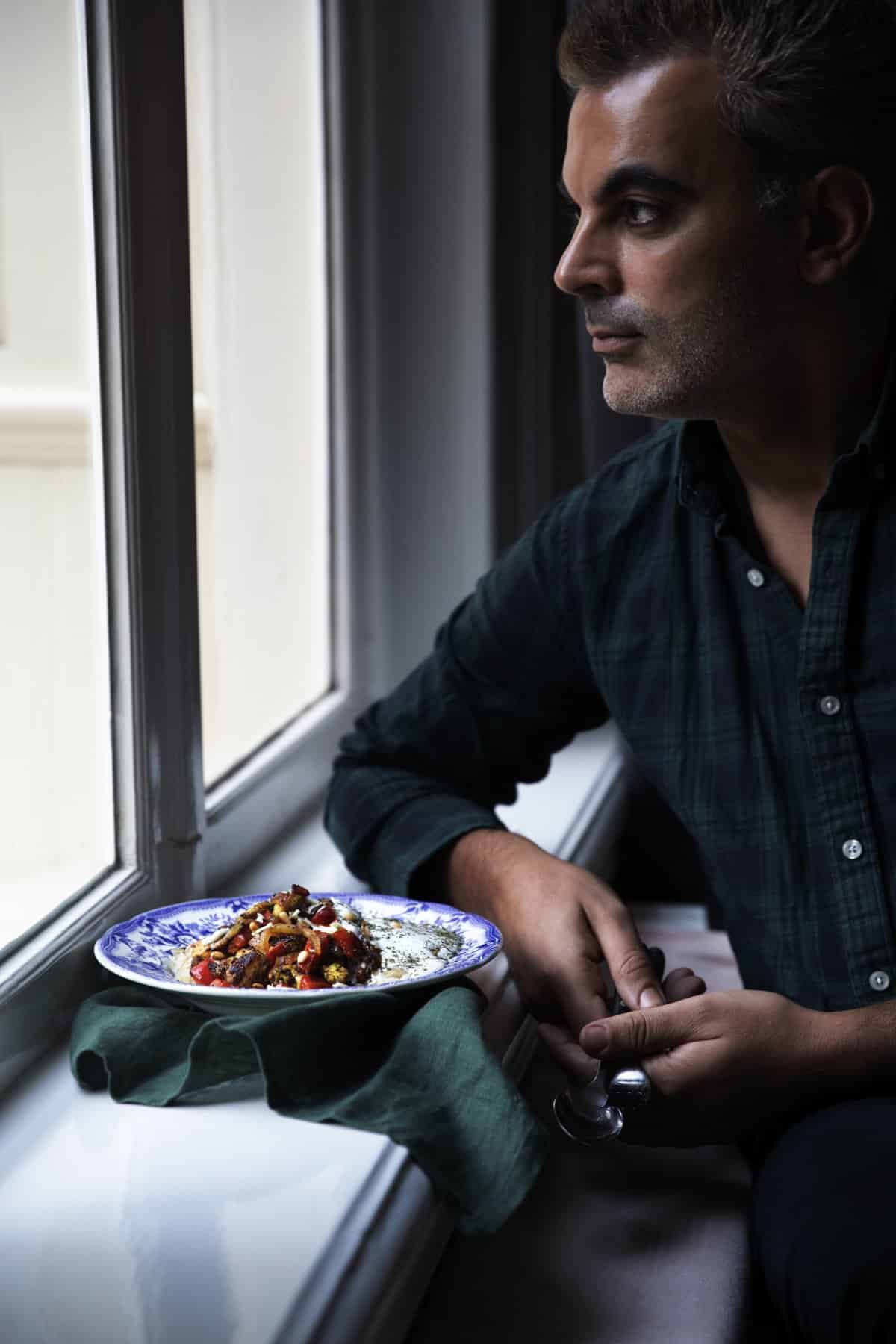
Cookbook author Matay DeMayee is pictured.
Courtesy of Emma Peijnenburg, Claire Witteveen, and Daan Heijbroek
One of your relatives, Semun Hanne Haydo Turan, was highlighted in the book as a hero during the Assyrian genocide during the early part of the 20th century. Does an English language book exist about him? How can we learn more about his life?
There is an English translation of Kemal Yalcin’s book on Semun Hanne Haydo, my great-grandfather, who was a hero of the resistance. During the horrors of the Sayfo, the 1915 genocide by the Ottoman Empire, around the time of the first World War, he and his brother Malke protected as many people as possible and prevent attacks on entire villages such as Sare and Bsorino.
Eventually, my Christian great-grandfather was taken prisoner. He and a friend, who was Muslim, executed a daring escape from the prison by tying blankets together and jumping out of a high window. They concealed themselves in the tall wheat and corn in the fields and survived. He passed away much later in 1964. Later this year his memorial in Tur Abdin will be revealed, including the screening of a documentary film that will be released.
We will be looking forward to viewing that documentary. This book reminded me of how much Assyrian culture and traditions have been lost over time due to genocide, war, and displacement. What can communities in diaspora do to maintain their culture and pass it on to future generations?
Language is a key identity marker. Assyrians must endeavor to keep their language alive through speech and education. If diaspora fails in this respect, they should at the very least record their language. Assyrians can also educate fellow Assyrians on their identity, their culture and traditions, and try to build strong institutions (churches, schools, cultural centers) to safeguard and celebrate the Assyrian heritage for future generations. Culture gets passed and lives on through food. That’s also one of the reasons why I wrote this book. As our culture is likely to become endangered within the foreseeable future and many stories and recipes are transmitted orally from one generation to another, I’d like to stress the importance of documentation so it will be maintained, especially when this is firsthand information or experience. I hope I’ve contributed through this book.
What does your mom hope for the future?
Democracy, equal rights, and protection of Indigenous Peoples and minorities, in the Syriac–Assyrian–Aramean-Chaldean peoples’ home countries of Iraq, Syria, Lebanon, Israel, Turkey, Iran, and Jordan. We have become a minority people in our home countries with atrocities and policies of exclusion. She hopes that our endangered culture and language will be preserved.
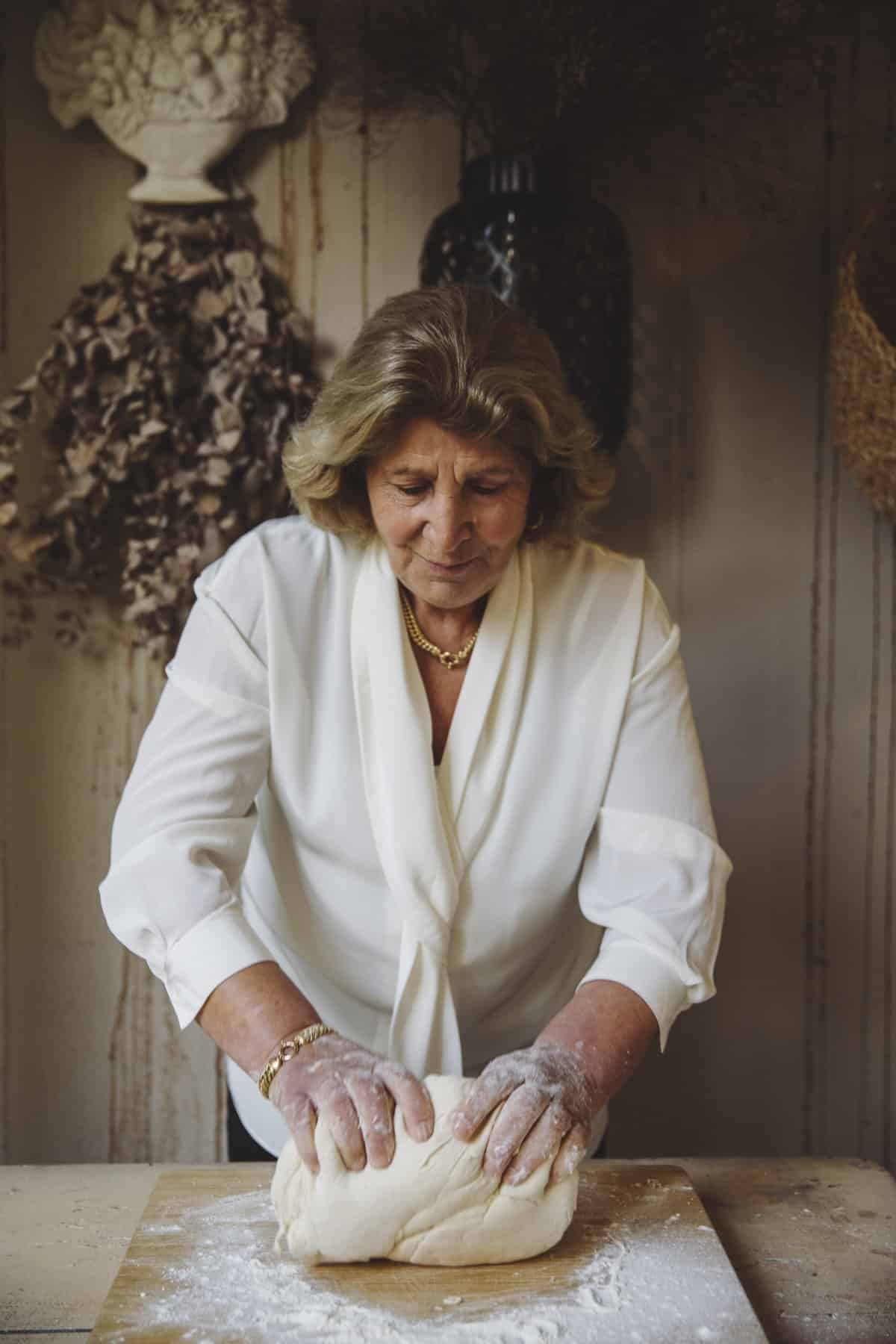
The cookbook author’s mother Smuni Turan is seen. The recipes featured in “The Oldest Kitchen in the World” were passed down throughout the generations.
Courtesy of Emma Peijnenburg, Claire Witteveen, and Daan Heijbroek
After leaving for Europe, your mother visited her village only once. Will she visit it again?
After 35 years she returned to her birth village Sare [in modern Turkey], once, during summer in 2007. She stayed at her ancestral home, which was rebuilt by her brother and nephew. It was hot and she slept outside on the flat rooftop of the house. She visited ancient monasteries such as Mor Gabriel and Dayr al-Zafaran. She dried grapes to make raisins and enjoyed delightful meals at a restaurant overlooking the border with Syria. She savored wine from the winemaker, who maintains the tradition of producing Assyrian wine.
Yet, she was also very saddened—most of the houses in her village were destroyed, and hardly anyone lived there anymore. The majority of people had been driven away, most Christians had left, and much of the culture had consequently been lost. They’ve become ghost towns.
Our plan is to go together soon, my first time, as she is still alive. She’d be my best guide. My mum’s nephew Fikri Turan still lives in her birthplace Sare and never left. My uncle, who lives in the Netherlands, rebuilt the house my mother grew up in. My mum will not return back to the homeland unless it’s with me. But there are certainly individuals here in the Netherlands who return back, invest in property, or choose to be buried there.
What other projects can we look forward to?
More international translations of our book will be published, and we’ve been contacted by a TV director who believes our cookbook and story reads like a movie; they recently recorded a promo with us for a potential TV series or documentary. The most excited project I am looking forward to is visiting Tur Abdin, the land of my ancestors and see what is left of the house of my parents. A place I can’t easily go to and hardly know, but I’d like to discover what traces are left of our people and culture. I’d like to travel to small villages in the region and ask the locals how they cook and learn more about the ingredients they use. I am curious if the taste of their cooking is familiar to the kitchen of our people that live in diaspora. This may be inspiration for a new book. I hope they’ll tell me about a dish or about a tradition, and open their hearts and their recipes and tell their stories and secrets. This could be historic documentation. I’d like to promote this cuisine, so people know about the Assyrians.
Any final thoughts?
My favorite cookbooks not only contain recipes, but also compelling photography and are full of stories—well explained, within a context. This way you are often introduced to a whole new world. Writers such as Claudia Roden and Nigel Slater are masters at this. You are truly drawn into their kitchen and world of thought. I love that, you immediately feel like getting started. I hope my cookbook will have these qualities, too.
Portions of this interview were edited for clarity.