After several years of growth, German birth rates have had a “massive” decline, a new analysis reveals, although fertility rates are not equal across the country.
Between 2011 and 2016, fertility rates across Germany rose from 1.38 to 1.59 children per woman. This, according to the Federal Statistical Office, was a result of better framework conditions for families with children and immigration.
However, in 2022, fertility rates dropped 8 percent, compared with the previous year, and they fell a further 7 percent in 2023, down to only 1.35 children per woman.
Provisional data for the first quarter of 2024 shows a continuation of this trend. So what is driving this crash in birth rates?
“The coronavirus crisis, the outbreak of war in Ukraine, and the subsequent drop in real income due to high inflation have clearly prompted many young families to put off having children for the time being,” Joachim Ragnitz of the Dresden branch of the ifo Institute, said in a statement released October 23.
“Childbearing behavior, expressed by the birth rate, has changed massively in the past three years. It currently stands at just 1.35 children per woman, compared to 1.58 children per woman in 2021,” he said.
The institute says another key piece of the puzzle is the dwindling number of women aged between 27 and 36 in eastern Germany—an age group that accounts for the majority of births in the region.
The map below shows where birth rates are the lowest:
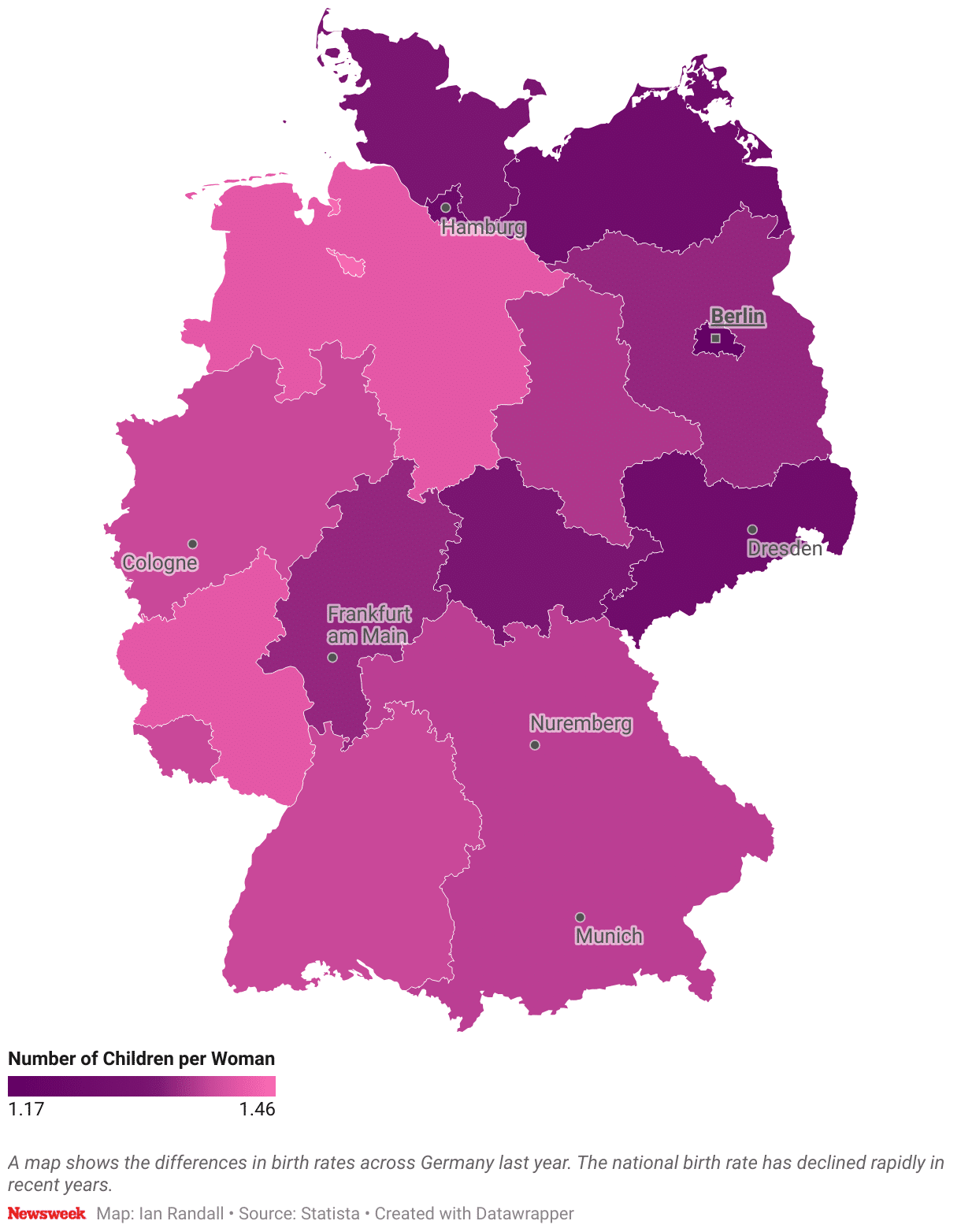
The states with the lowest birth rates are:
- Berlin: 1.17 children per woman
- Hamburg: 1.24
- Sachsen: 1.26
- Mecklenburg-Vorpommern: 1.26
- Thuringia: 1.33
At the other end of the spectrum, the states with the highest birth rates are:
- Bremen: 1.46
- Lower Saxony: 1.42
- Rhineland-Palatinate: 1.42
- Baden-Württemberg: 1.39
- North Rhine-Westphalia: 1.39
“Overall, almost 80,000 fewer children were born in 2022 and 2023 than would have been expected,” Ragnitz said.

Birth rates have taken a sharp decline in Germany following several years of growth. In 2022, fertility rates dropped 8 percent, compared with the previous year, and they fell a further 7 percent in 2023.
oatawa/Getty
In total, the country saw 692,989 births in 2023, with mothers having an average age of 30.3 at the birth of their first child. Meanwhile, as of 2022 the percentage of women who choose not to have children stood at 20 percent. This has remained fairly constant in Germany since 2012.
So far, it is too early to say whether the recent changes in birth rates are temporary or permanent.
“Politicians would be well advised to monitor these developments more closely, also in order to avoid possible wrong decisions when expanding daycare and schooling,” Ragnitz said.
Do you have a tip on a science story that Newsweek should be covering? Do you have a question about global populations? Let us know via science@newsweek.com.