As much as 94 percent of New Yorkers on public drinking water sourced from groundwater are predicted to have exposure to certain chemicals, according to a new analysis from the U.S. Geological Survey (USGS).
The study, which published on Thursday, found that up to 95 million people in the U.S. “may rely on groundwater that contains detectable concentrations of per- and polyfluoroalkyl substances, also known as PFAS, for their drinking water supplies,” a press release from the USGS said.
Also known as forever chemicals because of the long time it takes for them to breakdown, PFAS encompass thousands of man-made chemicals found in everyday items such as nonstick cookware, firefighting foams, grease-resistant food wrappers and water-resistant clothing.
These chemicals can be harmful in high amounts, leading to heightened cholesterol and an increased risk for some cancers, according to a U.S. Agency for Toxic Substances and Disease Registry webpage dedicated to PFAS.
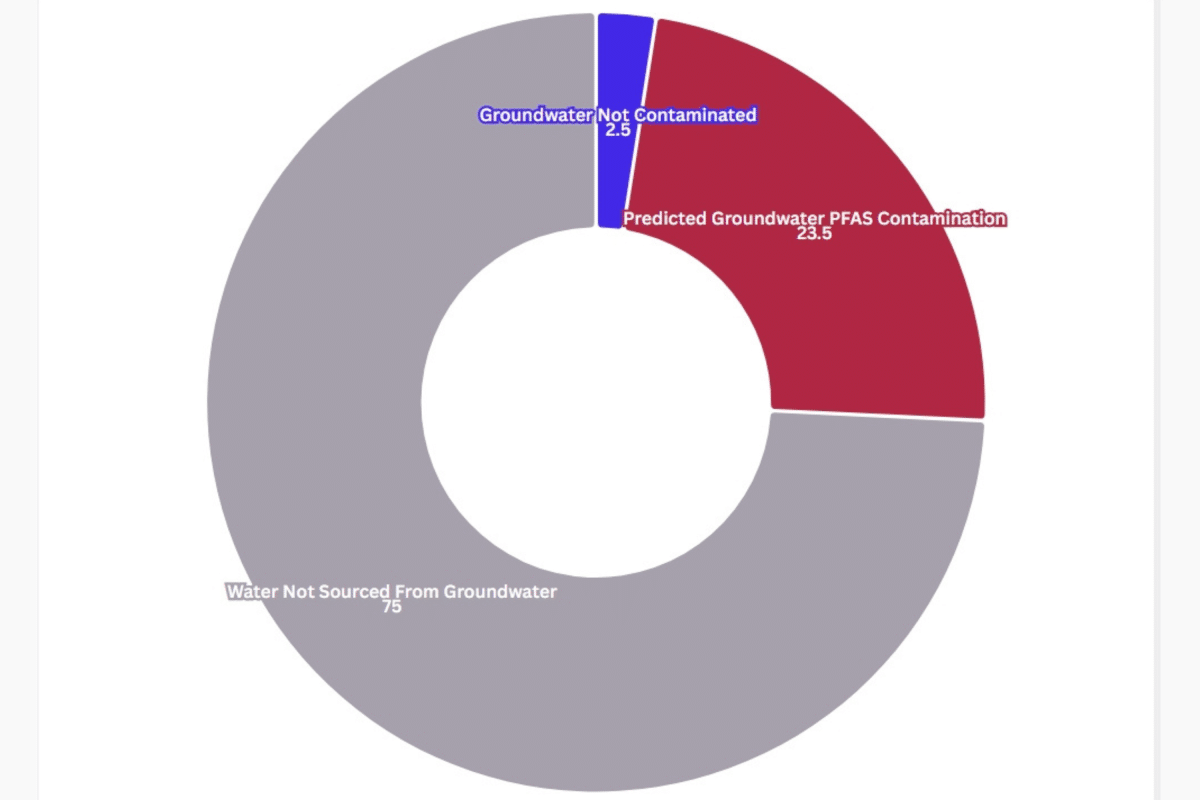
A chart showing the percentage of public water supply sourced from groundwater in New York predicted to have PFAS contamination. Up to 94 percent of the public water supply sourced from groundwater could have PFAS concentrations.
Newsweek
East Coast states are particularly at risk for PFAS exposure, and as much as 94 percent of the public water supply sourced from groundwater in New York was predicted to have PFAS concentrations on some level.
Roughly a quarter of New Yorkers receive their water from groundwater, or “water that exists underground in saturated zones beneath the land surface”, according to the USGS.
Of the New Yorkers that source their drinking water from public groundwater supply, 74 to 94 percent are predicted to have concentrations of PFAS in their water, the USGS study found. Up to 56 percent of those sourcing their water through a domestic supply of groundwater, such as private wells, are predicted to have some level of PFAS concentration.
The study predicted the “probability of occurrence above detectable concentrations,” not the actual concentrations themselves, USGS research hydrologist and lead study author Andrea Tokranov told Newsweek.
“The number one predictor for PFAS occurring in groundwater is urban land use, which matches nicely with what we see here in the map,” Tokranov said, adding that the East Coast has the highest population density in the country.
Well depth and clay percentage are also top predictors for PFAS concentrations in groundwater.
The study comes as New Yorkers have expressed concern about their water for myriad reasons. Officials in a Long Island village found wells to be contaminated by a possible carcinogen earlier this year. A recent poll found that 83 percent of likely voters surveyed found the quality of Long Island drinking water to be a “serious” problem.
Meanwhile, cities around the nation are taking a closer look at the quality of their drinking water. Some cities have considered raising water rates to pay for things like new nanofiltration systems to reduce the levels of PFAS in the water supply.
The USGS is now considering whether it can predict PFAS concentrations on a national scale, rather than predicting the probability of occurrence, Tokranov said. However, the most recent study can be used to guide sampling in areas that have a high likelihood of occurrence. Further action can then be taken at the state or municipal level.