In a letter obtained by Newsweek, a senior Iranian diplomat has warned of a harsher attack against Israel should the country respond to missiles strikes launched by the Islamic Republic amid a worsening series of escalations in the Middle East.
The letter, written by Iranian Permanent Representative to the U.N. Amir Saeid Iravani and addressed to U.N. Security Council President Pascale Christine Baeriswyl and Secretary-General Antonio Guterres, sought to justify the launching of what the Israel Defense Forces (IDF) estimated to be 180 ballistic missiles as an act of “self-defense” in response to “aggressive actions of the Zionist regime.”
These include the unclaimed assassination of Hamas Political Bureau leader Ismail Haniyeh in Tehran in late July, the wounding of Iran’s envoy to Lebanon in a series of blasts that affected communication devices primarily used by the Lebanese Hezbollah movement last month, and the killings of Hezbollah Secretary-General Hassan Nasrallah and Islamic Revolutionary Guard Corps (IRGC) General Abbas Nilforushan in Israeli airstrikes in southern Beirut on Friday.
Iravani argued that Iran’s actions following “an extended period of restraint” contrasted with those of Israel, which he accused of “illegal actions” in the form of its ongoing attacks in the Gaza Strip, Lebanon and Syria as the war that began in October 2023 between Israel and the Palestinian Hamas movement neared the one-year mark and continued to spark new region-wide confrontations.
“The Islamic Republic of Iran strongly warns against any acts of aggression by the Israeli terrorist regime against its national security and vital interests,” Iravani wrote. “Iran is fully prepared to take further defensive measures, if necessary, to protect its legitimate interests and defend its territorial integrity and sovereignty against any acts of military aggression and the illegal use of force.”
“Should the Israeli regime repeat such an internationally wrongful act again, Iran’s response will be swift, decisive, and stronger than before,” he added. “In this regard, Iran will have no hesitation.”
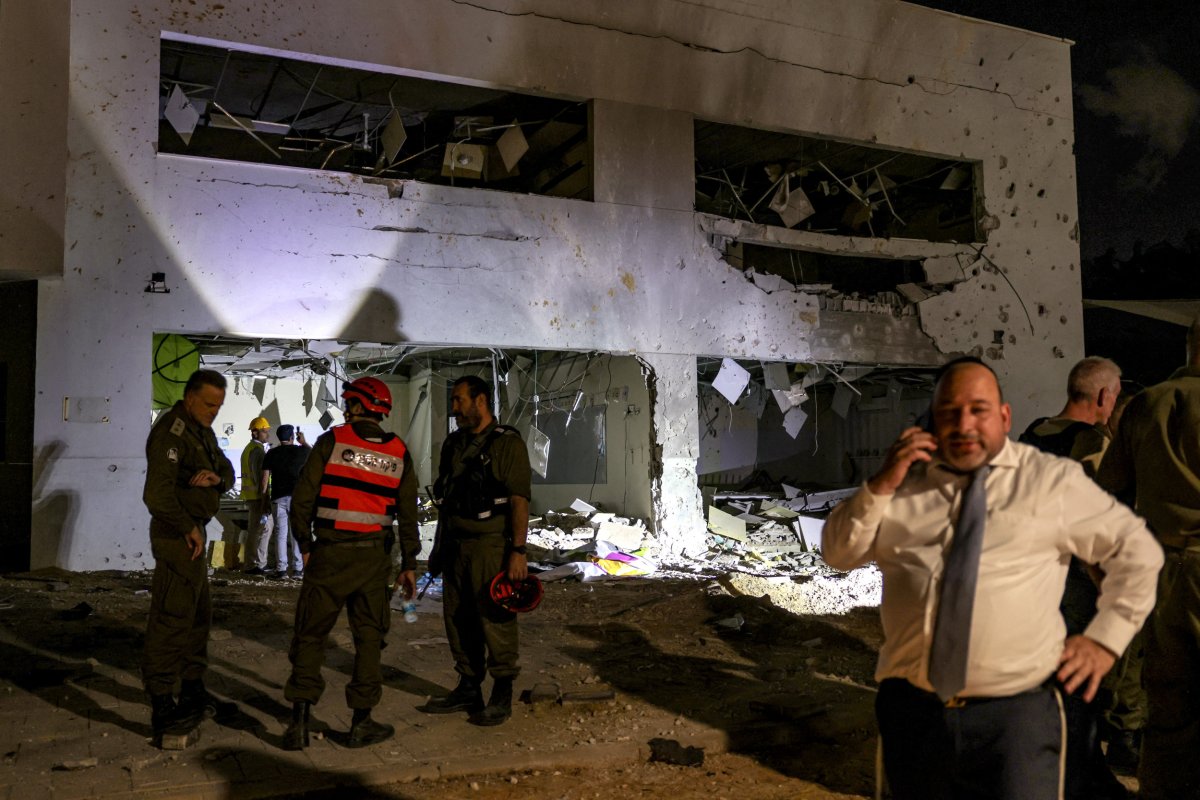
Israel’s Home Front Command and police forces inspect a crater left by an exploded projectile at a heavily damaged school building in Israel’s southern city of Gedera on October 1, after Iran launched a barrage of missiles at Israel in response to Israeli operations in the region.
MENAHEM KAHANA/AFP/Getty Images
Iravani also appealed to the U.N. Security Council “to urgently and decisively intervene to halt Israel’s continued aggression and war crimes against Lebanon, Gaza and Syria and to prevent the situation from escalating into a full-scale regional war.”
The IDF has yet to officially report any casualties from the strikes, while Palestinian officials reported that a Palestinian man in Jericho had died from shrapnel wounds sustained during the missile strike.
In a statement shared with Newsweek, an Israeli security official said that, in cooperation with U.S. Air Forces Central, the Israeli Air Force “operated in an effective and precise manner, intercepting most of the missiles—several hits were identified, and the damage is being assessed.”
IDF spokesperson Rear Admiral Daniel Hagari told reporters that “the Air Force continues to operate fully, and tonight it will continue to strike in the Middle East powerfully, as has been happening throughout the past year.”
“Iran committed a serious act tonight, pushing the Middle East towards escalation,” he added. “We will act at the time and place we decide, in accordance with the instructions of the political echelon. There will be consequences to these events. We are doing and will do what is necessary to protect the residents of Israel.”
Israeli Prime Minister Benjamin Netanyahu, who met with security cabinet members in a secure bunker complex in Jerusalem to discuss the strikes, also warned that Tehran had “made a big mistake tonight and will pay for it.”
“We will keep to the rule we have determined: Whoever attacks us—we attack them,” Netanyahu said. “This is true wherever we fight the axis of evil. It is true in Judea and Samaria. It is true in Gaza, Lebanon, Yemen and Syria—and it is also true in Iran.”
“We are fighting the axis of evil everywhere,” he added, “including in southern Lebanon and Gaza, where our heroic soldiers are active.”
The White House and Pentagon had warned of “severe consequences” should Iran carry a missile strike against Israel amid indications earlier Tuesday that Tehran was “imminently” preparing to conduct such a launch. Following the strikes, President Joe Biden touted the performance of U.S.-Israel military cooperation and said his administration was in active talks with Israeli counterparts regarding a potential response.
In a statement shared with Newsweek, the Iranian Mission to the United Nations stated that “no notice was given to the United States prior to our response; however, a serious warning was issued afterwards.”
The statement followed a warning to Israel not to pursue additional attacks once the Iranian barrage had concluded.
“Iran’s legal, rational, and legitimate response to the terrorist acts of the Zionist regime—which involved targeting Iranian nationals and interests and infringing upon the national sovereignty of the Islamic Republic of Iran—has been duly carried out,” the Iranian Mission said in the statement.
“Should the Zionist regime dare to respond or commit further acts of malevolence, a subsequent and crushing response will ensue,” the Mission added at the time. “Regional states and the Zionists’ supporters are advised to part ways with the regime.”
The IDF has been engaged in a multi-front war since Hamas launched a massive surprise attack on Israel on October 7, 2023, sparking the longest and deadliest conflict in Gaza to date. Hezbollah began launching rocket and drone strikes against Israel in support of Hamas and cross-border clashes have intensified to levels not witnessed since their last war fought in July 2006.
On Monday, days after killing Nasrallah and following months of threats of waging a ground offensive in Lebanon, the IDF announced that it had begun “limited, localized, and targeted ground raids based on precise intelligence against Hezbollah terrorist targets and infrastructure in southern Lebanon.”
Hezbollah has continued to launch strikes against northern Israel “in support of our steadfast Palestinian people in the Gaza Strip, in support of their valiant and honorable resistance, and in defense of Lebanon and its people.”
Other factions of the Iran-aligned Axis of Resistance, including Yemen’s Ansar Allah, also known as the Houthi movement, and a coalition of militias known as the Islamic Resistance in Iraq have also intensified operations against Israel from further abroad.
This is a developing story and further information will be added as it becomes available.