NASCAR has formally responded to the antitrust lawsuit and preliminary injunction request filed by 23XI Racing and Front Row Motorsports. The lawsuit, initiated on October 2, 2024, contests NASCAR’s charter allocation policies and seeks significant changes to protect the teams’ interests, focusing on NASCAR’s control over revenue distribution and track ownership. Now, NASCAR’s legal rebuttal aims to dismiss the injunction request, insisting it is financially motivated rather than about genuine competition concerns.
NASCAR’s Response to Injunction Request
NASCAR’s legal representatives have strongly rejected the plaintiffs’ preliminary injunction, arguing its basis is unfounded.
The plaintiffs, 23XI Racing and Front Row Motorsports, aim to keep racing under the current charter system amidst their lawsuit, which they say would prevent the loss of revenue and competitive opportunities. However, NASCAR counterclaims that granting this motion would disrupt budget planning and communication with teams regarding prize money distribution.
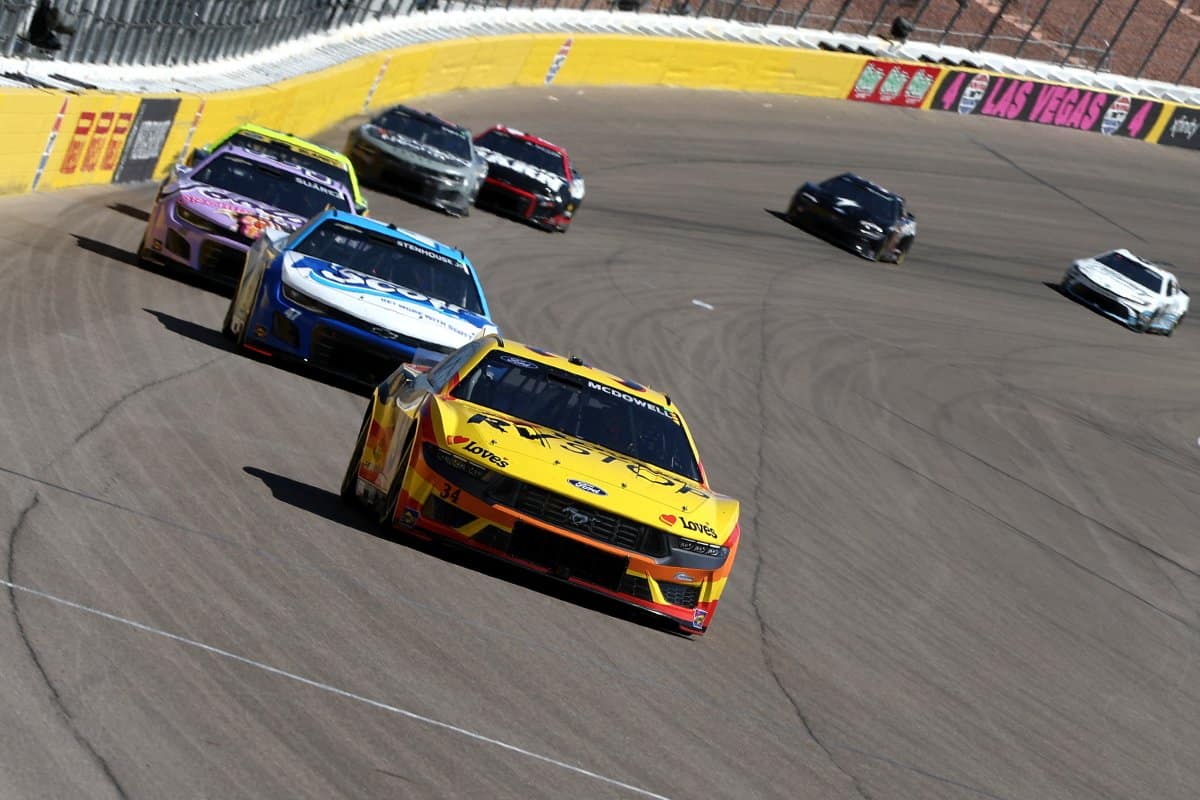
Michael McDowell, driver of the #34 Love’s Travel Stops Ford, drives during the NASCAR Cup Series South Point 400 at Las Vegas Motor Speedway on October 20, 2024 in Las Vegas, Nevada. NASCAR responds to antitrust lawsuit.
Getty Images/Meg Oliphant
“Plaintiffs’ requested relief would cause real harm to NASCAR and the 32 Charter holders. Teams must budget for next season, and NASCAR needs to calculate and communicate to teams the prize money available for each race. NASCAR cannot simply reissue 2025 Charters without affecting Charter teams and other stakeholders, especially since Plaintiffs’ refusal to sign the 2025 Charters increased prize amounts for Charter and open teams alike.
“Plaintiffs’ Motion—an attempt to force NASCAR into a contract on Plaintiffs’ preferred terms—falls far short of meeting the demanding standard required for obtaining a mandatory injunction. The Motion seeks to change the status quo, not maintain it; is about money, not irreparable harm; and fails to show a likelihood of success on the merits. This lawsuit is not about protecting competition; it’s a bid by Plaintiffs to secure more money than they could through arm’s-length negotiations. The Motion should be denied.
“Plaintiffs willingly agreed to Section 10.3 when signing or acquiring 2016 Charters, a provision that “release[s] their antitrust rights.” The teams—undeniably sophisticated parties—were represented by counsel in both rounds of negotiations, and the teams secured the same release for themselves in Section 10.4.
“Plaintiffs also ignore that they agreed to the same release when acquiring 2016 Charters and never objected to it during two years of 2025 Charter negotiations. These contradictions expose Plaintiffs’ motive: to use this Court to extract more money and better contractual terms from NASCAR.
“Finally, using the Court to force NASCAR into a contract with Plaintiffs is neither equitable nor in the public interest.
“All of their claimed harm is compensable through money damages should Plaintiffs ultimately prevail; indeed, Plaintiffs implicitly acknowledge this by providing calculations of their potential losses.”
NASCAR’s Response to Antitrust Lawsuit
On top of the response to the injunction request, NASCAR has also given an early response to the antitrust lawsuit itself.
“Plaintiffs’ allegations—concerning contractual terms present in the 2016 Charter (such as exclusivity), NASCAR’s 2018 acquisition of ISC, its 2019 acquisition of ARCA, and the 2019 adoption of Next Gen car requirements—are all barred by the four-year statute of limitations applicable to antitrust claims, and laches.
“Regardless, NASCAR has every right to exercise its ‘business judgment’ to decide whether and how to share its revenues with teams,’ citing its own victory in Kentucky Speedway LLC v. National Association of Stock Car Auto Racing.
“Indeed, the Supreme Court has repeatedly confirmed businesses are generally ‘free to choose the parties with whom they will deal, as well as the prices, terms, and conditions.'”
It added:
“Nor do Plaintiffs explain how NASCAR’s acquisitions of ISC or ARCA were anticompetitive. Many acquisitions are procompetitive, particularly when they do not give the defendant any ‘advantage’ it did not already have.
“Here, the France family had owned a controlling percentage of ISC’s voting stock since it was founded. The 2018 ISC acquisition also underwent government review. And ARCA — acquired by NASCAR for only (redacted) — was never a potential competitor to NASCAR.”